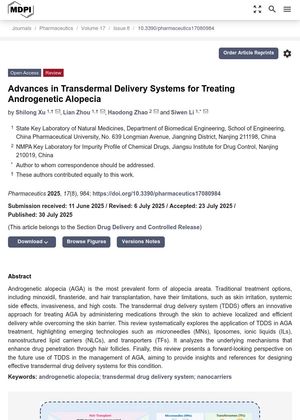
April 2025 in “International Journal of Pharmaceutics” Liposomes improve minoxidil delivery to hair follicles, enhancing treatment for hair loss.
March 2025 in “Clinical Reviews in Allergy & Immunology”  November 2024 in “Pharmaceutics”
 This study found that dutasteride-loaded transfersomes, compared to traditional liposomes, better target hair follicles by releasing the drug in a more controlled manner, as shown in vitro with enhanced follicular targeting (Tf = 0.32 versus 0.15, p < 0.005) using porcine ear skin.
 October 2024 in “Small Methods”
 This study found that dissolving microneedles loaded with platinum nanozymes induced faster hair growth in an androgenetic alopecia model than daily minoxidil applications, with no significant safety concerns.
6 citations
,
August 2024 in “Aesthetic Plastic Surgery”  May 2024 in “Chemical engineering journal”
 This study reports that a new minoxidil and epigallocatechin gallate co-loaded ionic liquids system showed superior efficacy in promoting hair regrowth in a mouse model of androgenic alopecia by activating hair follicle stem cells and improving microenvironment conditions, compared to existing minoxidil products.
 April 2024 in “Bioactive materials”
 This study found that a microneedle system delivering VEGF and Ritlecitinib improved hair regeneration in mice with androgenetic alopecia, showing faster anagen onset and better hair quality compared to minoxidil.
 March 2024 in “International Journal of Pharmaceutics”
 This study found that combining minoxidil with ginsenosides Rg3 in a novel delivery system improved hair growth by reducing inflammation and oxidative stress in androgen alopecia treatments.
 February 2024 in “Drug Delivery and Translational Research”
 In this study, a newly developed cardamonin-loaded liposomal formulation significantly enhanced hair growth and improved hair follicle performance in mice with androgenic alopecia.
 November 2023 in “Journal of Cosmetic Dermatology”
 This study concluded that while both 5% topical and 1 mg oral minoxidil significantly improved hair diameter in androgenetic alopecia patients, there was no significant difference in overall effectiveness or patient satisfaction between the treatments.
 2 citations
,
November 2023 in “Bioactive materials”
2 citations
,
November 2023 in “Bioactive materials” The researchers reported that a newly developed ionic liquid-based microemulsion significantly improved the local delivery of copper peptides in mice, enhancing hair growth-related factor activation while offering a safer, non-invasive alternative to existing treatments for hair loss.
 October 2023 in “Bioactive Materials”
 This study developed a novel liposome-based delivery system for Minoxidil and nitric oxide, which showed promising results in promoting hair regrowth in an androgenetic alopecia model by enhancing transdermal absorption, prolonging skin retention, and reducing inflammation.
 October 2023 in “Journal of Cosmetic Dermatology”
 In this study, a combination of 5% minoxidil lotion and 0.25% topical finasteride spray significantly increased hair density and improved photographic assessments in men with androgenetic alopecia compared to the treatments used alone, with all methods showing good tolerability.
This comprehensive review analyzes androgenetic alopecia treatments, discussing the mechanisms, costs, efficacy, and safety of FDA-approved drugs like minoxidil and finasteride, as well as newer non-FDA-approved options that have shown effectiveness across various studies.
March 2023 in “ACS Applied Materials & Interfaces” This study reports that a water-soluble microneedle patch with minoxidil-loaded microspheres showed similar or better hair regeneration effects in mice with less frequent application compared to daily topical minoxidil.
1 citations
,
December 2022 in “Journal of Controlled Release” This review summarizes recent research on microneedles for alopecia treatment and hair regrowth, noting their potential to improve drug delivery and patient outcomes, but reports no new clinical results.
45 citations
,
November 2022 in “Acta Biomaterialia” This study developed a biomimetic 3-D co-culture system that enhances the hair-inductive properties of human dermal papilla cell aggregates, potentially improving hair follicle tissue engineering.
 25 citations
,
June 2022 in “Developmental cell”
25 citations
,
June 2022 in “Developmental cell” In this study, Hedgehog signaling in dermal papilla fibroblasts was found to accelerate hair growth and induce follicle multiplication in mice via the SCUBE3/TGF-β pathway, with some effects observed in human scalp hair follicles.
 4 citations
,
May 2022 in “Journal of Drug Delivery Science and Technology”
4 citations
,
May 2022 in “Journal of Drug Delivery Science and Technology” This research observed that nanoliposomes delivering a combination of bioactive peptides significantly promoted hair growth in vitro and in vivo by enhancing the proliferation and function of hair growth-targeted cells in C57BL/6 mice, suggesting a promising approach for treating androgenetic alopecia.
 19 citations
,
May 2021 in “Clinical, Cosmetic and Investigational Dermatology”
19 citations
,
May 2021 in “Clinical, Cosmetic and Investigational Dermatology” This review discusses the progress in research on topical formulations for treating alopecia, highlighting potential advantages of advanced formulation technologies but reporting no new clinical results.
 13 citations
,
January 2021 in “Histochemistry and Cell Biology”
13 citations
,
January 2021 in “Histochemistry and Cell Biology” In this study, human hair follicles showed varying expression of cholesterol transport proteins during the hair cycle, suggesting a potential role of cholesterol in hair growth and cycling.
 8 citations
,
October 2020 in “Pharmaceutics”
8 citations
,
October 2020 in “Pharmaceutics” This study explored using a chitosan oligomer coating for topical delivery of dutasteride-loaded nanostructured lipid carriers, aiming to reduce systemic exposure and cytotoxicity.
 59 citations
,
July 2020 in “Journal of The American Academy of Dermatology”
59 citations
,
July 2020 in “Journal of The American Academy of Dermatology” This study concluded that oral minoxidil is an effective and well-tolerated alternative to topical minoxidil for healthy patients struggling with application-related compliance issues.
425 citations
,
June 2020 in “Nature” Scientists created human skin with hair from stem cells, which could help treat hair loss and skin conditions.
 15 citations
,
April 2020 in “Journal of The American Academy of Dermatology”
15 citations
,
April 2020 in “Journal of The American Academy of Dermatology” This article notes the lack of physician-reported outcome studies supporting the efficacy of off-label spironolactone in treating female pattern hair loss, despite its common prescription alongside FDA-approved topical minoxidil.
 2 citations
,
March 2020 in “Medical journal, Armed Forces India”
2 citations
,
March 2020 in “Medical journal, Armed Forces India” This study found that hair transplantation using the follicular unit extraction method significantly improved hair density and patient satisfaction in males with androgenetic alopecia, especially those younger than 33 and with less severe hair loss.
 32 citations
,
March 2020 in “Drug Design Development and Therapy”
32 citations
,
March 2020 in “Drug Design Development and Therapy” This review examines the pharmacology, clinical efficacy, and adverse effects of oral finasteride for female pattern hair loss, and discusses potential new treatments like topical finasteride and dutasteride, but reports no new clinical results.
 117 citations
,
August 2019 in “Drug Design Development and Therapy”
117 citations
,
August 2019 in “Drug Design Development and Therapy” This review article provides an updated overview of the pharmacology, mechanism of action, clinical efficacy, and adverse events associated with topical minoxidil, a widely used treatment for androgenetic alopecia and other hair loss conditions, while noting that its exact mechanism is still not fully understood.
 25 citations
,
July 2019 in “Experimental Dermatology”
25 citations
,
July 2019 in “Experimental Dermatology” This review discusses the role of cholesterol homeostasis in hair follicle biology and its potential connections to various hair disorders, but it reports no new findings.
 14 citations
,
May 2019 in “Journal of Maxillofacial and Oral Surgery”
14 citations
,
May 2019 in “Journal of Maxillofacial and Oral Surgery” This article explains the FUE technique for hair transplantation, its associated risks and complications, and outlines a protocol for maxillofacial surgeons, but reports no new clinical results.
 52 citations
,
May 2019 in “Journal of The American Academy of Dermatology”
52 citations
,
May 2019 in “Journal of The American Academy of Dermatology” This study evaluated the effectiveness and safety of low-dose oral minoxidil (2.5-5 mg daily) in men with male androgenetic alopecia, aiming to contribute data to an area with limited previous reports. Results are not provided in the abstract.
 12 citations
,
December 2018 in “Journal of Cosmetic Dermatology”
12 citations
,
December 2018 in “Journal of Cosmetic Dermatology” In this study, hair transplantation was found to significantly improve self-esteem and satisfaction with appearance among male androgenetic alopecia patients.
 151 citations
,
November 2018 in “International Journal of Pharmaceutics”
151 citations
,
November 2018 in “International Journal of Pharmaceutics” This review discusses various nanoparticles and nanoemulsions being investigated for transdermal drug delivery and reports no clinical results; it highlights potential applications in treating alopecia, wound healing, psoriasis, and melanoma.
 10 citations
,
October 2018 in “Sexual medicine reviews”
10 citations
,
October 2018 in “Sexual medicine reviews” This review discusses sexual side effects in men with androgenic alopecia treated with 5-alpha reductase inhibitors and reports no new clinical findings.
 26 citations
,
August 2018 in “Dermatologic Therapy”
26 citations
,
August 2018 in “Dermatologic Therapy” This review discusses the research supporting the approval and use of minoxidil for androgenic alopecia and reports no new clinical results, emphasizing recent findings and developments.
 32 citations
,
December 2017 in “Journal of Drug Delivery Science and Technology”
32 citations
,
December 2017 in “Journal of Drug Delivery Science and Technology” This study found that co-delivery of minoxidil and caffeine in transfersomes with an optimized polysorbate formulation enhanced hair length and weight in vivo.
 1 citations
,
April 2017 in “Journal of Investigative Dermatology”
1 citations
,
April 2017 in “Journal of Investigative Dermatology” This study found that a novel 15% topical minoxidil solution achieved a clinically significant hair regrowth response in 60% of women with female pattern hair loss who did not respond to 5% minoxidil, without increasing adverse events.
 153 citations
,
March 2017 in “Endocrine”
153 citations
,
March 2017 in “Endocrine” This review examines recent advances in understanding the pathophysiology and molecular mechanisms of androgenetic alopecia, highlighting two major genetic risk loci, but does not report new clinical findings.
 90 citations
,
March 2017 in “JAMA Internal Medicine”
90 citations
,
March 2017 in “JAMA Internal Medicine” In this study, older men using 5α-reductase inhibitors for prostatic enlargement did not show increased risk of suicide, but had elevated risks of self-harm and depression.
 110 citations
,
August 2016 in “Drugs”
110 citations
,
August 2016 in “Drugs” Minoxidil is the only FDA-approved topical drug for treating male or female pattern hair loss, and other medications like finasteride and dutasteride can also increase hair growth.
111 citations
,
August 2015 in “Reviews in Endocrine and Metabolic Disorders” 5α-reductase inhibitors may cause persistent sexual dysfunction and depression, needing more research on long-term effects.
 77 citations
,
January 2015 in “International Journal of Biological Macromolecules”
77 citations
,
January 2015 in “International Journal of Biological Macromolecules” This study developed minoxidil sulphate-loaded chitosan nanoparticles that doubled drug delivery to hair follicles in vitro compared to a control solution, suggesting potential for improved alopecia treatment.
 89 citations
,
November 2014 in “International Journal of Nanomedicine”
89 citations
,
November 2014 in “International Journal of Nanomedicine” This study suggests that spironolactone-loaded nanostructured lipid carriers could enhance follicular delivery and offer a more localized treatment for androgenic alopecia, potentially reducing systemic side effects.
 18 citations
,
March 2014 in “Drug Development and Industrial Pharmacy”
18 citations
,
March 2014 in “Drug Development and Industrial Pharmacy” This study evaluated new aqueous gel formulations of minoxidil without irritants and found that the calcium alginate gel showed the best performance in terms of drug release and skin permeation.
 42 citations
,
August 2013 in “International Journal of Women's Health”
42 citations
,
August 2013 in “International Journal of Women's Health” This review discusses the current therapeutic options for female pattern hair loss and emphasizes the need for managing patient expectations of permanent regrowth, reporting no new clinical results.
 115 citations
,
September 2012 in “Experimental Dermatology”
115 citations
,
September 2012 in “Experimental Dermatology” This article reviews the molecular mechanisms involved in androgenetic alopecia and the androgen's paradoxical role in hair growth, but reports no new experimental findings.
 100 citations
,
June 2011 in “Journal of The American Academy of Dermatology”
100 citations
,
June 2011 in “Journal of The American Academy of Dermatology” This study found that a once-daily 5% minoxidil topical foam is as effective as a twice-daily 2% minoxidil topical solution for hair growth in women with androgenetic alopecia, with fewer side effects and greater styling convenience.
 26 citations
,
April 2009 in “Australasian Journal of Dermatology”
26 citations
,
April 2009 in “Australasian Journal of Dermatology” In this study, a 9-year-old girl with female pattern hair loss showed clinical improvement and hair regrowth after six months of daily oral spironolactone.
408 citations
,
May 2004 in “The Journal of clinical endocrinology and metabolism/Journal of clinical endocrinology & metabolism” This study found that dutasteride more effectively reduced serum dihydrotestosterone levels than finasteride in patients with benign prostatic hyperplasia.
 71 citations
,
January 2004 in “Dermatology”
71 citations
,
January 2004 in “Dermatology” This study found that oral finasteride was more effective than 5% topical minoxidil in treating mild to severe androgenetic alopecia in males, with both treatments deemed effective and safe over 12 months.
 139 citations
,
June 2003 in “Journal of Investigative Dermatology Symposium Proceedings”
139 citations
,
June 2003 in “Journal of Investigative Dermatology Symposium Proceedings” This article reviews androgenetic alopecia in women, highlighting diagnosis criteria and noting that topical minoxidil is currently the only proven treatment for hair growth; it reports no clinical trial findings.
 233 citations
,
November 2002 in “The journal of investigative dermatology/Journal of investigative dermatology”
233 citations
,
November 2002 in “The journal of investigative dermatology/Journal of investigative dermatology” This review explores androgen metabolism in the skin, highlighting enzyme localization and potential implications for treating androgen-dependent skin conditions, but it reports no new clinical results.
 269 citations
,
August 2002 in “Journal of The American Academy of Dermatology”
269 citations
,
August 2002 in “Journal of The American Academy of Dermatology” This study found that 5% topical minoxidil significantly increased hair regrowth and improved psychosocial perceptions of hair loss in men with androgenetic alopecia compared to 2% topical minoxidil and placebo over 48 weeks.
 121 citations
,
March 1989 in “Journal of Investigative Dermatology”
121 citations
,
March 1989 in “Journal of Investigative Dermatology” Minoxidil can help grow hair in mice by making cells grow and improving hair quality. More research needed.
 94 citations
,
August 1975 in “Journal of Cutaneous Pathology”
94 citations
,
August 1975 in “Journal of Cutaneous Pathology” In this study, the researchers observed that male pattern alopecia is characterized by miniature follicles, enlarged sebaceous glands, and an increased number of mast cells, without significant abnormalities in enzyme activity.