August 2024 in “Journal of Drug Delivery Science and Technology” In this study, the researchers reported that minoxidil-loaded transfersomes using a cyclodextrin strategy significantly increased drug stability, skin permeation, and hair regrowth in a mouse model of androgenetic alopecia compared to traditional formulations and commercial tinctures.
 March 2024 in “International Journal of Pharmaceutics”
 This study found that combining minoxidil with ginsenosides Rg3 in a novel delivery system improved hair growth by reducing inflammation and oxidative stress in androgen alopecia treatments.
 February 2024 in “International Journal of Pharmaceutics”
 This study found that combining the natural product cedrol with minoxidil can improve the treatment of androgenetic alopecia by reducing the minoxidil dose needed, while a new nanocarrier system enhances drug delivery and effectiveness at hair follicles.
 January 2024 in “Advanced Healthcare Materials”
 In a mouse model of androgenetic alopecia, this study developed a treatment combining a copper-curcumin nanoparticle oleogel with traditional Gua Sha therapy, which augmented hair regeneration more effectively than minoxidil by improving the follicular microenvironment and regulation of inflammatory responses.
 December 2023 in “European Journal of Medicinal Chemistry”
 This review highlights potential therapeutic mechanisms of natural products for androgenetic alopecia, suggesting they may modulate signaling pathways and have anti-inflammatory and antioxidant effects.
 October 2023 in “Bioactive Materials”
 This study developed a novel liposome-based delivery system for Minoxidil and nitric oxide, which showed promising results in promoting hair regrowth in an androgenetic alopecia model by enhancing transdermal absorption, prolonging skin retention, and reducing inflammation.
 October 2023 in “International Journal of Pharmaceutics”
 This study found that ethosome-loaded minoxidil and tocopherol acetate improved hair regeneration and regulated the microenvironment around hair follicles better than commercial minoxidil in androgenic alopecia model mice, showing promise as a treatment strategy.
 July 2023 in “Journal of Drug Delivery Science and Technology”
 This study found that finasteride niosomes may enhance hair follicle drug accumulation and promote hair regeneration in androgenetic alopecia mice more effectively than current finasteride formulations.
May 2023 in “Clinical, Cosmetic and Investigational Dermatology” This review examines the efficacy of various novel treatments for androgenetic alopecia, including oral minoxidil and platelet-rich plasma, suggesting potential benefits but emphasizing the need for further high-quality clinical trials to thoroughly evaluate their effectiveness.
April 2023 in “Journal of Drug Delivery Science and Technology” This study reported that optimized transfersomes and their gel form significantly improved transdermal delivery and hair growth promotion of minoxidil in C57BL/6 mice compared to commercial formulations.
March 2023 in “Clinical, Cosmetic and Investigational Dermatology” This study concluded that both oral and topical spironolactone effectively treat androgenetic alopecia, with topical administration being safer and suitable for any gender, especially when combined with minoxidil.
February 2023 in “Current Pharmaceutical Design” This review explores medicinal plants as potential treatments for hair loss, suggesting their promise due to anti-inflammatory and antioxidant properties, but reports no new clinical results.
15 citations
,
July 2022 in “Nano Research” This study suggests that using cholesterol-free liposomes, specifically PPD-Lip, as a delivery system with dutasteride may enhance the treatment of androgenetic alopecia by promoting hair regrowth in mice models.
5 citations
,
April 2022 in “Pharmaceutics” This study reported that 5% minoxidil nanoparticles enhanced hair growth more effectively in mice than a commercial minoxidil solution, with significantly higher drug accumulation in the upper hair follicles.
 2 citations
,
January 2022 in “Dermatologic Therapy”
2 citations
,
January 2022 in “Dermatologic Therapy” Natural products like saw palmetto, caffeine, melatonin, marine extracts, rosemary oil, procyanidin, pumpkin seed oil, and cannabidiol oil could potentially treat male hair loss.
 38 citations
,
July 2021 in “ACS Nano”
38 citations
,
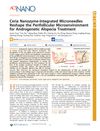
July 2021 in “ACS Nano” This study found that a ceria nanozyme-integrated microneedles patch accelerated hair regeneration in an androgenetic alopecia mouse model more effectively than minoxidil, with reduced application frequency and minimal skin damage.
 5 citations
,
January 2021 in “Biomedicine & Pharmacotherapy”
5 citations
,
January 2021 in “Biomedicine & Pharmacotherapy” This study suggests that policosanol may prevent androgenetic alopecia in mice by regulating hormone levels and suppressing premature hair follicle entry into the regression phase.
29 citations
,
January 2021 in “Journal of nanobiotechnology” In this study, exosome-mimetic nanovesicles derived from neural progenitor cells promoted hair follicle regeneration in mice by activating the Wnt/β-catenin signaling pathway.
 7 citations
,
December 2020 in “Pharmaceutics”
7 citations
,
December 2020 in “Pharmaceutics” In this study, a mixture of tocopherol acetate, L-menthol, and stevioside was more effective in promoting hair growth in mice compared to tocopherol acetate or L-menthol alone.
13 citations
,
September 2020 in “Sensors” This study used melamine formaldehyde particles to measure a pH gradient along the hair shaft, showing a significant pH decrease from the hair sheath to the external shaft.
 32 citations
,
January 2019 in “American Journal of Clinical Dermatology”
32 citations
,
January 2019 in “American Journal of Clinical Dermatology” This review discusses the use of topical minoxidil for various types of alopecia and reports mixed evidence on its efficacy, with stronger support noted for conditions like eyebrow hypotrichosis and chemotherapy-induced alopecia.
 42 citations
,
February 2018 in “International Journal of Molecular Sciences”
42 citations
,
February 2018 in “International Journal of Molecular Sciences” This study suggests that minoxidil may enhance hair growth by stimulating adipose-derived stem cell motility and growth factor secretion, promoting dermal papilla cell proliferation and accelerating anagen induction.
 32 citations
,
December 2017 in “Journal of Drug Delivery Science and Technology”
32 citations
,
December 2017 in “Journal of Drug Delivery Science and Technology” This study found that co-delivery of minoxidil and caffeine in transfersomes with an optimized polysorbate formulation enhanced hair length and weight in vivo.
 19 citations
,
November 2017 in “Journal of Pharmaceutical Sciences”
19 citations
,
November 2017 in “Journal of Pharmaceutical Sciences” This research investigated aqueous alginate-based hydrogels for delivering minoxidil and reported that using hydroxypropyl-β-cyclodextrin (HP-β-CD) with molar substitution 0.65 significantly enhanced minoxidil's solubility and skin permeability without damaging the epidermis, suggesting potential as an alternative to commercial minoxidil solutions.
 30 citations
,
July 2017 in “BioEssays”
30 citations
,
July 2017 in “BioEssays” This review discusses the potential benefits of activating NRF2 for treating hair follicle disorders linked to oxidative stress and reports no new clinical results.
 178 citations
,
April 2017 in “Journal of The American Academy of Dermatology”
178 citations
,
April 2017 in “Journal of The American Academy of Dermatology” This systematic review and meta-analysis found that minoxidil, finasteride, and low-level laser light therapy significantly improve hair growth in men with androgenetic alopecia, while minoxidil is also effective for women, compared to placebo.
 26 citations
,
January 2016 in “Annals of Dermatology”
26 citations
,
January 2016 in “Annals of Dermatology” This study found that Ecklonia cava polyphenols increased human dermal papilla cell proliferation and extended hair shaft length in vitro and ex vivo, suggesting potential as a therapeutic candidate for hair loss.
 17 citations
,
August 2015 in “Expert Opinion on Pharmacotherapy”
17 citations
,
August 2015 in “Expert Opinion on Pharmacotherapy” This article discusses the social and psychological impact of hair disorders and the challenges in their treatment, but reports no new clinical results.
 77 citations
,
January 2015 in “International Journal of Biological Macromolecules”
77 citations
,
January 2015 in “International Journal of Biological Macromolecules” This study developed minoxidil sulphate-loaded chitosan nanoparticles that doubled drug delivery to hair follicles in vitro compared to a control solution, suggesting potential for improved alopecia treatment.
 3 citations
,
October 2014 in “Pharmaceutical Development and Technology”
3 citations
,
October 2014 in “Pharmaceutical Development and Technology” This study found that an optimized microemulsion for minoxidil with high solubility, permeation flux, and skin deposition can be achieved with specific low and high levels of certain surfactants and co-solvents.
 48 citations
,
December 2013 in “Drug Delivery and Translational Research”
48 citations
,
December 2013 in “Drug Delivery and Translational Research” This study found that minoxidil-loaded niosomes with a Span 60 and cholesterol ratio of 1:2 significantly increased skin retention of minoxidil compared to control gel.
 56 citations
,
September 2013 in “Journal of Biochemistry and Molecular Biology”
56 citations
,
September 2013 in “Journal of Biochemistry and Molecular Biology” This study observed that androgen treatment increased ROS production and TGF-β1 secretion in rat hair follicle dermal papilla cells, suggesting that the androgen-induced TGF-β1 is mediated by ROS.
 24 citations
,
May 2013 in “Drug Design Development and Therapy”
24 citations
,
May 2013 in “Drug Design Development and Therapy” This pilot study found that a multimodal minoxidil microemulsion with diclofenac and tea tree oil was more effective and safer than minoxidil alone for treating androgenic alopecia over 32 weeks.
46 citations
,
December 2010 in “PubMed” This study demonstrated that tocotrienol supplementation increased hair number in individuals with hair loss compared to a placebo, likely due to its antioxidant effects.
 25 citations
,
January 2010 in “International Journal of Pharmaceutics”
25 citations
,
January 2010 in “International Journal of Pharmaceutics” This study found that polymeric nanoparticles retained more minoxidil and facilitated superior drug permeation compared to lipid nanoparticles, although premature drug release affected formulation performance.
 58 citations
,
January 2006 in “Skin Pharmacology and Physiology”
58 citations
,
January 2006 in “Skin Pharmacology and Physiology” This study found that testosterone and 5α-dihydrotestosterone induced apoptosis in dermal papilla cells from nonbalding scalp regions, suggesting a high androgen stimulus can trigger cell death related to androgenetic alopecia.
 269 citations
,
August 2002 in “Journal of The American Academy of Dermatology”
269 citations
,
August 2002 in “Journal of The American Academy of Dermatology” This study found that 5% topical minoxidil significantly increased hair regrowth and improved psychosocial perceptions of hair loss in men with androgenetic alopecia compared to 2% topical minoxidil and placebo over 48 weeks.
 83 citations
,
December 2001 in “Journal of Investigative Dermatology”
83 citations
,
December 2001 in “Journal of Investigative Dermatology” Minoxidil boosts hair growth by targeting adenosine and possibly sulfonylurea receptor 2B.


