3 citations
,
August 2024 in “British Journal of Dermatology” This study observed sustained hair regrowth in some patients with alopecia areata and improvement in vitiligo symptoms, indicating a potential role for dupilumab in treating these conditions, particularly when associated with atopic dermatitis.
 9 citations
,
July 2018 in “European Journal of Dermatology”
9 citations
,
July 2018 in “European Journal of Dermatology” Brodalumab effectively treated a man's severe hand and foot psoriasis.
May 2023 in “Journal of Pharmaceutical Innovation” May 2014 in “Japanese Society of Anti-Aging Medicine”  July 2025 in “SKIN The Journal of Cutaneous Medicine”
 In this study, a patient with severe alopecia areata showed significant hair regrowth after 15 months of partial response to baricitinib and oral minoxidil, following the addition of dupilumab to their treatment regimen.
23 citations
,
November 2013 in “Lupus” This study found that the quality of life for Japanese lupus erythematosus patients with skin manifestations improved after treatment, though female gender and older age were associated with poorer outcomes in certain quality of life domains.
May 2022 in “Journal of Neurology Neurosurgery & Psychiatry” This case report highlights the overlap of Sjögren’s Syndrome and Systemic Lupus Erythematosus, noting major salivary gland enlargement and bilateral facial nerve involvement, which may better explain the patient's symptoms than lupus alone.
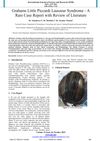 October 2023 in “International Journal of Science and Research (IJSR)”
 This paper describes Grahams Little Piccardi Lassueur Syndrome, a rare type of Lichen Planopilaris that causes different types of alopecia and distinctive skin papules, primarily affecting females aged 40 to 70, and notes the current challenges in treatment options, particularly once scarring occurs.
1 citations
,
November 2025 in “Neuro-Oncology” In this study, safusidenib erbumine was evaluated for its efficacy and safety in patients with untreated IDH1-mutated WHO grade 2 gliomas, achieving a 44.4% objective response rate and 87.9% 24-month event-free probability, but with some mild to moderate adverse effects.
 November 2022 in “Journal of The Pakistan Dental Association”
 This study found that patients with systemic lupus erythematosus often experience oral mucosal pathologies, with oral ulcers being the most common, and observed significant associations between oral and systemic manifestations.
 May 2025 in “The Journal of Rheumatology”
 This case report highlights the rare occurrence of overlapping syndromes including SLE, RA, and AAV in a patient with discoid lupus erythematosus, noting the persistent role of prior viral infection remains unclear.
 1 citations
,
November 1953 in “Archives of Dermatology”
1 citations
,
November 1953 in “Archives of Dermatology” This case presentation by Dr. Howard Fox describes a persistent skin eruption in a woman following sun exposure and the use of a specific lotion, highlighting diagnostic challenges between Lupus Erythematosus and Erythema Perstans but reports no definitive diagnosis.
25 citations
,
January 2024 in “Journal of Lipids” This review reports that cubosomes, used as drug nanocarriers in topical treatments, offer potential benefits for managing skin and eye diseases by improving bioadhesion, retention, and sustained release compared to conventional formulations, but also face manufacturing and biological challenges for effective clinical outcomes.
11 citations
,
February 2011 in “International Journal of Molecular Sciences” This article reviews sPLA2-mediated phospholipid metabolism using sPLA2 transgenic/knockout mice and lipid mass spectrometry, offering insights into the distinct roles of sPLA2 enzymes in various biological events.
 3 citations
,
March 2021 in “Clinical, Cosmetic and Investigational Dermatology”
3 citations
,
March 2021 in “Clinical, Cosmetic and Investigational Dermatology” This study reviews the types of alopecia associated with lupus erythematosus and discusses treatment challenges, highlighting that non-scarring alopecia is specific to systemic lupus while chronic cutaneous lupus can cause scarring alopecia, with topical corticosteroids and oral antimalarials as primary treatments for cutaneous lupus erythematosus.
 117 citations
,
February 2017 in “American Journal of Clinical Dermatology”
117 citations
,
February 2017 in “American Journal of Clinical Dermatology” This systematic review concluded that the support for using spironolactone at commonly prescribed doses is based on evidence of limited quality.
6 citations
,
March 2023 in “Journal of Ethnopharmacology” In this mouse study, researchers found that the Jieduquyuziyin prescription may lessen lupus-like symptoms and atherosclerosis by inhibiting TLR9/MyD88 signaling and promoting cholesterol efflux.
 47 citations
,
July 2014 in “European Journal of Pharmaceutics and Biopharmaceutics”
47 citations
,
July 2014 in “European Journal of Pharmaceutics and Biopharmaceutics” This study concluded that polymeric nanoparticles effectively targeted hair follicles for drug delivery, but the organogel formulation did not enhance their penetration into the hair shaft.
19 citations
,
September 2010 in “Journal of the European Academy of Dermatology and Venereology” This study found that while the CLASI is generally useful for assessing disease activity and damage in cutaneous lupus erythematosus, it may not accurately reflect all subtypes, indicating a need for revision.
 January 2024 in “Theranostics”
 This study found that hypoxia-preconditioned HF-MSC-derived exosomes improved therapeutic outcomes in models of ulcerative colitis, potentially through miR-214-3p-mediated pathways affecting mitochondrial function and inflammatory responses.
January 2021 in “Journal of clinical & experimental dermatology research” This study found that a high dose of LustrivaTM, containing biotin and silicon, significantly increased hair thickness and reduced facial wrinkle depth in women with thinning hair compared to a placebo, without any reported adverse events.
 1 citations
,
May 2025 in “The Journal of Rheumatology”
1 citations
,
May 2025 in “The Journal of Rheumatology” In this case report, researchers described a 48-year-old man with systemic lupus erythematosus who developed a fungus ball (aspergilloma) within a tuberculosis cavity, a complication rarely reported in such patients, emphasizing the role of CT scans in diagnosis and the potential need for surgical intervention.
 April 2023 in “Journal of Investigative Dermatology”
 This research reexamined transcriptomic data to study stem and progenitor cell proliferation in psoriasis, finding that the number of committed progenitor cells increased eight-fold in psoriatic skin without altering stem cell numbers, potentially identifying new therapeutic targets.

In this case report, a patient's atypical neuropsychiatric and dermatological symptoms were crucial for diagnosing systemic lupus erythematosus, highlighting the disease's clinical heterogeneity and the importance of early detection to prevent organ damage.
July 2022 in “European Journal of Dermatology” In this study, researchers found that patients with psoriasis had a higher probability of achieving and maintaining a clinical response using brodalumab compared to ustekinumab over 52 weeks, as measured by a multistate modelling approach based on absolute PASI scores.
May 2023 in “Karnataka Pediatric Journal” This case report details an 8-year-old girl with systemic lupus erythematosus presenting as lupus pancreatitis, whose symptoms improved significantly following glucocorticoid and immunosuppressive therapy.
 October 2024 in “Reumatizam”
 This paper describes that approximately 80% of patients with systemic lupus erythematosus develop skin changes over time, highlighting the prevalence of skin involvement in this autoimmune condition.
 March 2004 in “Journal of The American Academy of Dermatology”
 This study found that the vehicle of hydrocortisone impacts its absorption and therapeutic effectiveness, as demonstrated by efficacy tests using UV-erythema and vasoconstriction models.
 June 2023 in “International Journal for Research in Applied Science and Engineering Technology”
 This research highlights the potential of emulgel as an advanced topical drug delivery system, offering improved efficacy for hydrophobic medications in treating dermatological conditions and a range of ailments with its dual release control mechanism of gel and emulsion.