 April 2024 in “Canadian Women s Health Today”
 This review suggests that "polycystic ovarian syndrome" is a misleading name, as the disorder involves complex metabolic and reproductive issues beyond ovarian dysfunction and may stem from factors affecting the fetus in utero.
 April 2024 in “International journal of women's health”
 This review explores adult female acne, focusing on its multifactorial causes, treatment options, and impact on quality of life, but reports no new clinical results.
This study examined the molecular communication in psoriasis cells, highlighting unique immune cell interactions and identifying new features of the hair follicle cell-psoriasis axis. It suggests the potential for targeted therapies at the single-cell level to improve psoriasis treatment.
 January 2024 in “Clinical dermatology open access journal”
 This paper reviews existing research on the cosmetic benefits of hemp-derived cannabinoids for skin and hair, highlighting their unique mechanisms of action, while discussing formulation, legal, and regulatory challenges associated with using these compounds in cosmetic products.
 November 2023 in “TẠP CHÍ KHOA HỌC TRƯỜNG ĐẠI HỌC QUỐC TẾ HỒNG BÀNG”
 This study isolated and identified three natural compounds—syringaresinol, mayuenolid, and ciwujiaton—from Leersia hexandra, a traditional liver treatment used in Huyện Tam Nông, Đồng Tháp, using advanced chromatography and spectroscopy techniques.
 November 2023 in “bioRxiv (Cold Spring Harbor Laboratory)”
 This study found that disrupted cholesterol homeostasis impairs hair regrowth in individuals with primary cicatricial alopecia by damaging hair follicle stem cells, highlighting the importance of cholesterol in maintaining stem cell function and hair follicle integrity.
 October 2023 in “Advancement in yoga and physical therapy”
 This narrative review explores the potential influence of brown adipose tissue on polycystic ovary syndrome and reports no new experimental findings.
 October 2023 in “Frontiers in endocrinology”
 This review investigates molecular mechanisms behind PCOS pathogenesis and discusses potential therapies, but reports no new clinical results.
 October 2023 in “Frontiers in endocrinology”
 This review examines the role of androgens and androgen receptors in regulating glucose and lipid metabolism, focusing on their effects on mitochondrial content and function; it also discusses the sex-dimorphic influence of androgens and provides theoretical insights into their mechanisms.
 October 2023 in “International Journal of Science and Research (IJSR)”
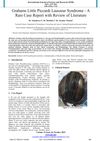
 This paper describes Grahams Little Piccardi Lassueur Syndrome, a rare type of Lichen Planopilaris that causes different types of alopecia and distinctive skin papules, primarily affecting females aged 40 to 70, and notes the current challenges in treatment options, particularly once scarring occurs.

Bee pollen, green tea, essential oils, and various plant extracts improve skin and hair health.
 September 2023 in “Frontiers in medicine”
 This review suggests that the mTOR signaling pathway may play a significant role in hair follicle health by influencing the effects of Vitamin D receptor deficiency, potentially contributing to hair follicle damage and related hair loss conditions.
 September 2023 in “Ain Shams medical journal”
 In this study conducted among secondary school girls in Minia, Upper Egypt, researchers reported a traction alopecia prevalence of 31%, suggesting a significant occurrence of this potentially reversible hair loss due to tight hairstyles.
 August 2023 in “Repository of the University of Primorsk (University of Primorska)”
 A Western diet may increase acne risk, while a Mediterranean diet and certain supplements can help reduce it.
 June 2023 in “Research Square (Research Square)”
 This study identified shared gene expression changes and immune cell infiltration patterns that may contribute to hair loss in alopecia areata and cutaneous lupus erythematosus, but also highlighted factors that might preserve hair in psoriasis patients.
 April 2023 in “Digital Library of Theses and Dissertations (Universidade de São Paulo)”
 This study concluded that mesenchymal stem cells from adipose tissue harvested using laser-assisted liposuction with selective photo-stimulation are as effective and low-risk for cell therapy as those obtained through conventional liposuction, based on their differentiation potential, cellular proliferation, and cytokine expression.
The study found that adipose-derived mesenchymal stem cells obtained via laser-assisted liposuction with selective photo-stimulation are comparable in differentiation potential and tumorigenic risk to those from conventional liposuction for cell therapy applications.

This study found that while iron depletion through phlebotomies is safe for women with functional ovarian hyperandrogenism, it does not improve their cardio-metabolic profile and may reduce non-enzymatic antioxidant capacity.
This study developed a new analytical method to identify a wide range of endocrine disrupting compounds in full-term amniotic fluid, revealing diverse substances with potential endocrine activity.
 September 2022 in “Institutional Repositories DataBase (IRDB)”
 Adipose-derived stem cells can be transformed into hair-forming cells using specific extracellular vesicles, offering potential for hair regeneration therapies.

This study found a significant discordance between clinical symptoms and dermatoscopic signs with histopathological inflammation in patients with LPP and AFF, affecting diagnostic and therapeutic approaches.
 July 2022 in “Research Square (Research Square)”
 This study found that miR-23b and miR-133 significantly reduce mRNA and protein levels of specific target genes involved in Merino sheep hair follicle development, providing insight into molecular breeding for fine wool production.
 February 2022 in “Research Square (Research Square)”
 This study identified candidate genes related to hair follicle development in Merino sheep, providing insights for improving sheep wool quality and potentially understanding human hair growth mechanisms.
 December 2021 in “THE THERAPIST (Journal of Therapies & Rehabilitation Sciences)”
 This review highlights the increased need for awareness about Polycystic Ovarian Syndrome (PCOS) and suggests that more research is necessary to understand its management through lifestyle modifications.
 September 2021 in “International Journal of Biomedicine”
 This study found that SNPs in the MVK, ARPC1B, and CA2 genes may indicate a genetic predisposition for severe acne related to steroidogenesis.
 August 2021 in “Research Square (Research Square)”
 This study found that BEO inhibited cell proliferation and inflammatory mediator release in a human keratinocyte acne model and reduced acne lesion severity in a rabbit model, suggesting its potential as a natural alternative to conventional acne treatments.
 August 2021 in “Research Square (Research Square)”
 In this study of clinical-grade ADMSCs, researchers found that cells expanded in PowerStem MSC1 media exhibited increased negative marker expression, chromosomal abnormalities, and signs of senescence compared to those cultured in StemMACS MSC Expansion Media, suggesting that the latter is more suitable for therapeutic applications.
 June 2020 in “Journal of Dermatological Treatment”
 This source outlines the potential effects of treatments commonly used in trichology on SARS-CoV-2 infection and offers a guide for managing trichological patients during the COVID-19 era, addressing the challenges of safely visiting and treating patients.
 May 2020 in “bioRxiv (Cold Spring Harbor Laboratory)”
 This study found that hair-type tissues in hedgehogs show higher enrichment of immune-related genes compared to spine-type tissues, suggesting that spines evolved to protect against injuries and infections.
 January 2020 in “Research Portal Denmark”
 This study concludes that anti-androgenic chemicals causing short anogenital distance in male fetuses also induce a feminized transcriptional profile in the perineum, implicating Wnt and estrogen signaling in the process.