37 citations
,
May 2021 in “Frontiers in Cell and Developmental Biology” This study found that Ng2+ perivascular cells in mouse skin are a diverse lineage-restricted population primarily recruited from papillary or reticular fibroblast lineages during wound healing, maintaining heterogeneity in both wounded and non-wounded skin.
169 citations
,
January 2018 in “Cell Reports” In this study, researchers successfully derived skin organoids from mouse pluripotent stem cells that spontaneously produce hair follicles, potentially aiding in hair growth research and in vitro drug testing.
EGF affects hair and skin development.
5 citations
,
January 2001 in “Journal of dermatological science” In this study, researchers found that the G(S)alpha subunit is strongly expressed in neonatal mouse hair follicles, indicating it may play a role in initiating follicle growth.
January 2010 in “Chinese journal of clinical anatomy” This study observed that hair follicle development in C57BL/6 mice begins at fetal stage E15.5, with a rapid increase in hair follicle numbers from E17.5 to three days after birth.
39 citations
,
November 2007 in “Journal of Histochemistry & Cytochemistry” This study found that in neonatal mice, the absence of the NG2 proteoglycan leads to reduced epidermal thickness and delayed subcutis thickening due to impaired proliferation and adipocyte deficiencies.
June 2008 in “The Knowledge Bank (The Ohio State University)” This study found that deleting Smad2 and Smad3 in murine skin leads to severe skin abnormalities and cancerous lesions, similar to but more severe than those seen in Smad4 mutants, indicating the critical role of TGF-β signaling in skin development.
 10 citations
,
August 2023 in “Developmental cell”
10 citations
,
August 2023 in “Developmental cell” In this study, researchers used advanced techniques to map the early embryonic development of mouse skin, identifying diverse cell populations and uncovering complex interactions essential for skin structure, signaling, and function.
25 citations
,
January 2004 in “The International Journal of Developmental Biology” This review discusses the molecular mechanisms involved in hair and epidermal development, highlighting how studies on human inherited diseases and mouse models have deepened our understanding; it reports no new results.
33 citations
,
June 2007 in “Gene Expression Patterns” This study found that CTIP2 is highly expressed in mouse skin during embryogenesis and adulthood, suggesting it may play a role in skin development and homeostasis.
 2 citations
,
December 2022 in “Scientific Data”
2 citations
,
December 2022 in “Scientific Data” This study used single-cell ATAC sequencing to map chromatin accessibility in developing mouse hair follicles, offering insights into the transcriptional regulation and epigenetic mechanisms underlying hair follicle development.
 93 citations
,
April 2003 in “Proceedings of the National Academy of Sciences of the United States of America”
93 citations
,
April 2003 in “Proceedings of the National Academy of Sciences of the United States of America” This study identified an unexpected critical role for the FATP4 protein in skin and hair development in mice, linking it to a potential candidate gene for restrictive dermopathy in humans.
7 citations
,
October 2022 in “Development” This study demonstrated that Wnt5a can serve as an orienting signal for mouse skin's planar cell polarity but its overexpression disrupts hair follicle orientation, which can be rescued by modifying Fzd6 levels.
24 citations
,
July 1994 in “Journal of Investigative Dermatology” 12 citations
,
August 2015 in “Experimental Dermatology” This study indicated that the mineralocorticoid receptor (MR) plays a transient role in regulating epidermal differentiation during late embryonic stages, with glucocorticoid receptor (GR) potentially compensating for MR loss during the perinatal period.
14 citations
,
January 2005 in “Cell Stress and Chaperones” January 2004 in “Molecular biotechnology”  10 citations
,
June 2019 in “Journal of Tissue Engineering and Regenerative Medicine”
10 citations
,
June 2019 in “Journal of Tissue Engineering and Regenerative Medicine” This study found that cultured mouse dermal papilla (mDP) cells can induce hair follicle neogenesis in de novo regenerated skin tissues grafted onto mice.
 41 citations
,
June 2013 in “PLOS ONE”
41 citations
,
June 2013 in “PLOS ONE” This study demonstrated that engineered skin substitutes using human keratinocytes and murine dermal papilla cells can develop pigmented hairs without sebaceous glands, suggesting separate pathways for hair development and eruption.
July 2025 in “Genome biology” This study highlighted the effectiveness of HT-scCAT-seq as a tool for understanding gene regulation in single cells, offering insights into embryonic skin development and proposing a framework for exploring regulatory mechanisms in various biological and disease contexts.
1 citations
,
September 2019 in “Journal of Investigative Dermatology” This study developed a pemphigus model in mice showing that anti-Desmocollin 3 and anti-Desmoglein 3 antibodies lead to more severe disease, suggesting diverse antigens contribute to varying human pemphigus phenotypes.
 September 2017 in “Journal of Investigative Dermatology”
 This study found that the expression levels of Siah1 and Siah2 in mice skin vary dynamically during postnatal hair follicle development, suggesting their specific roles in modulating the HIF pathway.
4 citations
,
June 2002 in “Veterinary Dermatology” In this study, prenatal exposure to all-trans-retinoic acid in pregnant mice resulted in increased BrdU-positive nuclei in hair bulbs without altering hair follicle morphogenesis, suggesting potential for non-teratogenic studies on skin diseases.
1 citations
,
August 2019 In this study, researchers developed a pemphigus mouse model expressing anti-Desmocollin 3 antibodies and found it mimicked atypical pemphigus with distinct pathological features compared to the standard Desmoglein 3 model.
 829 citations
,
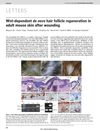
May 2007 in “Nature”
829 citations
,
May 2007 in “Nature” Hair follicles can regrow in wounded adult mouse skin using a process like embryo development.
 April 2026 in “Experimental & Molecular Medicine”
 This study used integrated single-cell chromatin and transcriptomic analyses in developing mouse skin to uncover gene networks involved in skin lineage specification and identified Mef2c+ upper fibroblasts as potential precursors to certain muscle-like structures, with cross-species findings in human skin.
 2 citations
,
August 2020 in “Natural Product Communications”
2 citations
,
August 2020 in “Natural Product Communications” This study found that the topical application of a mixture of Platycladus orientalis leaf extract and α-terpineol promoted hair growth in mice by inducing early anagen transition and increasing growth factor expressions.
28 citations
,
July 2005 in “Journal of Investigative Dermatology” Sca-1+ cells in newborn mouse skin may become fat cells.
10 citations
,
June 2022 in “Development” This study suggests that distinct chromatin topologies allow different lineage-specific enhancers to regulate Hoxd genes in mouse vibrissae and chicken feather primordia, while conserved regulatory elements maintain transcriptional robustness in the embryonic trunk across species.
 11 citations
,
January 2015 in “Skin pharmacology and physiology”
11 citations
,
January 2015 in “Skin pharmacology and physiology” In this study, oral collagen peptides increased certain gene expressions related to epidermis development and the hair cycle in hairless mice skin, suggesting potential links to hair health.