 1 citations
,
August 2020 in “British Journal of Dermatology”
1 citations
,
August 2020 in “British Journal of Dermatology” Caffeine may protect hair follicles from stress-related hair loss.
 42 citations
,
July 2014 in “European journal of pharmaceutics and biopharmaceutics”
42 citations
,
July 2014 in “European journal of pharmaceutics and biopharmaceutics” This study established a stable formulation for caffeine nanocrystals in specific solvent mixtures, which could be used to test their potential for enhanced hair follicle targeting and penetration.
January 2023 in “Zenodo (CERN European Organization for Nuclear Research)” This abstract discusses the FitSpresso weight loss supplement's potential benefits and mechanisms but provides no clinical research findings; it reports on its ingredients and consumer ratings instead.
 8 citations
,
April 2020 in “European Journal of Nutrition”
8 citations
,
April 2020 in “European Journal of Nutrition” This study found that newborn hair caffeine content reflects maternal caffeine intake during the third trimester, providing a potential method for assessing fetal caffeine exposure.

In this animal study, leaf extracts of Kalanchoe pinnata increased hair length in rabbits in a concentration-related manner, surpassing minoxidil at the highest concentration, though hair mass was unaffected.
 October 2025 in “INSOLOGI Jurnal Sains dan Teknologi”
 In this laboratory study on rabbits, the researchers observed that both FET and FHE fractions improved hair length and weight, but minoxidil still led to better results, highlighting the comparative effects of different treatments on hair growth over 28 days.
 7 citations
,
July 2018 in “International Journal of Applied Pharmaceutics”
7 citations
,
July 2018 in “International Journal of Applied Pharmaceutics” This study found that optimizing chitosan-tripolyphosphate nanoparticles can enhance the sustained percutaneous delivery of caffeine, with certain conditions affecting stability and release rates.
55 citations
,
March 2005 in “Neuropharmacology” A neurosteroid can reduce caffeine-induced anxiety in rats.
 8 citations
,
January 2020 in “Skin Pharmacology and Physiology”
8 citations
,
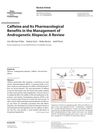
January 2020 in “Skin Pharmacology and Physiology” This article discusses the potential for topical caffeine as a natural alternative for treating androgenetic alopecia due to its ability to penetrate skin, but it reports no new clinical findings.
 April 2018 in “Journal of Investigative Dermatology”
 This study found that kaempferol increased the proliferation potential of basal epidermal cells in three-dimensional skin models by enhancing integrin expression and altering cell morphology.
This study conducted a pre-formulation evaluation of a caffeine shampoo for androgenic alopecia treatment, finding that the formulation remains stable under various conditions, suggesting its viability for compounding.
This study developed nanoparticulate systems for caffeine delivery in hair follicles, demonstrating effective caffeine loading and release, as well as successful imaging within model hair follicles.
 94 citations
,
May 2011 in “BJCP. British journal of clinical pharmacology/British journal of clinical pharmacology”
94 citations
,
May 2011 in “BJCP. British journal of clinical pharmacology/British journal of clinical pharmacology” This study found that hair follicles contribute significantly to caffeine absorption shortly after topical application, with a faster absorption rate compared to the stratum corneum.
January 2021 in “AIP conference proceedings” This research found that the most cost-effective extraction for developing a coffee-based hair serum is from fall grade cherry coffee, which balances active ingredient content and material cost effectively.
 5 citations
,
January 2020 in “Journal of Dermatology and Dermatologic Surgery”
5 citations
,
January 2020 in “Journal of Dermatology and Dermatologic Surgery” This review discusses the potential dermatological benefits of caffeine for hair growth, rosacea, and skin cancer, but notes significant limitations in available research.
 15 citations
,
April 2001 in “Journal of Dermatological Science”
15 citations
,
April 2001 in “Journal of Dermatological Science” This study found that KF19418 stimulated hair follicle growth in vitro and accelerated hair regrowth in a mouse alopecia model, with effects comparable to minoxidil.
2 citations
,
July 2025 in “Acta Pharmacologica Sinica” Isoginkgetin reduces inflammation in cells by blocking NF-κB activation.
 August 2015 in “Arquivo Brasileiro de Medicina Veterinária e Zootecnia/Arquivo brasileiro de medicina veterinária e zootecnia”
 This study found that maternal caffeine intake during gestation and lactation can lead to skin lesions like hypotrichosis and alopecia in both mother and offspring rats, irrespective of maternal cortisol levels.
 12 citations
,
April 2020 in “British Journal of Dermatology”
12 citations
,
April 2020 in “British Journal of Dermatology” In this study, researchers found that caffeine can counteract stress-induced damage in ex vivo human androgenetic alopecia hair follicles, suggesting it may help prevent stress-related hair loss.
 4 citations
,
February 2022 in “Journal of Pharmaceutical and Biomedical Analysis”
4 citations
,
February 2022 in “Journal of Pharmaceutical and Biomedical Analysis” The conclusion is that a new method can measure caffeine and drugs in hair, finding caffeine abusers have 70 times more caffeine than normal, with a proposed cut-off value for abuse.
 82 citations
,
May 2009 in “BJCP. British journal of clinical pharmacology/British journal of clinical pharmacology”
82 citations
,
May 2009 in “BJCP. British journal of clinical pharmacology/British journal of clinical pharmacology” The study reported that combining the Follicular Closing Technique with the Franz diffusion cell is a valuable method for investigating follicular caffeine penetration in vitro, though kinetics differ from in vivo results.
 21 citations
,
January 2017 in “Skin Pharmacology and Physiology”
21 citations
,
January 2017 in “Skin Pharmacology and Physiology” In this noninferiority study, researchers found that a 0.2% caffeine-based topical liquid was not less effective than 5% minoxidil solution in improving hair growth in men with androgenetic alopecia over six months.
 5 citations
,
November 2021 in “Frontiers in Cell and Developmental Biology”
5 citations
,
November 2021 in “Frontiers in Cell and Developmental Biology” Caffeine can damage hearing cells and affect hearing recovery after ear trauma.
December 2025 in “The Journal of Nutritional Biochemistry” This study found that kaempferol may stimulate hair growth in androgenetic alopecia by enhancing dermal papilla cell function and reducing dihydrotestosterone-induced damage, showing comparable efficacy to finasteride in a mouse model.
 2 citations
,
January 2012 in “International Journal of Trichology”
2 citations
,
January 2012 in “International Journal of Trichology” Coffee and tea might help hair growth in balding individuals, but side effects and alternative uses are being considered.
 May 2024 in “Journal of cosmetic dermatology”
 This study found that while caffeine and adenosine can inhibit hair loss and stimulate hair growth, more research is needed to fully understand the efficacy of shampoo formulations containing specific proportions of these compounds for hair loss treatment and prevention.
 August 2024 in “Bioimpacts”
 In this study on mice, a hydro-alcoholic solution containing kopexil significantly enhanced hair growth and increased hair-promoting factors without causing notable liver or kidney toxicity compared to minoxidil.
 August 2024 in “Faedah Jurnal Hasil Kegiatan Pengabdian Masyarakat Indonesia”
 In this community outreach, participants in Langkat were educated about the benefits of gotu kola leaves as a natural facial moisturizer, resulting in improved knowledge, especially among children, teenagers, and mothers, as shown by pre- and post-test gains.
January 2010 in “Research and Practice on Chinese Medicines” This study found that coffee extraction and its active compound, caffeotannic acid, showed high enzyme inhibition activity against 5a-reductase in an in vitro model.
 1 citations
,
July 2017 in “Journal der Deutschen Dermatologischen Gesellschaft”
1 citations
,
July 2017 in “Journal der Deutschen Dermatologischen Gesellschaft” Topical caffeine improves hair loss intensity, speed, and shedding, and works better with minoxidil/azelaic acid.