 10 citations
,
May 2016 in “Polymer”
10 citations
,
May 2016 in “Polymer” This study reports that novel core-ABS nanocarriers efficiently loaded with dexamethasone and finasteride show potential for dermal drug delivery, exhibiting non-toxic interactions with human keratinocyte cells and skin penetration.
 10 citations
,
May 2010 in “Analytica Chimica Acta”
10 citations
,
May 2010 in “Analytica Chimica Acta” This study reported the development of two highly sensitive ELISA assays to detect banned substances finasteride and dutasteride in human urine, offering better sensitivity than existing HPLC/MS/MS methods.
 9 citations
,
January 2017 in “Organic Process Research & Development”
9 citations
,
January 2017 in “Organic Process Research & Development” This article describes the efficient synthesis of (S)-N-(2-bromo-6-methoxypyridin-4-yl)-2-hydroxy-2,4-dimethylpentanamide, a novel topical antiandrogen, with high purity and enantiomeric excess but reports no pharmacological results.
 9 citations
,
February 2011 in “Revista Brasileira de Farmacognosia”
9 citations
,
February 2011 in “Revista Brasileira de Farmacognosia” This study reported that phytochemicals SA-4 and SA-6 from Tridax procumbens exhibited a dose-related immunostimulatory effect on mice, suggesting their potential as immunostimulators.
 8 citations
,
July 2019 in “Pure and Applied Chemistry”
8 citations
,
July 2019 in “Pure and Applied Chemistry” This study identified natural compounds from Iris plants that showed potential as inhibitors of urease and carbonic anhydrase-II enzymes, suggesting their possible use in treating related disorders.
 8 citations
,
July 2017 in “Biochemical and biophysical research communications”
8 citations
,
July 2017 in “Biochemical and biophysical research communications” This study reported that the pseudoceramide bis-oleamido isopropyl alcohol (BOI) promotes hair growth in ex vivo cultured human hair follicles, likely by enhancing sphingolipid synthesis in dermal papilla cells.
![Synthesis of Spiro[cyclohexane-1,2'-[2H]indene] Derivatives as Inhibitors of Steroid 5α-Reductase](/images/assets/d91300a7-4d66-4d2c-90ac-293b0dbc5ff5/small/21048.jpg) 8 citations
,
June 1995 in “Helvetica Chimica Acta”
8 citations
,
June 1995 in “Helvetica Chimica Acta” This article outlines the synthesis of spiro[cyclohexane‐1,2′‐[2 H ]indene] derivatives similar to known steroid 5α‐reductase inhibitors, but it does not report experimental findings.
 7 citations
,
January 2019 in “Annals of dermatology/Annals of Dermatology”
7 citations
,
January 2019 in “Annals of dermatology/Annals of Dermatology” This study suggests that synthetic ceramides may promote hair growth by inducing proliferation of human dermal papilla cells through modulation of Wnt/β-catenin and BMP2/4 signaling pathways.
 7 citations
,
January 2017 in “Biological & Pharmaceutical Bulletin”
7 citations
,
January 2017 in “Biological & Pharmaceutical Bulletin” This study found that polyacetylene compounds in Panax ginseng extracts may inhibit neurotrophin receptor binding, suggesting potential therapeutic benefits for alopecia and other hair growth disorders.
![Discovery of 7-Methoxy-6-[4-(4-Methyl-1,3-Thiazol-2-yl)-1H-Imidazol-5-yl]-1,3-Benzothiazole (TASP0382088): A Potent and Selective Transforming Growth Factor-β Type I Receptor Inhibitor as a Topical Drug for Alopecia](/images/assets/9620bd26-3366-4f2a-bcac-f511697bbc41/small/35997.jpg) 6 citations
,
January 2013 in “Chemical & pharmaceutical bulletin/Chemical and pharmaceutical bulletin”
6 citations
,
January 2013 in “Chemical & pharmaceutical bulletin/Chemical and pharmaceutical bulletin” In this study, TASP0382088 showed potent selective inhibition of the ALK5 receptor, significantly reducing Smad2 phosphorylation in mouse skin following topical application.
 6 citations
,
July 2007 in “Organic Process Research & Development”
6 citations
,
July 2007 in “Organic Process Research & Development” This study optimized the reaction conditions for the stereoselective hydrogenation of a compound used in manufacturing finasteride and dutasteride, improving the selectivity for the desired isomer.
 6 citations
,
March 2003 in “Archiv Der Pharmazie”
6 citations
,
March 2003 in “Archiv Der Pharmazie” This study reported that newly synthesized nonsteroidal compounds were effective at inhibiting prostatic 5 alpha reductase isozyme 2, especially the compound with an N, N-diisopropylcarbamoyl substituent, suggesting potential for treating benign prostatic hyperplasia.
 5 citations
,
May 2025 in “Scientific Reports”
5 citations
,
May 2025 in “Scientific Reports” This study found that extracts from Indian gooseberry leaves showed strong antimalarial activity against Plasmodium falciparum, with low cytotoxicity, suggesting potential for developing new antimalarial drugs.
 5 citations
,
January 2021 in “iScience”
5 citations
,
January 2021 in “iScience” Using a combination of specific cell cycle regulators is better for safely keeping hair root cells alive indefinitely compared to cancer-related methods.
 5 citations
,
March 2019 in “Journal of lipid research”
5 citations
,
March 2019 in “Journal of lipid research” This study reports new fluorogenic ceramidase substrates and highlights RBM14C24:1 as an efficient substrate for neutral ceramidase, while RBM15C18:1 is the best probe for measuring ACER1 and ACER2 activities, potentially aiding high-throughput screening for ceramidase inhibitors.
 5 citations
,
January 2005 in “Journal of Enzyme Inhibition and Medicinal Chemistry”
5 citations
,
January 2005 in “Journal of Enzyme Inhibition and Medicinal Chemistry” This study found that certain steroidal compounds, especially 10a–10c, demonstrated strong antiandrogenic activity by binding to the androgen receptor and reducing prostate weight in a hamster model.
![Synthesis and In Vitro Study of 17β-[N-Ureylene-N,N′-Disubstituted]-4-Methyl-4-Aza-5α-Androstan-3-Ones as Selective Inhibitors of Type I 5α-Reductase](/images/assets/d19df8a7-8de6-4430-8a0d-4ffa1f502985/small/15608.jpg) 5 citations
,
February 1997 in “Bioorganic & Medicinal Chemistry”
5 citations
,
February 1997 in “Bioorganic & Medicinal Chemistry” This study found that among 17 beta-(N-ureylene-N,N'-disubstituted)-4-azasteroids, those with an N'-phenyl moiety were the most effective inhibitors of human type I 5 alpha-reductase.
 4 citations
,
May 2025 in “npj Parkinson s Disease”
4 citations
,
May 2025 in “npj Parkinson s Disease” This study identified peripheral myeloid cells as the earliest dysregulated immune cells in PINK1 KO mice with Parkinson’s-like symptoms following intestinal infections, suggesting that PINK1 regulates gut immune functions linked to early Parkinson’s disease mechanisms.
 4 citations
,
December 2014 in “European Journal of Chemistry”
4 citations
,
December 2014 in “European Journal of Chemistry” This study synthesized and characterized new 2-hydroxypyrrolidine/piperidine derivatives using FeCl₃·6H₂O as a catalyst, but it reports no biological or clinical results.
 4 citations
,
January 2014 in “RSC Advances”
4 citations
,
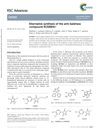
January 2014 in “RSC Advances” A new, less toxic and more efficient method to create the anti-baldness compound RU58841 was developed in 2014.
 4 citations
,
January 1998 in “Heterocycles”
4 citations
,
January 1998 in “Heterocycles” Researchers made two new compounds that could be used for medicine.
 3 citations
,
April 2019 in “bioRxiv (Cold Spring Harbor Laboratory)”
3 citations
,
April 2019 in “bioRxiv (Cold Spring Harbor Laboratory)” In this study, beta-caryophyllene enhanced wound healing in female mice by improving re-epithelialization, cell proliferation, and cell migration, suggesting potential benefits of essential oil compounds in inflammation reduction.
 3 citations
,
November 2017 in “International Journal of Pharmacy and Pharmaceutical Sciences”
3 citations
,
November 2017 in “International Journal of Pharmacy and Pharmaceutical Sciences” This study identified new oxidative derivatives of finasteride, including a newly discovered metabolite, by using the fungus Macrophomina phaseolina.
 3 citations
,
September 2016 in “Natural Product Communications”
3 citations
,
September 2016 in “Natural Product Communications” This study identified 8-hydroxy germacrene B from Curcuma aeruginosa as a highly potent in-vitro 5-alpha reductase inhibitor with significant anti-androgenic activity, while exhibiting mild cytotoxicity on prostate cancer cells without affecting human dermal papilla cells at tested concentrations.
 3 citations
,
January 2003 in “Synthetic Communications”
3 citations
,
January 2003 in “Synthetic Communications” This research describes the synthesis of 16β-chloro- and 16β-bromo-cyproterone acetate, detailing the chemical processes involved, but reports no clinical outcomes.
 2 citations
,
April 2020 in “bioRxiv (Cold Spring Harbor Laboratory)”
2 citations
,
April 2020 in “bioRxiv (Cold Spring Harbor Laboratory)” This study reveals that basement membrane composition and structure in mouse hair follicles are specialized for distinct inter-tissue interactions, with laminin α5 being essential for maintaining these interfaces.
 2 citations
,
August 2019 in “Turkish Journal of Chemistry”
2 citations
,
August 2019 in “Turkish Journal of Chemistry” This study reported that CoFe2O4 magnetic nanoparticles efficiently catalyzed the synthesis of minoxidil from 2,6-diamino-4-chloro-pyrimidine N-oxide, achieving a 95% yield with sustained reusability.
 1 citations
,
November 2025 in “Frontiers in Immunology”
1 citations
,
November 2025 in “Frontiers in Immunology” This review explores the complex role of the Innate Immune System in rheumatoid arthritis, highlighting gaps in understanding its functions and interactions with the Adaptive Immune System, offering insights into potential biomarkers and therapeutic strategies for this challenging autoimmune condition.
 1 citations
,
October 2023 in “Life science alliance”
1 citations
,
October 2023 in “Life science alliance” This study observed that pantethine, a vitamin B5 precursor, attenuates tumor growth in immunocompetent mice by enhancing antitumor immunity, but its effect is limited by immune cell exhaustion over time.
 1 citations
,
April 2021 in “Current Stem Cell Reports”
1 citations
,
April 2021 in “Current Stem Cell Reports” This review discusses the role of metabolism in maintaining adult stem cell homeostasis with aging and highlights the potential benefits of dietary restrictions on stem cell function and longevity. It reports no new clinical results and emphasizes the need for further molecular studies.