 1 citations
,
January 2018 in “Acta dermato-venereologica”
1 citations
,
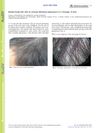
January 2018 in “Acta dermato-venereologica” A teenager's hair with alternating white and dark bands, known as Pili annulati, is a genetic condition that is usually harmless and often considered attractive.
 105 citations
,
December 2009 in “Archives of dermatology”
105 citations
,
December 2009 in “Archives of dermatology” This overview discusses primary cicatricial alopecias, focusing on lichen planopilaris, and highlights the challenges in treatment and the progressive nature of hair loss despite symptom management, without providing new clinical results.
151 citations
,
August 2011 in “The EMBO Journal” The enzyme PA-PLA1α is important for proper hair follicle development.
July 2022 in “Journal of Investigative Dermatology” The combination of a plant extract and a peptide can increase hair pigmentation and may reverse greying.
 35 citations
,
September 2012 in “PloS one”
35 citations
,
September 2012 in “PloS one” This study found that in Arabidopsis seedlings, tonoplast intrinsic proteins are targeted to the vacuole via at least two pathways, including pathways with differing sensitivity to a chemical inhibitor that affect root hair growth and PIN2 targeting.
 April 2016 in “Journal of Investigative Dermatology”
 This study found that administering botulinum toxin A via Flex-PADs to mouse footpads inhibited sweating similarly to traditional injections, suggesting a promising patient-friendly delivery method for hyperhidrosis treatment.
 20 citations
,
December 2015 in “Journal of Pharmacopuncture”
20 citations
,
December 2015 in “Journal of Pharmacopuncture” In this study, thread-embedding therapy enhanced hair regrowth in C57BL/6 mice by regulating growth factors associated with hair follicle anagen development and promoting cellular proliferation in hair follicles.
 December 2023 in “Journal of ethnopharmacology”
 This study found that tribuloside, a flavonoid from Tribulus terrestris L., enhances melanin production in human melanocytes, zebrafish, and human skin samples without causing toxicity, potentially through inhibiting PDE to increase cAMP levels and promote the melanin biosynthesis pathway.
 4 citations
,
May 2005 in “Seminars in Plastic Surgery”
4 citations
,
May 2005 in “Seminars in Plastic Surgery” This article discusses the development and refinement of the hair-micrografting technique in cosmetic surgery and reports no new clinical results.
 September 2025 in “AESTHETIC OROFACIAL SCIENCE”
 This study found that polidioxanona threads increased hair density and satisfaction in treating various types of alopecia, with no adverse events reported, though the small sample limits broader conclusions.
March 2010 in “European Journal of Cancer Supplements”  January 2023 in “Annali di stomatologia”
 This review traces the development and application of Platelet-rich Plasma in regenerative medicine, emphasizing its role in tissue healing and bone regeneration, but reports no new clinical results.
 3 citations
,
October 2020 in “Journal of Transfusion Medicine”
3 citations
,
October 2020 in “Journal of Transfusion Medicine” This review discusses the use and mechanisms of platelet-rich plasma therapy and highlights the need for standardized preparation and application protocols, without reporting new clinical results.
 March 2024 in “Journal of cosmetic dermatology”
 This study found that platelet-rich plasma may be more effective and satisfactory than topical clobetasol for treating lichen planopilaris over six months.
1 citations
,
August 2024 in “Skin Health and Disease” Among pediatric alopecia areata patients treated with DPCP, this study reported complete hair regrowth in 8.8% and any regrowth in 61.8% after one year, with better outcomes for those with milder initial symptoms and longer treatment durations.
In this observational and interventional study conducted in Dhaka, Bangladesh, PRP treatment led to clinical improvements in hair count, thickness, and density among 20 out of 30 male patients with androgenetic alopecia, with significant statistical support (p-value 0.00) following 2-3 treatment sessions.
14 citations
,
March 2019 in “European journal of pharmaceutics and biopharmaceutics” This study observed that proretinal nanoparticles delivered significantly higher concentrations of retinal to the stratum corneum and hair follicles compared to non-particulate forms, potentially improving topical retinoid therapy.
 November 2022 in “The journal of investigative dermatology/Journal of investigative dermatology”
 This study found that cPPARγ and dnPPARγ isoforms are differentially expressed in healthy human skin, suggesting that PPARγ modulators may have compartment-specific effects depending on isoform presence.
 July 2023 in “BENTHAM SCIENCE PUBLISHERS eBooks”
 This book chapter reviews the subclasses and applications of platelet-rich plasma in tissue engineering and highlights the challenges in clinical translation without reporting new clinical results.
 September 2023 in “International journal of biological macromolecules”
 This study found that a chitosan/PDRN nanopolyplex significantly improved diabetic wound healing in rats by enhancing cell proliferation, migration, and antimicrobial activities, suggesting its potential as a therapeutic product.
 10 citations
,
December 2017 in “Chemosphere”
10 citations
,
December 2017 in “Chemosphere” In this study, BPA rapidly increased dendritic spine and synapse densities in cultured rat hippocampal neurons, with involvement of estrogen receptors and ERK1/2 and p38 pathways, but disrupted dihydrotestosterone's effects on synaptic plasticity.
 3 citations
,
June 2022 in “European journal of human genetics”
3 citations
,
June 2022 in “European journal of human genetics” This study reports the first cases of recessive KRT17-related pachyonychia congenita involving all ectodermal derivatives in seven members of two consanguineous Pakistani families.
 5 citations
,
April 2017 in “Dermatologic Surgery”
5 citations
,
April 2017 in “Dermatologic Surgery” PRP treatment satisfies 58% of female hair loss patients, with most noticing fuller, thicker hair and less shedding.
18 citations
,
December 2016 in “European journal of pharmacology” In this study, 12-Chloracetyl-PPD showed anti-cancer activity by inhibiting cancer cell viability and inducing apoptosis through reactive oxygen species production without harming normal cells.
 6 citations
,
October 2018 in “Dermatologic Surgery”
6 citations
,
October 2018 in “Dermatologic Surgery” This abstract does not present new clinical findings or a research study.
December 2025 in “Journal of Food and Pharmaceutical Sciences” This study found that extracts and crude protein from the white oyster mushroom demonstrated significant thrombolytic activity compared to a positive control, suggesting their potential as natural thrombolytic agents for thromboembolism therapy.
8 citations
,
January 2025 in “JADA Foundational Science” This review discusses the state-of-the-art in photobiomodulation therapy for oral and dental applications and emphasizes the need for education, training, and addressing logistical issues for its routine use.
 July 2025 in “JOJ Dermatology & Cosmetics”
 This study observed that both polynucleotides (PN HPT™) and platelet-rich plasma (PRP) improved hair density and quality in men with androgenetic alopecia, with comparable outcomes and no significant adverse events.
 January 2024 in “Annals of Dermatology”
 This study found that DPCP immunotherapy effectively treats alopecia areata, identifying factors that influence treatment response and patient satisfaction, which may aid in standardizing the treatment for improved outcomes.
 2 citations
,
December 2021 in “Journal of Cosmetic Dermatology”
2 citations
,
December 2021 in “Journal of Cosmetic Dermatology” This review analyzes existing literature on platelet-rich plasma for hair loss, discussing its mechanisms and preparation, but reports no new clinical results and highlights the inconsistency of current evidence.