 26 citations
,
June 2020 in “Polymers”
26 citations
,
June 2020 in “Polymers” This study reported that a magneto-responsive transdermal microneedle system delivered Minoxidil effectively and significantly increased hair density by 800% in mice with androgenetic alopecia after 10 days.
 23 citations
,
January 2011 in “International Journal of Immunopathology and Pharmacology”
23 citations
,
January 2011 in “International Journal of Immunopathology and Pharmacology” In this small study, topical minoxidil 2% was associated with an increase in normal hair shaft production in patients with Monilethrix without any reported side effects.
 4 citations
,
September 2020 in “Cell division”
4 citations
,
September 2020 in “Cell division” In this study, XMU-MP-1 unexpectedly reduced cell proliferation and altered cell cycle progression in a model human hair follicle, possibly due to off-target kinase inhibition.
 2 citations
,
October 1999 in “Annals of the New York Academy of Sciences”
2 citations
,
October 1999 in “Annals of the New York Academy of Sciences” This article discusses plasma β-endorphin concentrations during natural and artificially induced winter hair growth in mink but reports no new clinical findings.
 2 citations
,
April 2008 in “Journal of Dispersion Science and Technology”
2 citations
,
April 2008 in “Journal of Dispersion Science and Technology” This study observed that including cationic minoxidil particles in a shampoo facilitated notable hair growth promotion despite a negative surface charge after rinsing, likely due to ionic interactions with the skin.
2 citations
,
May 2022 in “Journal of Industrial and Engineering Chemistry” This study observed that minoxidil-loaded nanoparticles significantly enhanced skin penetration and hair regrowth in mice within three weeks, without ethanol and propylene glycol, suggesting they are a promising delivery method for treating hair loss.
 49 citations
,
October 1994 in “Annals of Oncology”
49 citations
,
October 1994 in “Annals of Oncology” Minoxidil not effective in preventing chemotherapy-induced hair loss.
1 citations
,
January 2025 in “Regenerative Biomaterials” In this study, researchers found that exosomes derived from Pinctada martensii mucus can effectively inhibit melanin production in melanoma cells and zebrafish without adverse effects, potentially offering a promising therapeutic strategy for treating pigmentary disorders by modulating the NF-κB signaling pathway.
July 2026 in “Experimental Dermatology” In this study, researchers found that minoxidil sulfate enhances the anti-inflammatory effects of the JAK inhibitor baricitinib in alopecia areata, modulating inflammatory signals and preserving immune privilege features in human hair cells, which suggests potential benefits for combined therapy.
 2 citations
,
January 2009 in “Journal of Drug Delivery Science and Technology”
2 citations
,
January 2009 in “Journal of Drug Delivery Science and Technology” This study found that cationic vesicles enhanced minoxidil skin retention and in vivo hair growth efficacy compared to other formulation types due to electrostatic interactions with the skin.
 January 2019 in “Applied Organometallic Chemistry”
 The compound (NH4)2Mn0.17Cu0.83Cl4.2H₂O has a specific structure, shows weak magnetism at low temperatures, and undergoes phase changes at high temperatures.

This study found that nanoparticles developed with minoxidil-loaded thiolated β-cyclodextrins showed improved drug retention on hair surfaces and did not cause skin irritation in rabbits, suggesting potential for topical scalp disease treatment.
March 2026 in “ACS Applied Materials & Interfaces” This study described a novel three-dimensional-printed microneedle system designed for improved transdermal delivery of minoxidil to treat hair loss, demonstrating effective hair regrowth and safety in a mouse model while allowing sustainable needle base recovery.
 37 citations
,
May 2016 in “JAAD case reports”
37 citations
,
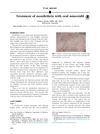
May 2016 in “JAAD case reports” This abstract describes monilethrix, an autosomal dominant genodermatosis with symptoms like hair fragility and keratosis pilaris, and does not report new experimental results.
 1 citations
,
August 2023 in “Advanced Drug Delivery Reviews”
1 citations
,
August 2023 in “Advanced Drug Delivery Reviews” This review discusses various microneedle technologies for long-acting drug delivery, highlighting design considerations and challenges in bringing these minimally invasive devices to market, but it reports no new clinical results.
 August 2025 in “Macromolecular Bioscience”
 This study found that microneedles co-delivering minoxidil and a nitric oxide donor effectively promoted hair growth and follicle transition to the growth phase in an alopecia mouse model, suggesting a promising new approach for androgenetic alopecia treatment.
 4 citations
,
January 2011 in “Analytical Letters”
4 citations
,
January 2011 in “Analytical Letters” This study demonstrated that a flow injection method using potassium permanganate for detecting minoxidil provided accurate recoveries and agreed closely with HPLC results, showing potential for effective analysis of commercial samples.
 March 2026 in “Nutrients”
 This study found that hair manganese levels did not vary by acute coronary syndrome or stable coronary artery disease severity, but a modest, non-significant correlation with body mass index suggests a potential link between manganese homeostasis and cardiometabolic status that warrants further investigation.
February 2023 in “Medicine in novel technology and devices” This study found that microneedle delivery of Polygonum multiflorum extract led to earlier pigmentation and hair regrowth in mice with androgenetic alopecia.
 77 citations
,
January 2015 in “International Journal of Biological Macromolecules”
77 citations
,
January 2015 in “International Journal of Biological Macromolecules” This study developed minoxidil sulphate-loaded chitosan nanoparticles that doubled drug delivery to hair follicles in vitro compared to a control solution, suggesting potential for improved alopecia treatment.
January 2026 in “Microchemical Journal” In this study, researchers developed an electrochemical method using gold nanostructures on a glassy carbon electrode to detect minoxidil levels in hair lotions, and found it effectively quantified minoxidil in commercial products, revealing discrepancies in their labeled versus actual concentrations.
 24 citations
,
June 2018 in “Expert Review of Pharmacoeconomics & Outcomes Research”
24 citations
,
June 2018 in “Expert Review of Pharmacoeconomics & Outcomes Research” This review discusses the potential of microneedle arrays for drug delivery and in the cosmetic market, but reports no new clinical results; factors for commercial therapeutic use are explored.
July 2026 in “Journal of Drug Delivery Science and Technology”  October 2025 in “Advanced Healthcare Materials”
 This study found that using a stevioside-based microneedle patch significantly increased minoxidil's solubility and skin absorption, promoting hair growth in animal models and achieving 67.5% area coverage by day 35, highlighting the potential of this novel delivery system for androgenetic alopecia treatment.
May 2026 in “Drug Delivery” This study introduces a co-design framework using finite element analysis to optimize separable bubble microneedles, demonstrating enhanced transdermal and sublingual drug delivery in preclinical models. In vivo results showed faster hair regrowth and glucose lowering in animals, indicating potential improvements over traditional methods.
This study found that combining electrical stimulation with minoxidil had a synergistic effect on the proliferation of cultured human dermal papilla cells, potentially through enhanced activation of the Wnt/β-catenin pathway.
May 2026 in “Advanced Materials Interfaces” This study reported that a new coating made with delaminated Ti₃C₂ MXene nano-sheets and a tea-derived compound effectively protects hair keratin from damage by providing UV screening, thermal dissipation, and antioxidation, while also enhancing mechanical strength and restoring wettability.
 July 2024 in “Experimental Dermatology”
 This study suggests that APC collagen peptides may accelerate hair growth and promote overall hair health by enhancing cellular proliferation and activating specific signaling pathways in human and mouse models.
This study found that a data-driven model using XGBoost effectively predicts individualized responses to minoxidil for androgenetic alopecia, outperforming traditional methods in accuracy and reliability.
 February 2026 in “Drug Delivery and Translational Research”
 Chitosan-coated nanocapsules improve minoxidil delivery for better hair regrowth.