 5 citations
,
July 2022 in “Orphanet journal of rare diseases”
5 citations
,
July 2022 in “Orphanet journal of rare diseases” This study found that RSPO1 mutations in patients with a 46XX disorder of sexual development contribute to impaired skin integrity and increased risk of squamous cell carcinoma in areas subject to friction.
February 2026 in “American Journal Of Pathology” Skin organoids can mimic human skin responses to injury and inflammation, making them useful for studying skin diseases and testing treatments.
 March 2021 in “bioRxiv (Cold Spring Harbor Laboratory)”
 This study found that type 2 immunity, especially involving ILC2 cells, helps maintain skin homeostasis by regulating the proliferation and community stability of hair follicle epithelial cells in the presence of Demodex mites.

This dissertation reported that the loss of Ovol2 impairs hair follicle regeneration and wound repair in mice, highlighting its role in regulating directional migration of epithelial cells.
 55 citations
,
November 2004 in “Expert opinion on drug safety”
55 citations
,
November 2004 in “Expert opinion on drug safety” This review describes the variety of mucocutaneous side effects caused by antineoplastic chemotherapy, with emphasis on skin, nails, and mucous membranes, while highlighting potential severity and the possibility of needing to adjust or interrupt treatment in rare cases; it presents no new clinical results.
 32 citations
,
January 2015 in “Annals of diagnostic pathology”
32 citations
,
January 2015 in “Annals of diagnostic pathology” This study highlights the importance of recognizing oral lesions in diagnosing syphilis, as illustrated by three reported cases.
3 citations
,
June 2023 in “Modern Pathology” This study found that GLI1 RNA CISH was highly sensitive and specific for distinguishing basal cell carcinoma from nonfollicular epithelial neoplasms but not from most benign follicular tumors.

This study found that wavy sinus hairs in cats were significantly associated with feline leukemia virus infection, suggesting this physical trait might be useful for identifying infected cats.
 March 2015 in “Zagazig University Medical Journal”
 The study found that CK15 expression, representing hair follicle stem cell activity, was reduced or absent in scarred primary cicatricial alopecia lesions, suggesting stem cell damage may contribute to the scarring process.
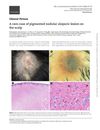
This study reported the case of a 30-year-old man with a bluish-grey scalp nodule that developed over a previously stable hairless plaque, revealing histopathological features consistent with epithelioid cell nests and spindle-shaped dermal melanocytes embedded in collagen.
 54 citations
,
November 2015 in “Methods in enzymology on CD-ROM/Methods in enzymology”
54 citations
,
November 2015 in “Methods in enzymology on CD-ROM/Methods in enzymology” This chapter reviews keratins in skin epithelia, including their roles in cellular function and disease, and reports no new experimental results.
 April 2026 in “Nature Communications”
 This study found that dedifferentiated corneal epithelial cells can revert to a stem-cell-like state, aiding tissue homeostasis and repair, with this plasticity limited to the epithelial lineage and enhanced by niche-derived cytokines.
 90 citations
,
January 1979 in “International review of cytology”
90 citations
,
January 1979 in “International review of cytology” This chapter reviews the complexity of hair and wool follicle formation, emphasizing the importance of cytological studies to understand the relationship between cellular components.
 35 citations
,
January 2017 in “Journal of Dermatological Science”
35 citations
,
January 2017 in “Journal of Dermatological Science” This study suggests that stress-induced premature senescence of dermal papilla cells may contribute to hair follicle aging by impairing critical epithelial-mesenchymal interactions and promoting inflammatory cytokine production.
 4 citations
,
November 2021 in “Frontiers in Cell and Developmental Biology”
4 citations
,
November 2021 in “Frontiers in Cell and Developmental Biology” Aging causes hair loss and graying due to stem cell decline and changes in cell behavior and communication.
 April 2024 in “Dermatovenerologiâ, kosmetologiâ”
 This study provides a comprehensive overview of actinic keratosis, highlighting its potential to progress to squamous cell carcinoma and noting that routine treatment poses a significant burden on healthcare providers.
 63 citations
,
January 1984 in “Journal of Investigative Dermatology”
63 citations
,
January 1984 in “Journal of Investigative Dermatology” Minoxidil promotes hair growth by increasing cell division and DNA synthesis.
39 citations
,
September 2007 in “BMC developmental biology” This study found that Neuregulin3 can influence the development and differentiation of mammary glands and epidermal features in mice, potentially by inducing c-Myc and altering cell proliferation and adhesion.
 38 citations
,
September 2011 in “PLOS ONE”
38 citations
,
September 2011 in “PLOS ONE” This study found that activin B promotes epithelial wound healing in mice through the RhoA-Rock-JNK-cJun signaling pathway, suggesting a potential therapeutic role for activin B in wound repair.
 20 citations
,
August 2014 in “PloS one”
20 citations
,
August 2014 in “PloS one” This study found that MED1 deficiency in keratinocytes accelerates skin wound healing in young mice but delays healing in older mice, suggesting differential roles in epidermal regeneration with age.
 28 citations
,
March 2019 in “Journal of Dermatological Science”
28 citations
,
March 2019 in “Journal of Dermatological Science” This review discusses methods for evaluating hair growth-promoting effects of candidate substances for androgenetic alopecia, focusing on cell assays, organ cultures, and animal models, and reports no new results.
 36 citations
,
July 2014 in “Experimental Dermatology”
36 citations
,
July 2014 in “Experimental Dermatology” This narrative piece considers how epigenetic factors may influence the processes of skin wound healing, including hair follicle formation, but it presents no new experimental results.
 12 citations
,
May 2001 in “British journal of dermatology/British journal of dermatology, Supplement”
12 citations
,
May 2001 in “British journal of dermatology/British journal of dermatology, Supplement” A rare benign skin tumor showed unusual features of sebaceous and sweat glands, important for correct diagnosis.
8 citations
,
July 2015 in “European journal of histochemistry” This study found that Sox9 was variably expressed in most canine skin neoplasms, particularly in those originating from the hair follicle's bulge region, suggesting its potential as a stem cell marker.
 October 2023 in “Clinical case reports”
 This case study reports the first Palestinian case of an ovarian steroid cell tumor with virilization in a young female, highlighting the challenges in diagnosis and varied chemotherapeutic responses.
2 citations
,
September 2020 in “International Journal of Molecular Sciences” In this study, the elimination of NG2+ hair follicle stem cells during the anagen phase was associated with an aggravated sensitization phase of allergic contact dermatitis, suggesting their immunosuppressive role.
1 citations
,
July 2025 in “JCI Insight” This study found that Krox20 marks a diverse stem cell population in mouse hair follicles, which significantly contributes to the interfollicular epidermis and regulates epidermal homeostasis.
 1 citations
,
June 2016 in “Equine Veterinary Education”
1 citations
,
June 2016 in “Equine Veterinary Education” This article discusses various diagnostic techniques for investigating equine skin diseases and reports no new clinical results.
64 citations
,
January 2013 in “The journal of investigative dermatology/Journal of investigative dermatology” This study found that ectodermal precursor cells derived from human induced pluripotent stem cells may enhance hair follicle morphogenesis through improved epithelial-mesenchymal interactions when cocultured with dermal cells.
 15 citations
,
July 2016 in “Biochemical Journal”
15 citations
,
July 2016 in “Biochemical Journal” This study found that Wnt ligands from CD133-positive dermal papilla cells are essential for maintaining hair growth by supporting cell signaling between different hair follicle structures.