 174 citations
,
November 2016 in “Cell stem cell”
174 citations
,
November 2016 in “Cell stem cell” This study found that squamous cell carcinomas from hair follicle stem cells are more prone to epithelial to mesenchymal transition and metastasis than those from interfollicular epidermis, due to distinct chromatin landscapes.
 162 citations
,
July 2011 in “Biomacromolecules”
162 citations
,
July 2011 in “Biomacromolecules” This study found that chitosan nanofibrillar scaffolds accelerated skin wound healing in mice by enhancing cell adhesion, proliferation, and regeneration of epidermis and dermis compared to other forms.
 126 citations
,
April 2006 in “International Journal of Dermatology”
126 citations
,
April 2006 in “International Journal of Dermatology” This study found that frontal fibrosing alopecia and lichen planopilaris have similar histopathological features, but FFA exhibits more prominent apoptosis and less inflammation with spared interfollicular epidermis.
124 citations
,
July 2017 in “eLife” This study found that COL17 deficiency in neonatal mice causes abnormal skin cell proliferation due to disrupted Wnt signaling, while replenishing or overexpressing COL17 can reverse this effect in both neonatal and aged skin.
 99 citations
,
January 2014 in “Nature communications”
99 citations
,
January 2014 in “Nature communications” In this study, researchers developed a method to differentiate human iPSCs into cells that can generate all lineages of hair follicles, potentially aiding treatments for hair loss and skin disorders.
 98 citations
,
August 2007 in “PLoS ONE”
98 citations
,
August 2007 in “PLoS ONE” This study found that Myc activation in epidermal stem cells leads to chromatin modifications that promote stem cell exit and differentiation, which can be influenced by HDAC inhibitors like trichostatin A.
 78 citations
,
September 2006 in “International Journal of Cosmetic Science”
78 citations
,
September 2006 in “International Journal of Cosmetic Science” This paper discusses the role of Malassezia yeast and inflammation in dandruff and highlights the potential of anti-inflammatory antidandruff formulations to improve scalp conditions and hair cycle disturbances; it presents no new experimental results.
 74 citations
,
June 2010 in “European Journal of Pharmaceutics and Biopharmaceutics”
74 citations
,
June 2010 in “European Journal of Pharmaceutics and Biopharmaceutics” This study found that hair follicles are a significant and efficient pathway for the absorption of topical minoxidil foam in humans, with faster blood detection when follicles are open.
 61 citations
,
May 2016 in “Scientific reports”
61 citations
,
May 2016 in “Scientific reports” This study found that IMT-P8, a novel cell-penetrating peptide, effectively facilitated the dermal delivery of proteins and peptides in mouse skin and cell lines, suggesting potential for topical applications in cosmetics and skin diseases.
 57 citations
,
May 2007 in “Nature”
57 citations
,
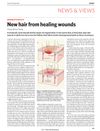
May 2007 in “Nature” This study suggests that wounding skin in adult mice can trigger new hair follicle formation, indicating mammalian skin may have greater regenerative capacity than previously thought.
 57 citations
,
February 1994 in “Experimental dermatology”
57 citations
,
February 1994 in “Experimental dermatology” This study found that murine skin is a target for melatonin bioregulation, as melatonin affected DNA synthesis and tyrosinase activity in skin organ culture.
 56 citations
,
March 2015 in “Cell death and differentiation”
56 citations
,
March 2015 in “Cell death and differentiation” This study found that H-Ras activation in aged mouse skin leads to increased dysplasia and progression to in situ squamous cell carcinoma, highlighting an age-linked connection between immune changes, senescence, and cancer risk.
 52 citations
,
May 2003 in “The journal of investigative dermatology/Journal of investigative dermatology”
52 citations
,
May 2003 in “The journal of investigative dermatology/Journal of investigative dermatology” This study found that overexpression of parathyroid hormone-related protein in mice resulted in 30–40% shorter hair due to premature transition into the catagen phase of the hair cycle.
 47 citations
,
November 2012 in “Pharmaceutical research”
47 citations
,
November 2012 in “Pharmaceutical research” This study found that surface modified nanoparticles showed increased skin permeation and improvement in allergic contact dermatitis, independent of the follicular pathway.
 34 citations
,
April 2018 in “EMBO journal”
34 citations
,
April 2018 in “EMBO journal” This study found that in mouse skin, the activation of stem/progenitor cells is synchronized across different niches during growth, with the glutamate transporter SLC1A3 playing a crucial role in this process.
 28 citations
,
November 2013 in “The journal of investigative dermatology/Journal of investigative dermatology”
28 citations
,
November 2013 in “The journal of investigative dermatology/Journal of investigative dermatology” This study found that the selective PPARγ modulator GMG-43AC may inhibit unwanted hair growth by inducing catagen phase while preserving hair follicle epithelial progenitor cells, suggesting potential in anti-hirsutism therapy.
 28 citations
,
March 2010 in “Histochemistry and Cell Biology”
28 citations
,
March 2010 in “Histochemistry and Cell Biology” This study identified specific markers that can distinguish between stem cells in different regions of human scalp hair follicles, offering potential strategies for cell sorting and purification based on these markers.
 24 citations
,
September 2008 in “Clinical and experimental dermatology”
24 citations
,
September 2008 in “Clinical and experimental dermatology” Repigmentation in vitiligo may come from melanocyte stem cells in the skin.
 23 citations
,
July 2007 in “The journal of investigative dermatology/Journal of investigative dermatology”
23 citations
,
July 2007 in “The journal of investigative dermatology/Journal of investigative dermatology” This study found that follicular stem cells in hair follicles are more sensitive to the antiproliferative effects of glucocorticoids compared to basal keratinocytes due to incomplete desensitization.
22 citations
,
December 2013 in “Stem cells and development” This study found that treating skin wounds with a combination of epidermis-derived epithelial-like stem/progenitor cells and platelet-rich plasma improved tissue repair and increased vascularization and elastin content compared to platelet-rich plasma alone.
 21 citations
,
January 2018 in “Journal of Investigative Dermatology”
21 citations
,
January 2018 in “Journal of Investigative Dermatology” This study found that large excisional wounds in rats across seven strains do not regenerate new hair follicles, unlike in mice, possibly due to differences in epidermal competence and transcriptional profiles.
 20 citations
,
July 2006 in “Veterinary dermatology”
20 citations
,
July 2006 in “Veterinary dermatology” This study found that hair regrowth in Pomeranians with hair cycle arrest treated with melatonin was not associated with a change in oestrogen receptor-α staining.
 19 citations
,
March 2017 in “PLoS ONE”
19 citations
,
March 2017 in “PLoS ONE” This study found that intact pilosebaceous units were more effective than truncated hair follicles at regenerating a multilayered epidermis in a de-epidermalized dermis in vitro.
 19 citations
,
July 1993 in “The journal of investigative dermatology/Journal of investigative dermatology”
19 citations
,
July 1993 in “The journal of investigative dermatology/Journal of investigative dermatology” The researchers reported that hair follicle germinative epidermal cells can form complex structures when associating with papilla cells in culture, unlike other types of epidermal cells.
 18 citations
,
September 1990 in “Veterinary Dermatology”
18 citations
,
September 1990 in “Veterinary Dermatology” This study in SPF lambs found that primary and secondary orf virus infections trigger similar skin responses, but the primary infection caused a more severe and prolonged reaction.
17 citations
,
August 2014 in “The Anatomical Record” The researchers reported that scaffoldin, a protein identified in chicken embryos, likely plays a role in forming periderm granules and contributes to the soft cornification of embryonic epidermis.
17 citations
,
June 1994 in “Archiv für Pathologische Anatomie und Physiologie und für Klinische Medicin” Tenascin is present in normal skin and certain skin tumors but not in sebaceous glands or their tumors.
 14 citations
,
November 2013 in “PloS one”
14 citations
,
November 2013 in “PloS one” This study found that transgenic mice overexpressing HGF/SF are more susceptible to UVA-induced melanoma, with melanin in the papillary dermis interacting with UVA to induce melanoma.
 13 citations
,
July 2012 in “Pigment Cell & Melanoma Research”
13 citations
,
July 2012 in “Pigment Cell & Melanoma Research” In this study, researchers identified a new dominant mutation in Hairless mice, called Pied, resulting from a deletion in the Adam10 gene, which causes freckle-like skin pigmentation by inhibiting melanocyte expansion.
12 citations
,
July 2015 in “Experimental Dermatology” This study found that overexpression of Gsdma3 in mice led to epidermal hyperplasia, skin inflammation, and hair growth defects, suggesting gain-of-function mutations in Gsdma3 cause these conditions.