2 citations
,
December 2013 in “Journal of dermatology” This letter reports a homozygous missense mutation in the LIPH gene causing autosomal recessive hypotrichosis simplex in a Chinese patient.
 February 2016 in “Acta Medica Marisiensis”
 This case study presents what is reportedly the first association of Graham Little-Lassueur Syndrome with chronic hepatitis C, observed in a 47-year-old female patient.
 February 2023 in “Journal of dermatology”
 This letter reports the first known Japanese case of autosomal recessive woolly hair/hypotrichosis with compound heterozygous mutations in the LIPH gene.
March 2025 in “Journal of Investigative Dermatology” 1 citations
,
January 2015 in “Hair transplant forum international” This review discusses low level laser therapy for hair loss but reports no new research findings; it serves as an introduction to understanding existing knowledge before upcoming evaluations of recent studies.
2 citations
,
March 2019 in “PubMed” This report presents the early development of the Lupus Foundation of America's LFA-REAL™ patient-reported instrument, designed to enhance evaluation of lupus disease activity by combining patient and physician assessments.
5 citations
,
November 2015 in “International Journal of Dermatology” This article discusses a case of Graham Little–Piccardi–Lassueur syndrome in a patient with androgen insensitivity syndrome and reports no new research findings.
May 2024 in “JAAD Case Reports” This case report describes a 29-year-old man with a year-long non-itchy skin eruption and hair loss, with distinct papules and plaques across his scalp, beard, body, and suprapubic regions, but no systemic symptoms or family history of autoimmune disease.
 August 2016 in “Journal of Investigative Dermatology”
 This case report identifies a novel LIPH gene mutation linked to autosomal recessive woolly hair/hypotrichosis in a Japanese boy, expanding the spectrum of known mutations associated with this condition.
September 2007 in “The American Journal of Gastroenterology” This case report illustrates that Systemic Lupus Erythematosus can lead to severe malabsorption, weight loss, and small bowel inflammation, requiring recognition for effective treatment and improved outcomes.
 November 2025 in “Pacific Journal of Medical Research”
 This study found that acute cutaneous lupus erythematosus, particularly malar rash, was the most common skin manifestation among SLE patients in Bangladesh, with significant occurrences of nonspecific lesions like alopecia and mucosal ulcers.
 December 2023 in “Journal of General Procedural Dermatology and Venereology Indonesia”
 The abstract highlights that lichen planus can manifest as cicatricial alopecia or lichen planopilaris, while discoid lupus erythematosus, a common form of lupus erythematosus, typically causes scarring alopecia. Results are not reported here.
 146 citations
,
May 2002 in “The American journal of pathology”
146 citations
,
May 2002 in “The American journal of pathology” This study found that cathepsin L deficiency in mice led to significant abnormalities in hair follicle development and cycling, including disrupted hair shaft outgrowth and premature hair growth phase entry.
September 2021 in “Authorea (Authorea)” This case report describes a middle-aged Sudanese woman with intussusception associated with systemic lupus erythematosus (SLE), presenting with multiple symptoms including joint pain and abdominal issues.
September 2008 in “Pediatric Rheumatology” This study reports that the symptoms and immunological findings in two children with diverse autoimmune-like conditions were ultimately attributed to lysinuric protein intolerance, confirmed by genetic analysis in one child.
 April 2017 in “Journal of Investigative Dermatology”
 This study suggests that sirolimus and propranolol may reduce abnormal lymphatic endothelial cell proliferation in lymphatic malformations, potentially improving vessel function and patient outcomes.
 27 citations
,
February 2009 in “Autoimmunity Reviews”
27 citations
,
February 2009 in “Autoimmunity Reviews” This study describes the development of the EUSCLE Core Set Questionnaire for cutaneous lupus erythematosus, designed to standardize data collection, facilitate epidemiological analysis, and guide diagnostic and therapeutic strategies across European centers.
This study found that the age of onset in systemic lupus erythematosus patients affects clinical features, with juvenile-onset SLE showing more severe disease activity and systemic involvement than adult or late-onset SLE.
 October 2023 in “International Journal of Science and Research (IJSR)”
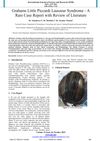
 This paper describes Grahams Little Piccardi Lassueur Syndrome, a rare type of Lichen Planopilaris that causes different types of alopecia and distinctive skin papules, primarily affecting females aged 40 to 70, and notes the current challenges in treatment options, particularly once scarring occurs.
January 2021 in “Dermatology online journal” This case report describes a 2-year-old girl with loose anagen syndrome type B, confirmed by painless trichoscopic examination, with no signs in her identical twin sister.
19 citations
,
September 2010 in “Journal of the European Academy of Dermatology and Venereology” This study found that while the CLASI is generally useful for assessing disease activity and damage in cutaneous lupus erythematosus, it may not accurately reflect all subtypes, indicating a need for revision.
July 2013 in “Indian Journal of Dentistry” This report describes a rare case of Graham-Little–Piccardi–Lassueur syndrome in a 46-year-old male, highlighting its typical features such as scarring alopecia and lichenoid follicular eruptions.
 June 2011 in “CRC Press eBooks”
 Low-Level Laser Therapy can stimulate healing and cell function, potentially leading to wider medical use.
July 2024 in “Journal of Investigative Dermatology”  16 citations
,
December 2017 in “Journal of The American Academy of Dermatology”
16 citations
,
December 2017 in “Journal of The American Academy of Dermatology” This study found that low-level laser therapy may reduce inflammation and increase hair thickness in patients with lichen planopilaris after six months of treatment, though the small sample size limits the findings.
 October 2021 in “Dermatology practical & conceptual”
 A Saudi girl was diagnosed with Loose Anagen Hair Syndrome, a rare condition causing easy hair loss without scarring.
 January 2026 in “International Journal of Dermatology Research”
 This case report discusses a young girl with loose anagen hair syndrome, highlighting the importance of recognizing the condition early to avoid misdiagnosis and unnecessary treatments, and noting her spontaneous improvement with conservative management.
 2 citations
,
July 2015 in “Case Reports in Dermatology”
2 citations
,
July 2015 in “Case Reports in Dermatology” In this case study, DDS treatment for LABD was complicated by hemolytic anemia and alopecia, suggesting the need for careful monitoring of these potential side effects.
 15 citations
,
March 2021 in “Rheumatology and Immunology Research”
15 citations
,
March 2021 in “Rheumatology and Immunology Research” The CSTAR registry, the largest in China for SLE, reports more than 25,000 patients registered since 2009, detailing demographics, clinical characteristics, and providing data for future studies.
 December 2022 in “Medical lasers”
 This study reviews the mechanism and potential treatment roles of low-level laser therapy for immune-mediated skin diseases, reporting no new clinical results.