 October 2021 in “The Egyptian Journal of Hospital Medicine”
 In this study, intralesional platelet-rich plasma was found to be a beneficial and safe treatment option for oral lichen planus, an inflammatory disease affecting the oral mucosa.
 68 citations
,
July 2011 in “Journal of Biochemistry/The journal of biochemistry”
68 citations
,
July 2011 in “Journal of Biochemistry/The journal of biochemistry” This review discusses newly identified non-Edg family lysophosphatidic acid receptors, detailing their roles in vascular development, platelet activation, and hair growth, and reports no clinical results.
January 2025 in “Dermatology Research and Practice” In this research, RNA expression analysis of scalp biopsies from lichen planopilaris patients revealed changes in specific genes after treatments with hydroxychloroquine, narrow band UVB, or low level laser light therapy, suggesting potential biomarkers and implicating M2 macrophages in the disease's immunopathogenesis.
 April 2023 in “IP Indian journal of clinical and experimental dermatology”
 This article reviews the pathogenesis, complications, and management of lichen planus, especially its persistent oral form, and highlights the need for further prospective studies.
 January 2025 in “Medical Research Archives”
 This review discusses various applications of low level laser therapy and argues for a holistic evaluation of patients but reports no new clinical findings.
 August 2023 in “The journal of investigative dermatology/Journal of investigative dermatology”
 This study reports that a patient with rare linear lichen planopilaris experienced complete hair regrowth after 12 weeks of treatment with the antibody ixekizumab, suggesting it as a potential targeted therapy.
 March 2024 in “Journal of cosmetic dermatology”
 This study found that platelet-rich plasma may be more effective and satisfactory than topical clobetasol for treating lichen planopilaris over six months.
39 citations
,
January 2006 in “Journal of Cosmetic and Laser Therapy” This study found that pneumatic skin flattening (PSF) significantly reduces pain and post-treatment erythema during high-energy IPL and laser hair removal while enhancing treatment efficacy.
 September 2021 in “CRC Press eBooks”
 This review discusses the clinical and trichoscopic features of lichen planopilaris and notes its potential underdiagnosis prior to hair transplant, but it reports no new findings.
433 citations
,
April 2015 in “Photomedicine and laser surgery” This editorial discusses the terminology and distinctions between Low-Level Light/Laser Therapy and Photobiomodulation Therapy but reports no new clinical findings.
 5 citations
,
August 2025 in “Drug Delivery and Translational Research”
5 citations
,
August 2025 in “Drug Delivery and Translational Research” This review discusses lipid-polymer hybrid nanoparticles for dermatological applications, outlining their structural and formulation advancements, but reports no new clinical results and calls for further research on their therapeutic potential.
July 2021 in “Authorea (Authorea)” This article discusses Graham-Little Piccardi Lassueur Syndrome, a rare variant of Lichen planopilaris, but reports no clinical findings or results.
 1 citations
,
January 2023 in “Journal of Drugs in Dermatology”
1 citations
,
January 2023 in “Journal of Drugs in Dermatology” This review discusses Graham-Little Piccardi-Lasseur syndrome, a rare dermatosis with limited treatment options, emphasizing the importance of early diagnosis through physical exam and dermoscopy, but reports no new results.
 January 2009 in “Elsevier eBooks”
 Low level laser therapy may help with hair loss.
 3 citations
,
June 2022 in “Dermatology and therapy”
3 citations
,
June 2022 in “Dermatology and therapy” This case report found that a novel botanical treatment halted disease progression and promoted hair regrowth in four patients with lichen planopilaris, indicating potential for use as a safe alternative therapy.
 31 citations
,
October 2010 in “Progress in lipid research”
31 citations
,
October 2010 in “Progress in lipid research” This review discusses the role of LPA(3) in embryo implantation and its genetic connection with prostaglandin signaling, but reports no new clinical results.
January 2005 in “Life sciences” This review discusses the pathophysiologic role of lysophosphatidic acid in the skin and reports no clinical results, suggesting pharmacological inhibition as a potential treatment for various skin disorders.
158 citations
,
June 2014 in “Journal of Lipid Research” This review summarizes recent discoveries of GPCRs for lysophosphatidylserine and lysophosphatidylinositol, detailing their roles as lipid mediators, but reports no new experimental results.
1 citations
,
December 2020 in “Medical lasers” The laser therapy device effectively increased hair growth in people with androgenetic alopecia.
 1 citations
,
September 2013 in “The Journal of Dermatology”
1 citations
,
September 2013 in “The Journal of Dermatology” An 8-year-old girl developed a rare skin condition in a linear pattern on one side of her body after a lung infection, which improved with treatment.
January 2025 in “Indian Journal of Dermatopathology and Diagnostic Dermatology” In this case report, a rare instance of Graham–Little–Piccardi–Lassueur syndrome coexisting with linear lichen planus was identified in a 35-year-old male, highlighting the condition's rarity in males, with dermoscopy aiding diagnosis through distinctive scalp and trunk lesion features.
 2 citations
,
January 2018 in “Recent clinical techniques, results, and research in wounds”
2 citations
,
January 2018 in “Recent clinical techniques, results, and research in wounds” This review discusses the effects of low-level laser therapy in various biological processes for wound healing and tissue repair and reports no new results.
 90 citations
,
July 2008 in “Dermatologic therapy”
90 citations
,
July 2008 in “Dermatologic therapy” This article reviews lichen planopilaris, a chronic scarring alopecia, and explores recent treatment developments, but it reports no new clinical results.
 October 2023 in “International Journal of Science and Research (IJSR)”
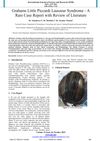
 This paper describes Grahams Little Piccardi Lassueur Syndrome, a rare type of Lichen Planopilaris that causes different types of alopecia and distinctive skin papules, primarily affecting females aged 40 to 70, and notes the current challenges in treatment options, particularly once scarring occurs.
 1 citations
,
June 2022 in “Curēus”
1 citations
,
June 2022 in “Curēus” This case study highlights the unique occurrence of Papillon-Lefévre syndrome in two siblings from a consanguineous family, emphasizing the potential role of genetic factors in the disease's development.
1 citations
,
May 2022 in “Journal of Drugs in Dermatology” This case report describes a patient with lichen planopilaris who experienced remarkable hair regrowth at a previously scarred area after treatment with low-dose naltrexone and platelet-rich plasma, following minimal response to other therapies.
2 citations
,
June 2016 in “Oral Surgery Oral Medicine Oral Pathology and Oral Radiology” This study reports the first known case of oral lichen planus preceding lichen planopilaris in a patient, highlighting a possible sequential relationship between the conditions.
1 citations
,
January 2015 in “Hair transplant forum international” This review discusses low level laser therapy for hair loss but reports no new research findings; it serves as an introduction to understanding existing knowledge before upcoming evaluations of recent studies.
October 2025 in “Our Dermatology Online” This study suggests that combining tranexamic acid with low-dose oral retinoids may offer moderate to good improvements for lichen plan pigmentosus, although larger trials are needed for confirmation.