
This study conducted a comparative analysis of platelet rich plasma and low level laser therapy for androgenetic alopecia but does not present new clinical findings.
 9 citations
,
January 2020 in “Skin appendage disorders”
9 citations
,
January 2020 in “Skin appendage disorders” This case report presents two instances where typically irreversible lichen planopilaris and frontal fibrosing alopecia showed signs of hair regrowth and symptom improvement following specific treatments.
 November 2022 in “CARDIOMETRY”
 This article discusses the potential benefits of GcMAF and oral MAF, developed by "Saisei Mirai", for cancer and other conditions, but reports no new clinical results.
February 2026 in “Indian Dermatology Online Journal” This study reports that oral tofacitinib treatment in a patient with refractory lichen planus pigmentosus and frontal fibrosing alopecia resulted in near-complete resolution of hyperpigmentation and cessation of hairline recession over 18 months, and suggests it may be a promising therapy for these challenging conditions.
This study found that low-level laser therapy may effectively stimulate hair growth in adults with androgenic alopecia, but further research is needed to confirm its long-term clinical effectiveness.
1 citations
,
July 2021 in “Health & Medical Journal” This case report describes a 29-year-old man with systemic lupus erythematosus who responded well to pulse-dose methylprednisolone treatment.
April 2021 in “The journal of investigative dermatology/Journal of investigative dermatology” This study examined clinical characteristics of lichen planopilaris and frontal fibrosing alopecia in 24 men, revealing common scalp symptoms, frequent beard involvement, and limited association with thyroid disease.
In this case report, a female patient with Graham-Little-Piccardi-Lassueur Syndrome and hidradenitis suppurativa showed significant improvement in symptoms, including hair loss and lesions, after six months of treatment with tofacitinib, with no recurrence or adverse effects over a two-year follow-up.
19 citations
,
November 2012 in “Cell Communication and Signaling” This study found that Fibroblast growth factor-9 (FGF-9) accelerates epithelial invagination in engineered ectodermal organs and suggests its potential role in organogenesis and regeneration research.
 October 2023 in “International Journal of Science and Research (IJSR)”
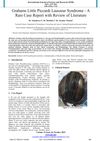
 This paper describes Grahams Little Piccardi Lassueur Syndrome, a rare type of Lichen Planopilaris that causes different types of alopecia and distinctive skin papules, primarily affecting females aged 40 to 70, and notes the current challenges in treatment options, particularly once scarring occurs.
17 citations
,
February 2001 in “Journal of the American Academy of Dermatology” This case report suggests that lithium, either alone or with haloperidol, may induce skin changes resembling follicular mycosis fungoides.
 July 1998 in “Proceedings of SPIE”
 This study found that Low Power Laser therapy may be an effective complementary treatment for scalp alopecia and crural ulcers, showing quicker and potentially better results than conventional treatments.
 September 2023 in “Al-Azhar International Medical Journal /Al-Azhar International Medical Journal”
 This study aimed to assess the safety and effectiveness of laparoscopic sleeve gastrectomy in children and adolescents with obesity, noting the scarcity of data despite emerging evidence of favorable outcomes.
 18 citations
,
November 2012 in “Australasian Journal of Dermatology”
18 citations
,
November 2012 in “Australasian Journal of Dermatology” This case report describes a 66-year-old man with frontal fibrosing alopecia, a rare lichen planopilaris variant, presenting with scarring alopecia at the hairline and extensive body hair loss.
 5 citations
,
April 2019 in “Journal of The American Academy of Dermatology”
5 citations
,
April 2019 in “Journal of The American Academy of Dermatology” This review discusses the complex nature of frontal fibrosing alopecia, suggesting it is a misnomer and possibly a subset of lichen planopilaris, but reports no new clinical results.
June 2020 in “Jurnal Penyakit Dalam Indonesia” This case study highlights that primary biliary cholangitis in a patient with systemic lupus erythematosus can respond well to ursodeoxycholic acid therapy, and anti-DFS70 findings may require further evaluation for other nonsystemic autoimmune conditions.
December 2025 in “Fertility and Sterility” Both LNG-IUD and systemic progestins are effective for fertility-sparing treatment, but close monitoring is needed due to recurrence risk.
 7 citations
,
March 2020 in “Lasers in Medical Science”
7 citations
,
March 2020 in “Lasers in Medical Science” LLLT is a safe, promising hair loss treatment, but more research needed.
 January 2024 in “Brazilian Journal of Hair Health”
 Combining low-level laser therapy with topical corticosteroids effectively improved Lichen Planopilaris symptoms.
5 citations
,
October 2020 in “Veterinary record case reports” In this case report, a 15-year-old golden retriever with calcinosis cutis showed accelerated improvement in FLE-treated skin infections compared to untreated areas, highlighting FLE's potential as a treatment adjunct.
 12 citations
,
October 2017 in “Journal of Cosmetic Dermatology”
12 citations
,
October 2017 in “Journal of Cosmetic Dermatology” This study found that plasma rich in growth factors (PRGF) as an adjuvant to follicular unit extraction (FUE) surgery may enhance hair graft performance and reduce post-surgical inflammation and pain in hair loss patients.

Lichen planopilaris and frontal fibrosing alopecia are likely the same disease with different clinical appearances.
 12 citations
,
January 2017 in “Skin appendage disorders”
12 citations
,
January 2017 in “Skin appendage disorders” This study reports cases of histopathologically proven cutaneous lupus erythematosus manifesting as frontal fibrosing alopecia, with improvement following treatment with oral hydroxychloroquine and/or intralesional triamcinolone acetonide.
January 2005 in “Cosmetic Surgery Times” This study reports that the Luce LDS 100 infrared light therapy shows positive hair growth results after one year in men and women with androgenetic alopecia.
 May 2026 in “Discover Oncology”
 This review discusses the role of LGR4 in tumors, highlighting its involvement in cancer progression, metastasis, and chemotherapy resistance, as well as its regulatory effects on tumor stem cell self-renewal and stem cell characteristics, based on multiple recent studies.
 2 citations
,
September 2014 in “PubMed”
2 citations
,
September 2014 in “PubMed” This review discusses low-level laser or light devices as an alternative treatment for androgenetic alopecia and highlights the need for further research to compare their efficacy with existing therapies.
 March 2022 in “Más dermatología”
 This report discusses the potential overlap between chronic cutaneous lupus and frontal fibrosing alopecia, noting ongoing debate over the significance of their association without presenting new clinical results.
 10 citations
,
January 2010 in “Journal of cosmetic and laser therapy”
10 citations
,
January 2010 in “Journal of cosmetic and laser therapy” This article describes a non-blinded study investigating low level laser therapy for seven patients but reports no new clinical findings.
 August 2021 in “Acta Haematologica Polonica”
 This paper discusses the diagnostic challenges and treatment options for folliculotropic mycosis fungoides, emphasizing the differing prognoses between its indolent and aggressive subtypes and reporting no new clinical results.