 July 2023 in “Nasza Dermatologia Online”
 More research is needed on CCCA in children, especially Black and Asian adolescents.

This review discusses central centrifugal cicatricial alopecia and emphasizes the need for more research to understand and manage the disease, while also suggesting initiatives like educating hairstylists for early detection.
April 2024 in “Journal of the American Academy of Dermatology” Diagnosing and treating CCCA requires understanding multiple causes and using various diagnostic tools.
December 2024 in “Clinical and Experimental Dermatology” This study found that patients with central centrifugal cicatricial alopecia preferred shared decision-making with their doctors regarding treatment management.
 November 2023 in “International Journal of Dermatology”
 In this study, CCCA patients were found to have higher odds of metabolic, autoimmune, atopic, and psychiatric comorbidities compared to matched controls.
 September 2021 in “CRC Press eBooks”
 This article discusses features, genetics, and diagnostic challenges of central centrifugal cicatricial alopecia in African American women but reports no new clinical results.
1 citations
,
December 2023 in “JAAD International” Mast cells may significantly contribute to central centrifugal cicatricial alopecia.
 32 citations
,
November 2011 in “International Journal of Dermatology”
32 citations
,
November 2011 in “International Journal of Dermatology” This article reviews central centrifugal cicatricial alopecia, focusing on its multifactorial etiology and challenges in clinical diagnosis, and calls for more research and better treatment options.
 September 2025 in “Cureus”
 This study found that dermatologists in an urban academic setting most frequently use topical corticosteroids, intralesional corticosteroids, and topical minoxidil for treating central centrifugal cicatricial alopecia, aligning with current literature recommendations on reducing inflammation.
 April 2019 in “The journal of investigative dermatology/Journal of investigative dermatology”
 In this study, researchers found that CCCA in women of African descent is associated with molecular changes, including dysregulation of fatty acid metabolism and fibrosis pathways, suggesting potential targets for new treatments.
 August 2023 in “JAAD international”
 This study, conducted at Montefiore Medical Center, reports that central centrifugal cicatricial alopecia predominantly affects middle-aged Black or African American women, often presenting without symptoms, which may delay diagnosis and treatment. The study underscores the need for a specific ICD-10 code for better epidemiological studies.
 3 citations
,
April 2022 in “Cutis”
3 citations
,
April 2022 in “Cutis” This article reviews central centrifugal cicatricial alopecia, particularly in women of African descent, and explains its progression and symptoms but provides no new clinical findings.
 January 2026 in “Dermatology Online Journal”
 This case report highlights that CCCA can present with multifocal patchy hair loss in younger men of African descent, suggesting the need for careful evaluation when diagnosing atypical alopecia patterns.
 1 citations
,
April 2022 in “The Journal of Family Practice”
1 citations
,
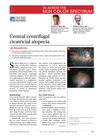
April 2022 in “The Journal of Family Practice” This report describes early and late stages of central centrifugal cicatricial alopecia in two Black women, highlighting progression from a small to a large central patch of hair loss.
5 citations
,
April 2023 in “Life” This review discusses central centrifugal cicatricial alopecia in adolescents, noting varied presentation and highlighting genetic and environmental factors, but reports no new clinical findings.
 46 citations
,
July 2008 in “Dermatologic Therapy”
46 citations
,
July 2008 in “Dermatologic Therapy” This study developed and evaluated a photographic scale to assess CCCA pattern and severity in African American women, finding it reproducible when used by investigators and participants.
 37 citations
,
August 2016 in “Clinical, Cosmetic and Investigational Dermatology”
37 citations
,
August 2016 in “Clinical, Cosmetic and Investigational Dermatology” This article discusses central centrifugal cicatricial alopecia, highlighting its prevalence, potential genetic factors, and management challenges, but reports no new clinical conclusions and calls for further research.
February 2026 in “ACS Applied Materials & Interfaces” This study developed a novel treatment method using carbon dots from Cinnamomum burmannii leaves, which improved hair regeneration and thickness in an AGA mouse model by promoting cell proliferation, angiogenesis, and reducing inflammation through multiple signaling pathways.
September 2017 in “The journal of investigative dermatology. Symposium proceedings/The Journal of investigative dermatology symposium proceedings” This case report suggests that in African-American patients, the histology of Central Centrifugal Cicatricial Alopecia may resemble lichen planopilaris, indicating a potential diagnostic challenge.
 27 citations
,
September 2017 in “Journal of Investigative Dermatology Symposium Proceedings”
27 citations
,
September 2017 in “Journal of Investigative Dermatology Symposium Proceedings” This article discusses central centrifugal cicatricial alopecia, noting its prevalence in women of African descent and highlighting the need for further genetic research to improve treatment options; it reports no new clinical results.
 64 citations
,
June 2014 in “Journal of The American Academy of Dermatology”
64 citations
,
June 2014 in “Journal of The American Academy of Dermatology” This study found that a peripilar white gray halo around hair emergence is a highly specific and sensitive dermatoscopic feature for diagnosing central centrifugal cicatricial alopecia in African American patients with mild central thinning.
1 citations
,
January 2022 in “Clinical Cases in Dermatology” This review discusses central centrifugal cicatricial alopecia, emphasizing its clinical features, potential contributing factors, and treatment options, but does not report new clinical findings.
 June 2001 in “Journal of The American Academy of Dermatology”
 The exam tested knowledge on various skin-related topics for CME credit.
19 citations
,
January 2015 in “Skin appendage disorders” This study identified a new variety of central centrifugal cicatricial alopecia that includes patchy hair loss on the lateral and posterior scalp in African-American women, which could be misdiagnosed as traction alopecia without dermatoscopy and pathology.
 75 citations
,
March 2009 in “Journal of The American Academy of Dermatology”
75 citations
,
March 2009 in “Journal of The American Academy of Dermatology” This review discusses the evolution and ongoing debate about the causes of central centrifugal cicatricial alopecia in African American women, without presenting new clinical findings.
 43 citations
,
August 2016 in “Scientific Reports”
43 citations
,
August 2016 in “Scientific Reports” This animal study found that Cinnamomi cortex water extract reduced prostate weight and improved histological changes in a benign prostatic hyperplasia model, suggesting potential as a treatment.
August 2026 in “Acta Dermato Venereologica” This study found that women with central centrifugal cicatricial alopecia had a substantial prevalence of systemic comorbidities, including strong associations with dyslipidemia, uterine leiomyomas, and anxiety disorders.
September 2017 in “The journal of investigative dermatology. Symposium proceedings/The Journal of investigative dermatology symposium proceedings” This study emphasizes the genetic component of central centrifugal cicatricial alopecia, highlighting an atypical case involving an adolescent male within an African-American family.
 72 citations
,
July 2008 in “Dermatologic Therapy”
72 citations
,
July 2008 in “Dermatologic Therapy” This article reviews central centrifugal cicatricial alopecia in African-descent females, discussing possible causes, associated styling habits, and potential treatments, but reports no new clinical findings; the authors call for further research.
 1 citations
,
July 2014 in “Our Dermatology Online”
1 citations
,
July 2014 in “Our Dermatology Online” This article describes a rare case of alopecia with both scarring and non-scarring features, combining histologic signs of central centrifugal cicatricial alopecia with select immunologic features of alopecia areata.