 March 2025 in “Indian Journal of Dermatology Venereology and Leprology”
 In this study, tofacitinib showed significant efficacy in treating alopecia totalis and universalis over a 6-month period, with notable hair regrowth outcomes, while younger age of onset and shorter treatment duration were linked to less effectiveness.
July 2024 in “Journal of Investigative Dermatology” ITK inhibitors may effectively treat alopecia areata.
 July 2025 in “Russian Journal of Clinical Dermatology and Venereology”
 This paper highlights the emerging trend of treating androgenic alopecia with botulinum toxin, despite insufficient scientific evidence supporting its effectiveness.
12 citations
,
December 2022 in “Current Protein and Peptide Science” This review discusses the molecular mechanisms and clinical applications of thymosin β4, highlighting its potential benefits for inflammation, wound healing, tumor metastasis, and other medical conditions but reports no new experimental results.
 October 2024 in “International Journal of Research in Dermatology”
 In this retrospective study, tofacitinib showed promise as a treatment for alopecia areata, with 46.5% of patients experiencing a very good response and minimal adverse effects, suggesting it could be a primary option for moderate to severe cases.
 October 2025 in “International Journal of Risk & Safety in Medicine”
 In this case study, a 5-year-old girl with alopecia areata and atopic dermatitis that were unresponsive to previous treatments achieved substantial improvement with long-term tofacitinib, highlighting its potential safety and efficacy in managing both conditions concurrently.
 61 citations
,
September 2010 in “Fitoterapia”
61 citations
,
September 2010 in “Fitoterapia” This study found that the EtOAc extract of Tridax procumbens aerial parts significantly inhibited rat paw edema and COX enzyme activity, suggesting its potential anti-inflammatory properties.
 1 citations
,
September 2023 in “Journal of the American Academy of Dermatology”
1 citations
,
September 2023 in “Journal of the American Academy of Dermatology” This study focused on baricitinib's effect on patients with severe alopecia areata, highlighting its efficacy for hair regrowth and its potential to improve health-related quality of life and psychological symptoms, as seen in two phase 3 trials.
13 citations
,
January 2018 in “International Journal of Trichology” In this study, intralesional triamcinolone acetonide injections were associated with halting the progression of frontal fibrosing alopecia in female patients and showed minimal adverse effects, but the efficacy as sole therapy remains unclear pending further trials.
 January 2023 in “Indian Dermatology Online Journal”
 This study found that there was no significant difference in hair regrowth between clobetasol and bimatoprost for scalp alopecia areata over 12 weeks, but bimatoprost had fewer side effects and prompted earlier, more pigmented hair regrowth.
 32 citations
,
July 2017 in “Wiley Interdisciplinary Reviews-Developmental Biology”
32 citations
,
July 2017 in “Wiley Interdisciplinary Reviews-Developmental Biology” This review discusses the emerging roles of transit-amplifying cells in tissue regeneration and cancer formation, highlighting their significance beyond a mere transitional state in hair follicles and the hematopoietic system.
5 citations
,
March 2021 in “Hepatitis Monthly” This study found that tenofovir alafenamide fumarate (TAF) is an effective and safer alternative to tenofovir disoproxil fumarate (TDF) for chronic hepatitis B, with fewer long-term side effects like nephrotoxicity and decreased bone density.
1 citations
,
April 2017 in “Journal of Investigative Dermatology” Abatacept may help some people with alopecia areata regrow hair.
1 citations
,
September 2021 in “Dermatologic Therapy” The researchers reported that intralesional botulinum toxin A effectively alleviated pain associated with cutaneous leiomyomas in a patient with hereditary leiomyomatosis and renal cell cancer syndrome, with repeated treatments every three months maintaining pain relief over 1.5 years.
 August 2020 in “Ugeskrift for Læger”
 This case report describes a 43-year-old male with alopecia totalis who successfully regrew all his hair after six months of treatment with tofacitinib, with no relapse at one year.
January 2026 in “Dermatologic Therapy” This study found that elevated tissue RBP4 levels correlate with disease severity in alopecia areata and decrease after effective baricitinib treatment, while the rs3758539 polymorphism is linked to disease susceptibility but not to treatment response.
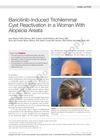
Baricitinib may reactivate trichilemmal cysts in people with a history of these cysts.
January 2026 in “Dermatologic Therapy” In this study, photobiomodulation therapy applied twice weekly for 12 weeks significantly improved hair regrowth and quality of life in alopecia areata patients, with no noted side effects.
October 2024 in “Endocrinology Insights” In this study, researchers found that both the EU-TIRADS and Bethesda systems exhibited high specificity but suboptimal sensitivity for predicting thyroid nodule malignancy in patients who underwent surgery, with Bethesda system showing particularly high specificity in this postoperative population.
17 citations
,
October 2024 in “Journal of the American Academy of Dermatology” In this study, brepocitinib was found to significantly reduce inflammatory biomarker CCL5 expression and improve clinical severity by week 24, while maintaining a favorable safety profile.
 June 2022 in “Value in Health”
 This study estimates that adding baricitinib to a commercial formulary for treating severe alopecia areata would slightly increase the budget by $1,383,345 over five years, with minimal impact per member per month.
 January 2018 in “Journal of the American Academy of Dermatology”
 This letter discusses a previous study on tofacitinib for alopecia areata, questioning its statistical analysis and suggesting that steroids may have influenced results, but it reports no new clinical findings.
 1 citations
,
May 2017 in “Journal of the American Academy of Dermatology”
1 citations
,
May 2017 in “Journal of the American Academy of Dermatology” Tofacitinib helped a teenager with severe hair loss grow hair back, but more research is needed.
1 citations
,
June 2007 in “Journal of Clinical Oncology” This study found that weekly low-dose bicalutamide was safe and appeared to be associated with high-grade PIN remission and favorable PSA modulation in subjects with persistently elevated PSA but negative biopsy.
 December 2025 in “Педиатрическая фармакология”
 In this pediatric retrospective study, tofacitinib (a Janus kinase inhibitor) improved the severity of alopecia and quality of life more effectively than traditional treatment methods, with significant reductions in alopecia severity score and dermatology life quality index over 16 weeks.
July 2022 in “British Journal of Dermatology” October 2025 in “International Journal of Cosmetic Science” This study found that longer-chain cationic surfactants like BTMC provided superior hair conditioning by reducing combing forces, but did not reverse oxidative hair damage, emphasizing the role of molecular structure in surfactant performance.
13 citations
,
September 2014 in “BMC Complementary and Alternative Medicine” Tanshinone IIA helps protect skin tissue from low oxygen damage by boosting certain cell markers.
 September 2023 in “British Journal of Dermatology”
 In this study, researchers identified subgroups of patients with severe alopecia areata treated with baricitinib who experienced early, gradual, or late hair regrowth, finding that response was influenced by baseline disease severity and duration of hair loss.
January 2023 in “JOURNAL OF CLINICAL AND DIAGNOSTIC RESEARCH” In this study, intralesional triamcinolone acetonide 10 mg/mL combined with topical betamethasone dipropionate 0.05% lotion was found to be more effective for treating alopecia areata than either treatment alone.