 June 2024 in “Neuromuscular Disorders”
 In this report, a 58-year-old woman with ocular myasthenia gravis experienced complete resolution of symptoms and hair regrowth after six months of treatment with the JAK inhibitor baricitinib, highlighting a potential new therapeutic approach for this condition.
 May 2024 in “Actas dermo-sifiliográficas/Actas dermo-sifiliográficas”
 This review outlines current treatment strategies for trichotillomania, noting cognitive-behavioral therapy's success, while highlighting the promise and limitations of various pharmacological options.
 February 2024 in “Journal of cutaneous and aesthetic surgery”
 This study reported that platelet-rich plasma therapy combined with intralesional triamcinolone acetonide was beneficial for patients with alopecia totalis, helping them reduce reliance on oral immunosuppressants.

In this study, a 75% ethanol extract of Fructus Psoraleae was found to significantly inhibit 5-α reductase and promote hair growth in mice, indicating its potential as a treatment for androgenetic alopecia through modulation of the Nrf2-Keap1 pathway.
December 2023 in “̒Ulūm-i dārūyī” This review provides a comprehensive examination of the causes and treatments for hirsutism in women, highlighting the role of pharmacological therapies and novel nanotechnology-based methods in improving patient quality of life.
 November 2023 in “Magna Scientia Advanced Research and Reviews”
 The researchers proposed that an epigenetic change in brain androgen receptors caused by finasteride could lead to post finasteride syndrome, while trazodone might reverse this effect by altering the epigenetic expression related to erection and libido.
November 2023 in “Plants” This study evaluated compounds from Jatropha cordata bark, finding that a sterol mixture and n-heptyl ferulate demonstrated notable anti-inflammatory activity in murine macrophage cells without toxicity, suggesting potential for treating chronic inflammation.
 October 2023 in “Russian Journal of Veterinary Pathology”
 This source reviews existing studies on treating canine noninflammatory alopecia, identifying microneedling and oral administration of certain drugs as optimal methods with fewer side effects, while noting that other treatments like mitotane and minoxidil cause serious side effects, limiting their future use.
 October 2023 in “Applied materials today”
 In this study, researchers developed a novel TA-encapsulated microneedle applicator that successfully promoted hair growth and reduced inflammation in a C3H/HeJ mouse model of alopecia areata, potentially offering an improved alternative to existing treatments.
 September 2023 in “Translational medicine reports”
 This case study reported that an 18-year-old woman ingested a large amount of topical minoxidil, leading to symptoms like low blood pressure, increased heart rate, and elevated liver enzymes, but recovered fully after treatment. Minoxidil toxicity may rarely cause abnormal liver enzyme levels.
August 2023 in “Frontiers in Oncology” This review highlights recent advancements in prostate cancer treatments, particularly new drugs targeting signaling pathways and showing promise in clinical trials, but notes the high recurrence rate of castration-resistant cancer post-therapy, requiring ongoing efforts for effective solutions.
 July 2023 in “IntechOpen eBooks”
 This review highlights that alopecia areata, a common type of hair loss, currently lacks preventive or curative treatments, and traditional therapies such as minoxidil and corticosteroids offer inconsistent results, necessitating patient-consensual treatment planning.
 May 2023 in “Journal of medical case reports”
 This case report describes a 6-year-old Middle-Eastern girl with skin lesions, scaling, discoloration, and patchy alopecia, diagnosed with acute granuloma annulare, alopecia areata, and dermatitis. The treatment, including topical minoxidil, betamethasone, and triamcinolone acetonide injections, showed modest effectiveness for alopecia.
 May 2023 in “Journal of drugs in dermatology”
 Most transgender patients getting laser hair removal before gender-affirming surgery are already on hormone therapy, which might affect the hair removal process.
 April 2023 in “Indian journal of paediatric dermatology”
 In this case study, a 12-year-old boy with isolated nail lichen planus showed significant improvement after receiving intramuscular triamcinolone acetonide and topical tacrolimus treatment, although his great toenails were less responsive.
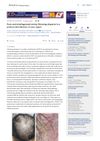 March 2023 in “Journal of Cosmetic Dermatology”
 This case report illustrates that fibrosing alopecia in a pattern distribution may be misdiagnosed as androgenetic alopecia due to similar hair loss patterns, but distinctive trichoscopic and histopathologic features help differentiate it.
 February 2023 in “Archives of Dermatological Research”
 This study found fractional carbon dioxide laser therapy effective in treating alopecia areata, both alone and with topical treatments, suggesting decorin's involvement in improving hair growth.
 January 2023 in “Acta medica Philippina”
 This study found that ethyl acetate extract of Carica papaya flowers exhibited the highest antioxidant and 5α-reductase inhibitory activities, suggesting potential hair growth-promoting properties.
January 2023 in “Odisha Journal of Psychiatry” This case study describes a patient initially misdiagnosed with pediculosis capitis, later identified as having trichotillomania, highlighting the importance of thorough behavioral inquiries by physicians in such cases.
 January 2023 in “Dermatologic Therapy”
 This study suggests that platelet-rich plasma is a safe and effective treatment for alopecia areata, showing superior treatment response compared to triamcinolone acetonide and placebo, with primarily minor side effects.
January 2023 in “Figshare” This meta-analysis found that a combination of clobetasol, hydroxychloroquine, and N-acetylcysteine may be the most effective treatment approach for lichen planopilaris compared to other therapies.
 October 2022 in “Miscellaneous”
 This study documented a case of a 57-year-old woman with postmenopausal virilism due to a Sertoli-Leydig cell tumor, which improved after surgical treatment.
 September 2022 in “JAAD Case Reports”
 In this study, researchers observed that approximately 25% of patients experienced hair loss after COVID-19 infection, with nonscarring alopecia being the most common form.
 July 2022 in “The journal of investigative dermatology/Journal of investigative dermatology”
 This study suggests that particulate matter can induce inflammation in human outer root sheath cells, potentially affecting hair growth, through oxidative stress-dependent MAPK and JAK-STAT signaling pathways.
 July 2022 in “Media Dermato Venereologica Indonesiana”
 In this case study, a 29-year-old man with alopecia areata experienced satisfactory hair regrowth after five months of combined intralesional triamcinolone acetonide and platelet-rich plasma therapy.
 January 2022 in “Clinical dermatology open access journal”
 This study reported rapid hair regrowth in a patient with early-stage alopecia areata after treatment with intralesional triamcinolone acetonide, prednisone, minoxidil, and vitamin C, leading to complete recovery of the bald area within three months.
January 2022 in “Figshare” This study found that inhibiting autophagy in mouse preputial glands alters lipid metabolism, delays aging-related duct changes, and reduces pheromone production, indicating autophagy's critical role in gland homeostasis and cell breakdown during secretion.
 October 2021 in “Meditsinskiy sovet = Medical Council”
 This study found that cyproterone acetate treatment improved quality of life and reduced anxiety and depressive symptoms in women with skin manifestations of hyperandrogenism.

In this study on patchy alopecia areata treatment involving 20 patients, TCA (triamcinolone acetonide) injections showed a significantly better response and minimal side effects compared to superficial cryotherapy.
August 2021 in “Oxford University Press eBooks” This review discusses recent advancements in behavioral and pharmacological treatments for trichotillomania but does not report new clinical results, emphasizing the need for rigorous future research.