380 citations
,
March 2000 in “Proceedings of the National Academy of Sciences” This study demonstrates that mice with ectopic expression of the human GLI-1 gene in their skin developed tumors resembling human basal cell carcinoma, suggesting that GLI-1 is central to tumor development without additional p53 or Ha ras mutations.
333 citations
,
March 2000 in “Proceedings of the National Academy of Sciences” In this study, researchers established that increased expression of the human GLI-1 gene in mouse skin leads to the development of tumors that closely resemble human basal cell carcinomas, without requiring additional mutations in the p53 or Ha ras genes.
133 citations
,
March 1999 in “Journal of Cutaneous Pathology” This study found that keratin 15 expression in trichoepitheliomas and some basal cell carcinomas suggests a link to hair follicle stem cells in the bulge.
54 citations
,
November 1986 in “Journal of the American Academy of Dermatology” This case report identifies a potential new syndrome characterized by trichoepitheliomas and alopecia, which may be associated with myasthenia gravis.
 6 citations
,
July 2015 in “International Journal of Dermatology”
6 citations
,
July 2015 in “International Journal of Dermatology” This study observed that multiple familial trichoepitheliomas commonly presented with a cribriform histopathological tumor pattern, differentiating them from solitary trichoepitheliomas.
5 citations
,
March 2015 in “Indian Journal of Dermatology” This report describes a rare case of multiple trichofolliculomas on the face, which clinically resembled multiple trichoepitheliomas.
1 citations
,
April 2016 in “Journal of the American Academy of Dermatology” Autoimmune conditions can be linked to trichoepitheliomas, with treatment focusing on cosmetic concerns.
August 2026 in “International Journal of Advanced Multidisciplinary Research and Studies” In this case study, a 15-year-old girl with multiple trichoepitheliomas on her face saw a 90% reduction in lesions after combined cryotherapy and topical tretinoin treatment, with no scarring or recurrence over four years.
June 2025 in “British Journal of Dermatology” In this study, researchers describe a rare case of trichoepitheliomas in a 7-year-old boy, characterized by multiple skin lesions in a Blaschko-linear pattern, hypothesizing it as a type 1 segmental mosaicism without detected CYLD gene mutations.
 March 2024 in “IP Indian journal of clinical and experimental dermatology”
 This case report highlighted the rarity and diagnostic challenges of a giant solitary trichoepithelioma occurring on the neck, noting that while typically benign, these tumors can rarely transform malignantly into basal cell carcinoma.
January 2016 in “Dermatology online journal” This case report describes an adolescent female with a linear array of trichoepitheliomas on her left neck, highlighting the clinical presentation of this benign tumor.
87 citations
,
January 1999 in “British Journal of Dermatology” This study found that trichoblastic fibroma and basal cell carcinoma cannot be differentiated by cytokeratin expression patterns, while trichoepithelioma lacks CK7 expression, distinguishing it from the other two neoplasms.
15 citations
,
September 2014 in “PloS one” This study found that HIF1 and mTORC1 signalling were active in both basal cell carcinoma and trichoepithelioma, but the pathways do not reliably differentiate between the two.
May 2025 in “International Journal of Trichology” This study suggests that hair removal lasers, potentially combined with topical minoxidil, may target and treat the underlying mechanisms of trichoepithelioma lesions effectively, though clinical trials are needed to verify this approach.
January 2022 in “Optometric clinical practice” This case report describes a 59-year-old woman with a rare trichoepithelioma on her eyelid, emphasizing the importance for optometrists to differentiate it from basal cell carcinoma.
This article reviews confocal microscopy findings in trichoepithelioma and desmoplastic trichoepithelioma, noting similarities with histological features, but it provides no new clinical results.
January 2002 in “Linchuang pifuke zazhi” This report describes an unusual case of proliferating trichilemmal cyst with trichoepitheliomatous change in a young woman, differing from its typical presentation in elderly women.
 5 citations
,
August 2020 in “Curēus”
5 citations
,
August 2020 in “Curēus” This review systematically analyzed literature to differentiate desmoplastic trichoepitheliomas from other cutaneous tumors based on clinical, histopathological, and immunohistochemical features but reports no new clinical results.
 2 citations
,
February 2009 in “Clinical and Experimental Dermatology”
2 citations
,
February 2009 in “Clinical and Experimental Dermatology” In this case study, a 51-year-old Japanese man was diagnosed with desmoplastic trichoepithelioma after histological examination of surgically excised facial plaques.
October 2025 in “Portuguese Journal of Dermatology and Venereology” In this case report, a 54-year-old woman with a rare desmoplastic trichoepithelioma presented with clinical features resembling basal cell carcinoma, highlighting the importance of histopathological and immunohistochemical analyses for accurate diagnosis.
September 2024 in “Journal of the American Academy of Dermatology” 71 citations
,
February 1992 in “Journal of Cutaneous Pathology” This study found that monoclonal antibodies identified distinct staining patterns in benign and malignant skin appendage tumors, highlighting their potential as markers for analyzing skin tumors.
54 citations
,
September 1999 in “PubMed” This study suggests that immunostaining for Keratin 15 may be a useful tool for differentiating between basal cell carcinoma and trichoepithelioma.
18 citations
,
January 2013 in “Veterinary Dermatology” This study found that K15 is a useful marker for investigating the role of stem cells in canine hair follicle tumours, while nestin is not optimal.
 9 citations
,
January 2017 in “Virchows Archiv”
9 citations
,
January 2017 in “Virchows Archiv” This study documented distinct expression patterns of stem cell markers LGR5 and LGR6 in various human skin tumors, highlighting differences in their potential roles and contributions to tumor development.
8 citations
,
July 2015 in “European journal of histochemistry” This study found that Sox9 was variably expressed in most canine skin neoplasms, particularly in those originating from the hair follicle's bulge region, suggesting its potential as a stem cell marker.
4 citations
,
January 2019 in “Journal of cutaneous pathology” This study found that phospho-S6 is strongly expressed in malignant hair follicle tumors but only patchily in a minority of benign tumors, indicating a potential marker for distinguishing between the two.
 3 citations
,
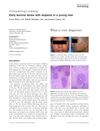
April 2016 in “International Journal of Dermatology”
3 citations
,
April 2016 in “International Journal of Dermatology” This article presents a clinicopathologic challenge involving early leonine facies with alopecia in a young man and reports no new clinical results.
1 citations
,
January 2015 in “Indian Journal of Veterinary Pathology” This report describes cases of trichoblastoma and trichoepithelioma in mixed-breed dogs, highlighting their distinct microscopic characteristics without suggesting broader clinical implications.
 July 2025 in “Clinical Dermatology Review”
 In this case report, researchers observed multiple trichofolliculomas in family members, noting this as a rare manifestation of typically singular hair follicle hamartomas.