1 citations
,
April 2022 in “The Journal of Urology” This study observed that discontinuation rates due to side effects were similar for penicillamine and tiopronin among cystinuria patients, and switching to the alternative agent was beneficial for half of those experiencing issues.
April 2016 in “The journal of investigative dermatology/Journal of investigative dermatology” This study found that applying topical 6% gabapentin twice daily reduced disease activity and scalp pruritus in a patient with lymphocytic cicatricial alopecia, with no adverse effects reported.
8 citations
,
June 2004 in “Journal of Investigative Dermatology” Certain peptides can prevent hair loss in young rats caused by a cancer drug.
July 2026 in “Free Radical Biology and Medicine”  June 2024 in “Archives of Medical Science”
 Telitacicept effectively improved hair regrowth in a woman with lupus and alopecia.
January 2024 in “Case Reports in Endocrinology” In this case report, significant improvements in a 58-year-old male with severe refractory myasthenia gravis and concurrent alopecia areata were observed following a cortisone taper, suggesting a potential therapeutic role, especially after thymectomy.
29 citations
,
July 2008 in “British Journal of Dermatology” This case report examines a patient with myasthenia gravis, invasive thymoma, and paraneoplastic pemphigus associated with alopecia areata, notably without the usual mucosal involvement.
 3 citations
,
September 2022 in “Veterinary Dermatology”
3 citations
,
September 2022 in “Veterinary Dermatology” This study found that 18 mg melatonin implants did not significantly prevent recurrence of canine flank alopecia compared to placebo in dogs, though the treatment was well-tolerated, with no evidence of improved efficacy.
1 citations
,
March 2013 in “Revista de Investigaciones Veterinarias del Perú” This study found that a single application of 0.1% aqueous benzalkonium chloride solution effectively treated dermatomycosis caused by Trichophyton species in guinea pigs.
 1 citations
,
March 2023 in “Science Translational Medicine”
1 citations
,
March 2023 in “Science Translational Medicine” The researchers reported that targeting glycoprotein 130's signaling site in animal models promoted tissue regeneration and reduced osteoarthritis progression through anti-inflammatory and protective effects.
January 2001 in “대한피부과학회지” This study found that oral minipulse therapy with betamethasone may effectively promote hair regrowth in alopecia areata while causing fewer severe side effects compared to traditional pulse therapy.
 2 citations
,
April 2022 in “Research Square (Research Square)”
2 citations
,
April 2022 in “Research Square (Research Square)” This study found that a 1% concentration of thyme oil was more effective at killing Demodex mites in vitro than higher concentrations of tea tree and sage oils, suggesting thyme oil may have therapeutic potential for ocular demodicosis.
 2 citations
,
October 1999 in “Annals of the New York Academy of Sciences”
2 citations
,
October 1999 in “Annals of the New York Academy of Sciences” This article discusses plasma β-endorphin concentrations during natural and artificially induced winter hair growth in mink but reports no new clinical findings.
 3 citations
,
June 1983 in “Archives of Dermatology”
3 citations
,
June 1983 in “Archives of Dermatology” This article discusses the effectiveness of adrenal cortex compounds E and F in treating connective tissue disorders like rheumatoid arthritis and lupus erythematosus, but it reports no new clinical results.
 15 citations
,
June 2019 in “Journal of Neuroendocrinology”
15 citations
,
June 2019 in “Journal of Neuroendocrinology” This study found that isoallopregnanolone reduced stress-induced tic-like behaviors and sensorimotor gating deficits in a mouse model of Tourette syndrome, suggesting potential therapeutic properties comparable to existing treatments like haloperidol and finasteride.
5 citations
,
September 2024 in “Biomolecules and Biomedicine” This study found that total glucosides of paeony (TGP) reduced hair loss and inflammation in alopecia areata mice by inhibiting cellular pyroptosis.
6 citations
,
May 2023 in “Molecules” In this study, dry powder inhalers containing Cepharanthine were administered to rats with acute lung injury, significantly reducing pulmonary edema, hemorrhage, and inflammatory markers, suggesting its potential as an effective anti-inflammatory treatment when inhaled directly into the lungs.
18 citations
,
April 2011 in “Neuropharmacology” This study found that metyrapone and etomidate provide dose-dependent anticonvulsant effects against seizures, with delayed effectiveness linked to increased neurosteroid levels.
5 citations
,
August 2002 in “Veterinary Dermatology” In this study, a combination of terbinafine and mitotane was used to treat a dog with pituitary-dependent hyperadrenocorticism and dermatophytosis, showing regrowth of hair and negative fungal cultures without detectable adverse effects.
 44 citations
,
May 2006 in “The Journal of the American Animal Hospital Association/Journal of the American Animal Hospital Association”
44 citations
,
May 2006 in “The Journal of the American Animal Hospital Association/Journal of the American Animal Hospital Association” This study observed that combination therapy with prednisolone and azathioprine provided similar outcomes to prednisolone alone for treating pemphigus foliaceus in dogs, with over half achieving remission and significant improvement in another 25%.
19 citations
,
January 2009 in “OpenSIUC (Southern Illinois University Carbondale)” This study found that extracts from Calotropis gigantea and Tridax procumbens individually demonstrated greater anti-inflammatory activity than Ibuprofen in a carrageenin-induced paw edema model.
This review discusses recent studies on thymosin β4's effects in wound healing and tissue regeneration, but it does not present new clinical results.
80 citations
,
June 2012 in “European Journal of Pharmaceutics and Biopharmaceutics” This study observed that smaller polymeric submicron particles provided more efficient selective drug delivery to inflamed skin in a mouse model, enhancing therapeutic effects while reducing systemic adverse effects.
 18 citations
,
July 2018 in “Journal of Cosmetic Dermatology”
18 citations
,
July 2018 in “Journal of Cosmetic Dermatology” This study found that microneedling combined with calcipotriol plus betamethasone was more effective in treating vitiligo than microneedling with tacrolimus, particularly in difficult-to-treat areas.
15 citations
,
August 2014 in “Journal of dermatological science” This study found that puerarin, derived from Pueraria thunbergiana, may stimulate melanogenesis and prevent follicular depigmentation in a hair graying mouse model.
 June 2023 in “Small animal advances”
 In this case report, a 2-month-old Chippiparai pup in Puducherry, India, successfully received treatment for concurrent scabies and dermatophytosis using ivermectin, a topical acaricide solution, a dewormer, and an herbal immunostimulant, with no signs of toxicity.
 December 2023 in “Journal of ethnopharmacology”
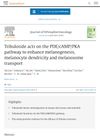
 This study found that tribuloside, a flavonoid from Tribulus terrestris L., enhances melanin production in human melanocytes, zebrafish, and human skin samples without causing toxicity, potentially through inhibiting PDE to increase cAMP levels and promote the melanin biosynthesis pathway.
3 citations
,
January 2025 in “Journal of Natural Products” In this study, researchers isolated new compounds from the plant *Calanthe cardioglossa* and found that five of these compounds, particularly calancardin B, significantly reduced TNF-α levels in immune cells relevant to multiple sclerosis, suggesting potential for immunomodulatory effects.
10 citations
,
April 1964 in “Journal of the American Geriatrics Society” This article reviews triamcinolone acetonide as an intramuscular long-acting steroid therapy for dermatologic disorders but reports no new clinical results.
 15 citations
,
November 1994 in “International Journal of Dermatology”
15 citations
,
November 1994 in “International Journal of Dermatology” This study found that while the combination of oral propranolol and intradermal injections in guinea pigs led to psoriasiform changes, it did not fully mimic psoriasis.