December 2023 in “Frontiers in Medicine” In this study, the researchers found that measuring tacrolimus levels in scalp hair could be a reliable method for monitoring drug exposure in kidney transplant recipients, offering an alternative to frequent blood tests by utilizing self-collected hair samples.
 November 2021 in “International journal of life science and pharma research”
 This study reported that a solid lipid nanoparticle-based gel formulation, specifically optimized for psoriasis, improved drug loading capacity and release properties using high-pressure homogenization, suggesting its potential efficacy as a topical treatment.
 March 2017 in “Fundamental & Clinical Pharmacology”
 This case study reported an improvement in lower limb edema for a patient with type 2 diabetes mellitus after starting dulaglutide treatment, suggesting a potential role of the drug in sodium retention disorders.

This review discusses cyclosporine A's mechanisms of action and side effects compared to tacrolimus in renal transplantation, but it reports no new experimental results; the authors highlight implications for cardiovascular risk management.
 May 2018 in “European Journal of Dermatology”
 Adjusting the medication tacrolimus resolved a boy's red nail beds after a stem cell transplant.
 October 2020 in “Journal of Pharmaceutical Sciences”
 This study found that using gallate-containing formulations like EGCG or tannic acid increased the solubility and controlled release of finasteride in microspheres, enhancing its dermal penetration in pig skin by 10 to 50 times compared to a control.

This review found that antimalarial agents were more effective than steroids for Lichen planopilaris, while finasteride and dutasteride showed favorable impacts on frontal fibrosing alopecia, despite heterogeneous study quality.
 May 2011 in “Dermatología argentina”
 In this case report, a female patient with frontal fibrosing alopecia and lichen scleroatrophicus vulvae experienced excellent results from hair microtransplants combined with finasteride and topical minoxidil, maintained over six years.
 36 citations
,
May 2011 in “Dermatologic therapy”
36 citations
,
May 2011 in “Dermatologic therapy” This review discusses topical and intralesional treatments for alopecia areata, providing a management strategy based on patient age and disease severity, but reports no new clinical results.
 August 2010 in “The Journal of Dermatology”
 The document concludes that low-dose acne treatment is most suitable for moderate acne, with high patient satisfaction and low relapse rates.
 13 citations
,
September 2019 in “Clinical, Cosmetic and Investigational Dermatology”
13 citations
,
September 2019 in “Clinical, Cosmetic and Investigational Dermatology” This review discusses the complex nature of erosive pustular dermatosis of the scalp, highlighting the challenges in diagnosis and management, and reports no new clinical findings.
January 2020 in “JAAD case reports” Systemic mastocytosis may cause a type of hair loss called cicatricial alopecia.
2 citations
,
April 2008 in “Advances in therapy” This report of four pediatric alopecia cases highlights the varied patterns and treatments, noting that differentiating alopecia from trichotillomania is crucial due to their different management approaches.
1 citations
,
January 2022 in “Clinical Cases in Dermatology” This case report describes a 22-year-old Asian man with erosive pustular dermatosis of the scalp, whose lesions improved after treatment with topical tacrolimus and oral isotretinoin.
 May 2024 in “Pigment International”
 In a randomized phase 2b clinical trial, oral ritlecitinib significantly reduced facial vitiligo area scores in patients with active nonsegmental vitiligo compared to placebo, with a favorable safety profile observed over 48 weeks, suggesting its potential as an effective treatment option (Ezzedine et al., 2023).
22 citations
,
January 2012 in “Mediators of inflammation” This review discusses the potential benefits of nonantibiotic macrolides for treating inflammatory skin disorders and reports no new clinical results.
11 citations
,
December 2010 in “American journal of transplantation” This study describes three female islet transplant recipients who unexpectedly developed alopecia areata about 7 years post-transplant, with a possible link to immunosuppressive treatment regimens.
 1 citations
,
December 2022 in “Life”
1 citations
,
December 2022 in “Life” This review systematically analyzed evidence on treatment options for erosive pustular dermatosis, finding that while potent topical steroids like clobetasol propionate can be effective, recurrence is common, and more robust studies are necessary for stronger recommendations.

In this case study, an 80-year-old woman developed lichen planus pigmentosus inversus after receiving multiple intra-articular injections of a homeopathic preparation, suggesting a possible link, though causality remains speculative.
May 2026 in “Case Reports in Dermatology” This case report detailed a 31-year-old kidney transplant recipient who experienced significant hair loss linked to tacrolimus-based immunosuppression, which improved after switching to cyclosporine A, emphasizing the importance of awareness and management of hair-related side effects in transplant patients.
 July 2025 in “Pharmaceuticals”
 In this study, chitosan nanoparticles loaded with phenobarbital were the most effective in promoting hair regrowth and quality in a mouse model of chemotherapy-induced alopecia, suggesting potential for preventing hair loss in cancer patients.
June 2025 in “Frontiers in Medicine” This study observed that omalizumab may induce alopecia, particularly in females aged 18-60, though establishing a direct cause-effect link remains challenging. Alopecia areata was noted as a possible uncommon, yet transient, hair loss type associated with omalizumab.
January 2018 in “Refubium (Universitätsbibliothek der Freien Universität Berlin)” This study demonstrated that combining amorphization and nanonization of drugs enhances both saturation solubility and dissolution rate, potentially offering therapeutic benefits for formulations like dermal applications.
April 2024 in “Cosmetics” This review highlights the use of microneedling devices and patches to deliver cosmetic agents through the skin, noting their applications in skin rejuvenation and safety considerations such as potential skin irritation and infection.
 3 citations
,
January 2018 in “Annals of Dermatology”
3 citations
,
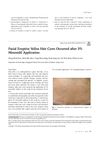
January 2018 in “Annals of Dermatology” A woman developed facial hair cysts after using a 3% minoxidil solution for hair loss, which disappeared after stopping the treatment and removing the cysts surgically.
 9 citations
,
October 2018 in “Elsevier eBooks”
9 citations
,
October 2018 in “Elsevier eBooks” This article discusses how challenges in drug development and success rates are driving a shift in the pharmaceutical industry towards engineering targeted drug delivery systems, with nanomaterials offering potential solutions for selective therapeutic delivery.
 June 2023 in “International Journal of Clinical Research and Reports”
 This study found that higher concentrations of topical diphenylcyclopropenone, especially when prepared with acetone, showed better stability over 6 months compared to lower concentrations.
1 citations
,
December 2022 in “Pharmaceutics” This study found that finasteride-loaded microemulsions using poloxamer 124 significantly enhanced skin penetration of the drug compared to a standard solution, primarily through targeting hair follicles via the transfollicular pathway, with intercluster, intercellular, and transcellular pathways contributing less.

In this nonrandomized controlled study, topical betamethasone dipropionate lotion was found to be significantly more effective for hair regrowth in patients with alopecia areata compared to topical minoxidil solution, with 74% showing efficacy versus 42%, respectively.
 December 2015 in “Dermatologic Therapy”
 This article compares the efficacy of topical tea and zinc sulfate in treating acne rosacea but does not present new clinical results.