11 citations
,
February 2011 in “International Journal of Molecular Sciences” This article reviews sPLA2-mediated phospholipid metabolism using sPLA2 transgenic/knockout mice and lipid mass spectrometry, offering insights into the distinct roles of sPLA2 enzymes in various biological events.
1 citations
,
March 2013 in “Journal of Dermatological Case Reports” This case report describes an atypical presentation of lichen planopilaris affecting only facial vellus hair, without scalp involvement, in a 46-year-old man.
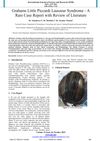 October 2023 in “International Journal of Science and Research (IJSR)”
 This paper describes Grahams Little Piccardi Lassueur Syndrome, a rare type of Lichen Planopilaris that causes different types of alopecia and distinctive skin papules, primarily affecting females aged 40 to 70, and notes the current challenges in treatment options, particularly once scarring occurs.
 April 2023 in “The journal of investigative dermatology/Journal of investigative dermatology”
 This study suggests that the expression and localization of toll-like receptors and caveolin-1 in lichen planopilaris may influence cicatricial alopecia pathobiology and that downregulating caveolae could offer a novel management strategy.
5 citations
,
September 2021 in “Clinical case reports” This case report documents the first known instance of Graham‐Little Piccardi Lassueur Syndrome in Saudi Arabia, observed in an adult dark-skinned male.
11 citations
,
August 2010 in “Annals of plastic surgery” This study found a significant relationship between lash ptosis severity and marginal reflex distance, levator function, and double fold presence in Asian patients, which may inform surgical planning for upper eyelid procedures.
 9 citations
,
July 2010 in “British Journal of Dermatology”
9 citations
,
July 2010 in “British Journal of Dermatology” This article reports on lentiginosis observed within plaques of linear atrophoderma of Moulin and discusses its potential classification as a twin-spotting phenomenon but provides no new clinical research results.
1 citations
,
December 2016 in “Rossijskij žurnal kožnyh i veneričeskih boleznej” This study reported that 80% of patients with non-scarring alopecia showed a clinical cure after treatment with unactivated platelet leukocyte autoplasma.
 16 citations
,
October 2014 in “Journal of the American Academy of Dermatology”
16 citations
,
October 2014 in “Journal of the American Academy of Dermatology” This study found that oral retinoid therapy may provide clinical improvement in a small percentage of patients with treatment-resistant lichen planopilaris, although it is not commonly used as a first-line treatment.
September 2025 in “Development” In this study, deleting the transcriptional pause factor Nelfb in mouse preadipocyte lineages led to defective dermal fat formation and lethal outcomes, while interventions targeting Pparg could rescue adipocyte differentiation and promote dermal white adipose tissue formation, underscoring Nelfb's critical role in adipogenesis.
 March 2024 in “Case Reports in Dermatology”
 This report details a case where diffuse lichen planopilaris and female pattern hair loss in a 32-year-old woman mimicked diffuse alopecia areata, highlighting the diagnostic value of dermoscopy-guided biopsies and the importance of timely treatment to prevent disease progression.
 3 citations
,
August 2019 in “International Journal of Dermatology”
3 citations
,
August 2019 in “International Journal of Dermatology” In this observational study, dermoscopy was found to be a useful tool in diagnosing lichen planopilaris among patients with primary cicatricial alopecia.
 October 2022 in “International journal of medical science and clinical research studies”
 In this study, the combination of Poly-D,L-Lactic Acid and Platelet-Rich Plasma was reported to be effective for improving wrinkle severity and skin brightness in a 45-year-old woman.
 May 2025 in “International Medical Case Reports Journal”
 This case report highlights lichen planus pigmentosus in a 60-year-old man, which was linked to previously undetected hepatitis C infection and liver cirrhosis, suggesting a need for hepatitis C testing in patients with similar dermatological manifestations.
 October 2014 in “Journal of the Portuguese Society of Dermatology and Venereology”
 This paper presents a therapeutic approach with excellent results in a case of lichen planopilaris overlapping with dermatomyositis and scleroderma, although broader applicability is not discussed.
August 2009 in “Mechanisms of Development”  December 2023 in “Journal of General Procedural Dermatology and Venereology Indonesia”
 The abstract highlights that lichen planus can manifest as cicatricial alopecia or lichen planopilaris, while discoid lupus erythematosus, a common form of lupus erythematosus, typically causes scarring alopecia. Results are not reported here.
 43 citations
,
December 2020 in “PLOS Genetics”
43 citations
,
December 2020 in “PLOS Genetics” This study used a new statistical approach, PLACO, to identify several novel shared genetic regions associated with both Type 2 Diabetes and Prostate Cancer in two large GWAS datasets.
4 citations
,
December 2016 in “Blood” This study describes a case of cyclic thrombocytopenia where a novel MPL gene mutation may contribute to the disease, with gene expression changes in platelet and neutrophil genes preceding platelet count fluctuations.
 23 citations
,
December 2013 in “British Journal of Dermatology”
23 citations
,
December 2013 in “British Journal of Dermatology” This study identified a new PNPLA1 mutation in a Spanish family with autosomal recessive congenital ichthyosis.
July 2026 in “Frontiers in Endocrinology” This study observed that beef cattle with certain prolactin receptor gene mutations, known as slick mutations, demonstrated improved post-weaning growth and temperature regulation in a hot, humid climate compared to other genotypes, suggesting genotype influences growth efficiency and heat tolerance.
 May 2024 in “Journal of the Egyptian Women's Dermatologic Society /Journal of the Egyptian Women's Dermatologic Society”
 In this split-scalp study, researchers observed that combining fractional CO2 laser and PRP treatment was significantly more effective in improving hair parameters in women with female pattern hair loss than using each intervention alone or placebo.
4 citations
,
April 2024 in “Clinical Cosmetic and Investigational Dermatology” This review examines the trichoscopic characteristics of scalp DLE and LPP, correlating these findings with histopathological data, but provides no new clinical results.
 23 citations
,
January 2010 in “Journal of The American Academy of Dermatology”
23 citations
,
January 2010 in “Journal of The American Academy of Dermatology” This article discusses the efficacy and safety of mycophenolate mofetil and hydroxychloroquine for treating lichen planopilaris and reports no new clinical results.
 91 citations
,
May 2003 in “American Journal of Pathology”
91 citations
,
May 2003 in “American Journal of Pathology” This study found that prolactin and its receptor are expressed in the murine hair follicle epithelium, influencing hair cycle phases by down-regulating keratinocyte proliferation during anagen and inducing premature catagen.
 November 2022 in “The journal of investigative dermatology/Journal of investigative dermatology”
 In this case study, a 26-year-old female with PLEC mutations and features of muscular dystrophy and myasthenia gravis showed significant improvement in symptoms following steroid treatment.
8 citations
,
June 2004 in “Journal of Investigative Dermatology” Certain peptides can prevent hair loss in young rats caused by a cancer drug.
 November 2021 in “Authorea (Authorea)”
 This case report suggests that platelet-rich plasma and hair transplantation may trigger or worsen the progression of cutaneous pseudolymphoma to lymphoma, particularly in patients with a family history.
20 citations
,
January 2015 in “Biochimica and biophysica acta. Molecular and cell biology of lipids” This review discusses lysophosphatidic acid's role in neuropathic pain and cholestatic itch, highlighting its complex signaling pathways, but reports no new clinical results.
 July 2018 in “Elsevier eBooks”
 This study highlights lichen planopilaris as a form of scarring hair loss with symptoms like shedding and itching, and notes successful treatment options such as topical and oral antiinflammatory medications to preserve hair follicles by early intervention.