 52 citations
,
February 2006 in “Archives of Dermatology”
52 citations
,
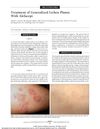
February 2006 in “Archives of Dermatology” This case report describes a 25-year-old woman with widespread lichen planus who did not respond to multiple systemic treatments, including antihistamines, hydroxychloroquine sulfate, and corticosteroids.
24 citations
,
September 2020 in “Pharmaceutics” In this study, solid lipid microparticles loaded with lidocaine hydrochloride were developed to effectively deliver pain relief and antimicrobial benefits for wound management, demonstrated by testing with bioengineered skin substitutes and showing effectiveness against common wound-infecting bacteria.
 28 citations
,
October 1992 in “JEADV. Journal of the European Academy of Dermatology and Venereology/Journal of the European Academy of Dermatology and Venereology”
28 citations
,
October 1992 in “JEADV. Journal of the European Academy of Dermatology and Venereology/Journal of the European Academy of Dermatology and Venereology” In this study, Scalp Immersion Proxigraphy (SIP) was shown to produce more accurate measurements of linear hair growth rate than crude phototrichogram techniques, suggesting SIP's suitability for clinical trials monitoring hair growth.
4 citations
,
February 1983 in “Journal of periodontology” Among young rats, this study found that a liquid protein diet significantly affects body condition but has minimal impact on gingival collagen metabolism.
November 2018 in “Journal of Investigative Dermatology” Lichen Planopilaris causes irreversible hair loss due to immune attacks on hair stem cells, but modulating PPAR-γ might help treat it.
 March 2024 in “Case Reports in Dermatology”
 This report details a case where diffuse lichen planopilaris and female pattern hair loss in a 32-year-old woman mimicked diffuse alopecia areata, highlighting the diagnostic value of dermoscopy-guided biopsies and the importance of timely treatment to prevent disease progression.
1 citations
,
July 2025 in “Journal of Cosmetic Dermatology” This case report suggests that exosome therapy may offer a promising alternative treatment for lichen planopilaris, showing potential benefits in hair regrowth, reduced inflammation, and improved scalp condition, but further studies are needed to confirm long-term efficacy and safety.
26 citations
,
January 2009 in “Annals of Dermatology” This case report describes two instances of rare linear alopecia on the occipital scalp, associated histologically with lupus erythematosus profundus, despite resembling alopecia areata clinically.
 April 2018 in “Journal of Investigative Dermatology”
 In a clinical phase I/IIa study, subcutaneous injections of the peptide FOL-005 increased hair growth by 8% and were safe for treating alopecia.
37 citations
,
January 1986 in “Carcinogenesis” This study found that TPA treatment transiently induces high levels of ODC in mouse epidermal cells, particularly around hair follicles, with localization reduced by retinoic acid or cycloheximide pretreatment.
 October 2023 in “International Journal of Science and Research (IJSR)”
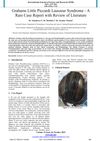
 This paper describes Grahams Little Piccardi Lassueur Syndrome, a rare type of Lichen Planopilaris that causes different types of alopecia and distinctive skin papules, primarily affecting females aged 40 to 70, and notes the current challenges in treatment options, particularly once scarring occurs.
 5 citations
,
September 2018 in “Acta histochemica”
5 citations
,
September 2018 in “Acta histochemica” This study observed that proteins in the mTOR signaling pathway are expressed differently in the hair follicles of patients with lichen planopilaris and frontal fibrosing alopecia, suggesting a role in the pathogenesis of these conditions.
 4 citations
,
July 2024 in “European Archives of Oto-Rhino-Laryngology”
4 citations
,
July 2024 in “European Archives of Oto-Rhino-Laryngology” This study found that platelet-rich plasma injections significantly improved olfactory function in patients with long-lasting postviral olfactory dysfunction, suggesting potential as a therapeutic strategy.
 April 2018 in “Journal of Investigative Dermatology”
 This study suggests that macrophages play a more substantial role in the pathogenesis of Lichen planopilaris compared to Frontal fibrosing alopecia, as indicated by increased CD68+ cells in Lichen planopilaris.
 July 2024 in “Dermatology Practical & Conceptual”
 This article discusses the diagnostic challenges between certain neonatal scalp conditions and highlights the potential of line-field confocal optical coherence tomography to provide detailed, non-invasive skin examination, without presenting new clinical findings.
 5 citations
,
April 2014 in “The American Journal of Dermatopathology”
5 citations
,
April 2014 in “The American Journal of Dermatopathology” This article reports on a typical case of lichen planopilaris with foreign-body granulomas around hair shaft material, suggesting these may be an additional criterion for diagnosing late-stage LPP/FFA.
 June 2019 in “The Medical journal of Basrah University”
 This study found that laparoscopic ovarian drilling effectively decreased LH and testosterone levels, aiding fertility in PCOS patients nonresponsive to certain medications, without negatively impacting ovarian reserve.
33 citations
,
March 2015 in “Experimental Dermatology” In this study, LHX2 and SOX9 were found to mark distinct epithelial progenitor cell populations within human hair follicles, suggesting roles in maintaining the hair follicle epithelium.
 April 2026 in “American Journal of Dermatopathology”
 This study identified a new dermoscopic feature, plexiform erythema, in lichen planopilaris lesions, suggesting it may indicate active disease and the potential need for more aggressive treatment.
 April 2021 in “Journal of Investigative Dermatology”
 This study identified a unique transcriptional signature in occipital hair follicles that may protect them from miniaturization in androgenetic alopecia, using an animal-free model to investigate gene roles.
This study observed that liposomes encapsulating minoxidil and PEP penetrate the skin at a slower rate but may reach deeper layers compared to a foam formulation.
July 2026 in “Journal of Investigative Dermatology”  16 citations
,
October 2014 in “Journal of the American Academy of Dermatology”
16 citations
,
October 2014 in “Journal of the American Academy of Dermatology” This study found that oral retinoid therapy may provide clinical improvement in a small percentage of patients with treatment-resistant lichen planopilaris, although it is not commonly used as a first-line treatment.
1 citations
,
May 2016 in “Aktuelle Dermatologie” This case study reported that a 34-year-old woman with classic lichen planopilaris achieved disease remission after two months of hydroxychloroquine treatment following ineffective corticosteroid therapy.
 April 2018 in “Journal of Investigative Dermatology”
 This study found that the loss of transcription factor Ovol2 in epidermal and hair follicle stem cells leads to migration defects, which are partially improved by deleting the EMT-inducing Zeb1.
161 citations
,
April 2006 in “Journal of Investigative Dermatology” Liposomes with certain properties can effectively deliver drugs deep into hair follicles.
 September 2018 in “Cosmetics”
 This study found that anisotropic osmolyte solutions may improve hair follicle turnover and condition in both in vitro and in silico models, as well as in human volunteers with hair disorders.
7 citations
,
March 2001 in “Journal of the European Academy of Dermatology and Venereology” This case report highlights the complexity of lupus erythematosus/lichen planus overlap syndrome, noting a high potential for progression to systemic lupus erythematosus.
 November 2022 in “The journal of investigative dermatology/Journal of investigative dermatology”
 This study found that cPPARγ and dnPPARγ isoforms are differentially expressed in healthy human skin, suggesting that PPARγ modulators may have compartment-specific effects depending on isoform presence.
 2 citations
,
January 2018 in “Recent clinical techniques, results, and research in wounds”
2 citations
,
January 2018 in “Recent clinical techniques, results, and research in wounds” This review discusses the effects of low-level laser therapy in various biological processes for wound healing and tissue repair and reports no new results.