January 2016 in “대한피부과학회지” This study found that a 0.5-mm microneedle depth was more effective than 0.3 mm for increasing hair density in AGA patients treated with a topical growth factor cocktail.
1 citations
,
June 2023 in “Journal of Visualized Experiments” This study describes a new intravital microscopy method for observing intestinal regeneration by tracking crypt dynamics in living mice after laser-induced tissue damage, revealing events like crypt fission, fusion, and disappearance over multiple weeks.
 1 citations
,
February 2023 in “International journal of research - granthaalayah”
1 citations
,
February 2023 in “International journal of research - granthaalayah” This study reports that electromagnetic energy from a hydrocolloid wound dressing paste adversely affected human skin lipid droplets in vitro, but the implications, including potential cancer links, are unknown.
 1 citations
,
April 2026 in “Aesthetic Plastic Surgery”
1 citations
,
April 2026 in “Aesthetic Plastic Surgery” This study found that radiofrequency microneedling is effective and well-tolerated for improving various skin conditions, showing comparable efficacy to fractional lasers for atrophic acne scars with generally favorable patient satisfaction and safety.
76 citations
,
January 2022 in “Journal of Tissue Engineering” This review summarizes recent progress in microneedle-based drug delivery systems and discusses their potential impact on cellular mechanisms and immunization signaling pathways, highlighting the need for further development in fabrication methods.
17 citations
,
May 2023 in “Pharmaceutics” This review highlights the potential of microneedles for immunotherapy, emphasizing their ability to enhance immune responses and reduce side effects through precise and stimuli-responsive delivery, especially in tumor treatment, while also noting the limitations and areas for improvement in current systems.
April 2026 in “Journal of Drug Delivery Science and Technology” This review highlights the potential of liposomes and nanofibers to enhance wound healing by allowing controlled drug release and supporting natural healing processes, although regulatory challenges remain for their clinical implementation.
January 2001 in “Chinese Journal of Medical Aesthetics and Cosmetology” In this study, the use of micrografts for male pattern hair loss led to natural hair growth and patient satisfaction, despite low hair density and the potential need for multiple procedures.
5 citations
,
October 2023 in “International Wound Journal” In this study, a novel portable LED device significantly accelerated wound healing in rats, with faster wound closure, increased collagen deposition, and more microvessels at a higher radiation intensity, suggesting its potential for innovative wound management.
8 citations
,
March 2022 in “Cancers” This study found that proton minibeam radiotherapy demonstrated a potential tissue-sparing effect in epidermis models by spatially confining DNA damage, suggesting reduced side effects in radiotherapy.
April 2020 in “Rice Research Repository (Rice University)” This study suggests that MultiDomain Peptide hydrogels may support wound healing in diabetic mice by accelerating closure and promoting tissue regeneration, though they did not inhibit bacterial growth in infected wounds as expected.
1 citations
,
January 2023 in “The Egyptian Journal of Hospital Medicine” This study found that combining platelet-rich plasma with microneedling and subcision was effective in treating atrophic acne scars in over 80% of patients with minimal adverse effects.
 4 citations
,
May 2023 in “Composites Part B: Engineering”
4 citations
,
May 2023 in “Composites Part B: Engineering” In this study, a novel nanocomposite hydrogel was developed for diabetic wound care, demonstrating superior tissue adhesion, antibacterial properties, and healing capabilities in vivo and in vitro, while also allowing real-time pH monitoring to aid clinical management.

In a rodent study, a flexible, self-powered triboelectric nanogenerator wound patch combining electrostimulation and photothermal effects was found to efficiently accelerate wound healing and hair follicle regeneration.
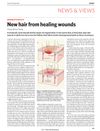
This review discusses the mechanisms regulating wound-induced hair-follicle neogenesis and highlights potential treatments, like Wnt signaling activators, for enhancing this process in humans, yet reports no new clinical results.
 57 citations
,
May 2007 in “Nature”
57 citations
,
May 2007 in “Nature” This study suggests that wounding skin in adult mice can trigger new hair follicle formation, indicating mammalian skin may have greater regenerative capacity than previously thought.
 January 2026 in “RSC Advances”
 The hydrogel helps heal wounds without scars by releasing two drugs gradually.
 March 2008 in “Journal of Clinical Dermatology”
 In this study, micropigmentation of scalp and eyebrow scars showed satisfying cosmetic outcomes in 94% of patients with no complications, as pigments remained stable in the superficial dermis after three weeks.
 8 citations
,
April 1999 in “Dermatologic Clinics”
8 citations
,
April 1999 in “Dermatologic Clinics” This study evaluates if using a dissecting stereomicroscope affects the rate of hair follicle transection during graft dissection, but reports no new conclusive results.
 2 citations
,
March 2023 in “European Polymer Journal”
2 citations
,
March 2023 in “European Polymer Journal” This study developed multifunctional nanofiber wound dressings that significantly reduced bacteria and promoted healing in a mouse wound model by incorporating antibacterial and growth-promoting agents.
 September 2007 in “Hair transplant forum international”
 This commentary discusses patient concerns regarding post-operative appearances after hair transplants and reports no new research findings.
 January 2025 in “Advances in Clinical Medicine”
 This source highlights that fractional CO2 laser, as a minimally invasive technology, shows significant benefits in treating various skin and mucosal conditions by improving therapeutic outcomes, shortening recovery times, and enhancing precise personalized interventions through emerging technologies like AI and biomarker monitoring.
 3 citations
,
December 1987 in “The Journal of Dermatologic Surgery and Oncology”
3 citations
,
December 1987 in “The Journal of Dermatologic Surgery and Oncology” This article discusses reconstructive challenges following Mohs micrographic surgery on the forehead and reports no new clinical results, illustrating techniques applicable to this region.
March 2019 in “SLAS TECHNOLOGY” This study found that MSN-ceria nanomaterial accelerates cutaneous wound healing in rat models by reducing ROS levels and promoting collagen deposition, leading to improved tissue regeneration without significant scarring.
4 citations
,
November 2023 in “Journal of Cosmetic Dermatology” In this study, researchers found that negative pressure fractional microneedle radiofrequency significantly improved periorbital wrinkles, hydration, and dermal thickness in patients with periorbital aging, while also increasing orderly collagen and elastic fibers, with minimal adverse effects reported.
 64 citations
,
May 2019 in “Materials Science and Engineering: C”
64 citations
,
May 2019 in “Materials Science and Engineering: C” This review outlines the development, applications, and challenges of microneedle-based drug delivery from 2000-2019, particularly highlighting fabrication techniques, but reports no new clinical results.
April 2019 in “C&EN global enterprise” In this study, a patch with microneedles regrew hair in shaved mice within six days, suggesting potential for treating hair loss in humans.
26 citations
,
June 2023 in “International Journal of Bioprinting” In this study, an innovative composite hydrogel incorporating methylene blue-loaded nanoparticles was developed for 3D-printed wound dressings, showing improved mechanical properties, excellent antibacterial effects, and enhanced skin healing in mice.
1 citations
,
September 2019 in “Hair transplant forum international” This article introduces a needleless microjet injector using laser pulse energy for tattoo pigments in scalp micropigmentation, highlighting an almost painless procedure without anesthesia.
This review discusses the generally well-tolerated use of PRP and microneedling, detailing mild adverse events like transient pain and rare severe complications such as irreversible blindness, emphasizing the need for proper technique and precautions to prevent these issues.