2 citations
,
January 2014 in “Photochemical & photobiological sciences” This study suggests that the Grasp protein may play a role in regulating skin homeostasis following UVB exposure by influencing p53-mediated apoptotic responses in mice.
 94 citations
,
April 2002 in “The Journal of clinical endocrinology and metabolism/Journal of clinical endocrinology & metabolism”
94 citations
,
April 2002 in “The Journal of clinical endocrinology and metabolism/Journal of clinical endocrinology & metabolism” This study describes the first case of female pseudohermaphroditism due to a novel homozygous glucocorticoid receptor gene mutation, indicating possible pre- and postnatal virilization in affected females.
 49 citations
,
November 2014 in “Journal of Medicinal Food”
49 citations
,
November 2014 in “Journal of Medicinal Food” In this study, red ginseng extract and its ginsenosides enhanced human hair follicle cell proliferation and countered dihydrotestosterone-induced suppression, suggesting potential to promote hair growth.
64 citations
,
August 1977 in “PubMed” This article describes the skin changes seen in acute and chronic graft-vs-host reactions after bone marrow transplantation, highlighting the potential for early recognition due to the visibility of these changes, but reports no new clinical results.
 9 citations
,
January 2011 in “EXPERIMENTAL ANIMALS”
9 citations
,
January 2011 in “EXPERIMENTAL ANIMALS” This study describes a novel hairless mutant rat strain, F344-Hr(krh), developed via ENU mutagenesis, which provides a model for skin disease and potentially focal glomerulosclerosis due to specific genetic mutations.
 January 2024 in “Wiadomości Lekarskie”
 In this study, a child's diagnosis of Silver-Russell syndrome was confirmed through phenotype data, genetic testing, and the exclusion of other developmental conditions, revealing a need for a multidisciplinary care approach.
11 citations
,
December 2021 in “Journal of Ginseng Research/Journal of ginseng research” This review discusses the chemical composition, potential health benefits, and extraction methods of red ginseng oil, and reports no new clinical results but emphasizes safety and proposed molecular mechanisms.
 April 2018 in “Journal of Investigative Dermatology”
 This study found that high skin expression of amphiregulin in acute graft-versus-host disease was associated with severe disease grade, poor overall survival, and increased non-relapse mortality.
February 2023 in “International journal of molecular sciences” This study used infrared spectral imaging to show for the first time the distribution of glypican-4 and glypican-6 in hair follicles across different growth phases, highlighting the potential of this technique for studying alopecia.
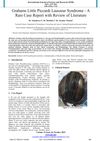 October 2023 in “International Journal of Science and Research (IJSR)”
 This paper describes Grahams Little Piccardi Lassueur Syndrome, a rare type of Lichen Planopilaris that causes different types of alopecia and distinctive skin papules, primarily affecting females aged 40 to 70, and notes the current challenges in treatment options, particularly once scarring occurs.
 October 2024 in “Skin Appendage Disorders”
 This study evaluated the effects of autologous micrografts for androgenetic alopecia, reporting moderate improvements in hair loss reduction and hair density among most patients after treatment, with satisfactory results noted in patient satisfaction and treatment tolerability.

This case series reports favorable outcomes for children with Parry Romberg Syndrome who underwent facial fat-grafting, showing it as a safe and well-tolerated procedure with no complications or relapses observed.
 22 citations
,
August 2013 in “International journal of gynaecology and obstetrics”
22 citations
,
August 2013 in “International journal of gynaecology and obstetrics” This study found that GAGS scores for acne were higher in younger women with PCOS and a lower BMI, but showed no association with levels of androgen hormones.
 October 2024 in “Annals of Dermatology”
 In this in vitro study, red ginseng extract and its main ginsenoside, G-Rb1, were found to protect human hair follicular keratinocytes from oxidative damage, preventing apoptosis, promoting hair growth, and modulating hair cycle transitions by influencing specific cellular signaling pathways.
 16 citations
,
September 2014 in “International Journal of Biological Markers”
16 citations
,
September 2014 in “International Journal of Biological Markers” This study found that the less common CAG-rs4045402 and GGN-rs3138869 polymorphisms were more frequent in patients with post-finasteride syndrome and androgenetic alopecia, suggesting a genetic predisposition to AGA development.
 1 citations
,
September 2021 in “Cureus”
1 citations
,
September 2021 in “Cureus” This study found that the rs1128977 SNP in the RXRG gene may be linked to altered clinical characteristics such as higher HDL-cholesterol levels and increased body mass index in individuals with dyslipidemia.
 April 2024 in “bioRxiv (Cold Spring Harbor Laboratory)”
 In a keratinocyte-specific knockout mouse model, this study found that deleting GRK2 disrupted hair follicle homeostasis, causing cyst-like structures, abnormal growth patterns, and eventual hair loss, suggesting potential links to immune-mediated alopecias.
17 citations
,
April 2006 in “Brain Research” This study found that stimulation with certain neurotransmitters and hormones suggests the involvement of 5α-reduced neurosteroids in glial cell differentiation in rat C6 glioma cells.
 3 citations
,
November 2008 in “Facial Plastic Surgery”
3 citations
,
November 2008 in “Facial Plastic Surgery” This article reviews the unique management skills necessary for building a successful hair restoration surgery team and contrasts them with managing a general cosmetic surgery practice, without reporting new research findings.
 February 2010 in “Journal of The American Academy of Dermatology”
 The document concludes that using gadolinium-based contrast agents during MRI can be linked to Nephrogenic Systemic Fibrosis in patients with severe kidney disease.
 58 citations
,
April 2012 in “Journal of the American Academy of Dermatology”
58 citations
,
April 2012 in “Journal of the American Academy of Dermatology” Graft-versus-host disease is a complication where donor immune cells attack the recipient's body, often affecting the skin, liver, and gastrointestinal tract.
October 2024 in “International Journal of Biological Macromolecules” This review discusses recent advances in extracting, purifying, and analyzing polysaccharides from Ginkgo biloba leaves, which are valued in traditional Chinese medicine for their diverse biological activities, including antioxidant and hair-growth promoting effects, aiming to inform future development and commercialization.
158 citations
,
June 2014 in “Journal of Lipid Research” This review summarizes recent discoveries of GPCRs for lysophosphatidylserine and lysophosphatidylinositol, detailing their roles as lipid mediators, but reports no new experimental results.
 1 citations
,
June 2021 in “bioRxiv (Cold Spring Harbor Laboratory)”
1 citations
,
June 2021 in “bioRxiv (Cold Spring Harbor Laboratory)” This study found that in wild-type Arabidopsis plants, root hair growth is suppressed with increased nutrient availability, with RHD6 subfamily genes down-regulated and GTL1 and DF1 genes influencing root hair morphology under these conditions.
 March 2023 in “Biomedicine & Pharmacotherapy”
 This study found that GPR40 agonists may promote hair growth by inducing angiogenesis via specific molecular pathways in both cell and animal models, suggesting potential for hair loss treatment.
 July 2021 in “Archives of Dermatological Research”
 This study found that serum GPER-1 levels were significantly higher in patients with androgenetic alopecia compared to healthy controls, suggesting a potential role in the condition's pathogenesis, independent of gender.
158 citations
,
January 2003 in “Journal of Forensic Sciences” This study demonstrates that a single exposure to GHB during a sexual assault can be detected by analyzing hair segments collected about one month after the incident.
July 2024 in “Journal of Investigative Dermatology” JW0061 may be a new treatment for hair loss by promoting hair growth through WNT signaling.
September 2023 in “Journal of the American Academy of Dermatology” Guselkumab effectively reduces fatigue in Psoriatic Arthritis patients over two years.
The study found that the combined administration of regulatory T cells and rapamycin improved outcomes in an experimental model of chronic graft-versus-host disease.