3 citations
,
August 2021 in “Nutrition research” This study suggests that estrogen regulates vitamin A metabolism in skin tissues in a sex-dependent manner, which may have implications for treating acne, hair loss, and skin immunity.
 3 citations
,
December 2016 in “Journal of epidemiological research”
3 citations
,
December 2016 in “Journal of epidemiological research” In this study, only European-ancestry females showed a linear increase in cutaneous malignant melanoma risk with age, potentially due to the loss of HPV-infected androgenic follicles after menopause.
 3 citations
,
May 2016 in “Dermatology Online Journal”
3 citations
,
May 2016 in “Dermatology Online Journal” This review discusses chronic telogen effluvium, focusing on the potential role of hormonal fluctuations and circadian control genes, and reports no new clinical findings.
3 citations
,
April 2010 in “The FASEB Journal” This study found that estrogen, through estrogen receptors, can regulate the expression of the HOXC13 gene involved in hair follicle development, with MLL3 histone methylase playing a collaborative role.
 3 citations
,
February 2019 in “Journal of Cosmetic Dermatology”
3 citations
,
February 2019 in “Journal of Cosmetic Dermatology” This summary reviews the conflicting reports regarding 17β‐estradiol's effects on hair follicle growth, highlighting potential estrogen receptor-mediated impacts and calling for further research.
 3 citations
,
December 2011 in “Pediatric Dermatology”
3 citations
,
December 2011 in “Pediatric Dermatology” In this case report, estrogen substitution therapy slightly increased hair volume in a 22-year-old patient with genetic predisposition to hair loss and alopecia caused by past treatment for leukemia, but hair loss returned after stopping the therapy.
1 citations
,
January 2004 in “PubMed” In this study, NGF and minoxidil increased the growth of human hair follicles while 17 beta-E2 inhibited it; NGF also neutralized 17 beta-E2's inhibitory effect.
1 citations
,
July 2024 in “Journal of Plastic Reconstructive & Aesthetic Surgery” In this study, older age was found to predict lateral hairline recession in TGNB AMAB individuals, while each year of feminizing hormone therapy in patients over 30 also predicted a decrease in lateral forehead length by 0.07 cm.
1 citations
,
July 2021 in “Frontiers in Oncology” This study found that patient-reported outcomes were similar between neoadjuvant endocrine therapy and chemotherapy in premenopausal breast cancer patients, but future perspective was significantly better with endocrine therapy.
 1 citations
,
January 2002 in “Journal of Clinical Dermatology”
1 citations
,
January 2002 in “Journal of Clinical Dermatology” This study found that androgen receptors were more prevalent in bald areas compared to non-bald areas in individuals with androgenic alopecia, suggesting a link between increased local androgen activity and hair loss.
 July 2026 in “Journal of Cutaneous and Aesthetic Surgery”
 This review suggests that female and male hair loss patterns differ due to hormonal influences, metabolic factors, and genetic loci, with female pattern hair loss potentially occurring without androgen influence, highlighting the need for distinct clinical management approaches.

This review reports that collagen as a nutraceutical shows promising results for improving skin health in estrogen-deficient women, but more research is needed for scalp hair, nail health, and optimal dosing of curcumin and glutathione.
 December 2025 in “Pakistan Journal of Health Sciences”
 This systematic review found that estrogen deficiency in postmenopausal women leads to structural and symptomatic changes in genital and cutaneous tissues, with local estrogen therapy providing short-term benefits, while evidence for device-based treatments remains limited and requires larger trials.
December 2025 in “International Journal of Innovative Technologies in Social Science” This review suggests that while estrogen-targeted therapies may improve skin quality in postmenopausal women, systemic risks limit hormone replacement therapies, and more research is needed for localized treatments.
 July 2025 in “The Egyptian Journal of Hospital Medicine”
 This study found that serum GPER-1 levels may serve as a biomarker for differentiating androgenetic alopecia from telogen effluvium and healthy controls, although its ability to distinguish between AGA and TE is limited.
 February 2024 in “Hormones”
 This study surveyed individuals seeking estrogen-based gender-affirming hormone therapy, revealing that improving life satisfaction and femininity are top treatment goals, and highlighting the need for trials aligned with community priorities.
 November 2022 in “Journal of the Endocrine Society”
 In this case study, a woman with high 25(OH)D levels and persistent symptoms showed decreased parathormone after transdermal estrogen therapy, highlighting the importance of assessing both parathormone and estrogen levels in similar patients.
April 2016 in “The FASEB Journal” This study found that blocking androgen receptors in male rats during the perinatal period led to permanently increased estrogen and ER-a expression in the hypothalamus, affecting sexual preference in adulthood.
December 2015 in “OPAL (Open@LaTrobe) (La Trobe University)” This study found that estrogen treatment induced premature catagen and apoptosis in hair follicles of wild-type mice, while having no effect on mice lacking estrogen receptor α.
 August 2013 in “Fertility and Sterility”
 This in vitro study suggests that factors in the serum of PCOS patients may contribute to ovarian dysfunction, evidenced by higher hormone production and primordial follicle survival compared to control sera.
 December 2012 in “Journal of Dermatological Science”
 In this study, estradiol was found to increase VEGF expression in cultured dermal papilla cells at physiological levels similar to pregnancy, suggesting that declining estrogen might contribute to female pattern hair loss in older Japanese women.
 August 2009 in “International Journal of Dermatology”
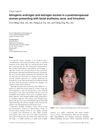
 This case report describes a postmenopausal woman who experienced facial erythema, acne, and hirsutism due to excess androgen and estrogen levels.
In this study, researchers observed that estrogen and its receptors play a crucial role in hair growth and control, with notable sex-dependent differences in human scalp hair follicles.
 March 2026 in “Scientific Reports”
 This study found that Cnidium officinale extract and its compound ferulic acid improved hair growth by promoting dermal papilla cell function and mitochondrial activity, suggesting their potential as a new treatment option for alopecia, possibly through estrogen receptor alpha activation.
February 2026 in “Journal of the American Academy of Dermatology” Estrogen is not recommended for menopausal hair loss due to insufficient evidence.
October 2025 in “Frontiers in Toxicology” This study found that a human relevant potency threshold for estrogen receptor alpha agonism may serve as a health-protective screening tool, and highlights inference performance as essential for scientific confidence frameworks.
October 2025 in “Journal of the Endocrine Society” The researchers reported that individuals with non-alcoholic fatty liver disease and nutritional deficiency often exhibit iron and estrogen deficiencies, which may contribute to liver cell stress and fibrosis.
 July 2025 in “Reproductive Biology and Endocrinology”
 This study found that early postnatal androgen activity affects the long-term expression of hormone receptors differently in female Wistar rats, influencing neural system programming during development.
 August 2024 in “Research Square (Research Square)”
 This study found that women taking 5α-reductase inhibitors (5aRI) for alopecia had a lower risk of breast cancer compared to those not using these medications, with no increased risk of developing ovarian or endometrial cancer.

This study found that a complex extract of Polygonatum sibiricum and Nelumbinis semen improved menopause symptoms in an ovariectomized rat model by enhancing blood lipid metabolism and reducing osteoporosis, without increasing risks of side effects like endometriosis, unlike conventional hormone-replacement therapy.