 May 2017 in “Journal of the American Academy of Dermatology”
 Graves' disease can cause hair loss in children and should be considered when treating pediatric alopecia areata.
3 citations
,
August 2025 in “International Journal of Molecular Sciences” This study found that women with PCOS have significantly higher prevalence and levels of thyroid autoantibodies, with these elevated levels suggesting a potential independent autoimmune activation associated with PCOS.
 15 citations
,
April 2022 in “Ginekologia Polska”
15 citations
,
April 2022 in “Ginekologia Polska” Higher thyroid hormone levels may be linked to certain types of polycystic ovary syndrome.
 6 citations
,
January 2012 in “Annals of Indian Academy of Neurology”
6 citations
,
January 2012 in “Annals of Indian Academy of Neurology” This study found that women with epilepsy on carbamazepine and sodium valproate monotherapy experienced more significant weight gain but showed no difference in PCOS incidence compared to phenytoin users; elevated TSH levels were more common among those on sodium valproate.
November 2023 in “Ibrahim Cardiac Medical Journal” This study observed that patients with alopecia areata have a significantly higher prevalence of thyroid disorders and elevated levels of thyroid-stimulating hormone and thyroid auto-antibodies compared to healthy individuals, with a 4.7 times greater risk of thyroid dysfunction among alopecia areata patients.
1 citations
,
January 2022 in “Open Journal of Endocrine and Metabolic Diseases” This case report describes a 70-year-old woman with pituitary resistance to thyroid hormone (PRTH) misdiagnosed as Graves disease, highlighting diagnostic challenges in managing this rare disorder.
 23 citations
,
March 2009 in “Skin Pharmacology and Physiology”
23 citations
,
March 2009 in “Skin Pharmacology and Physiology” This study found significant hormonal differences, including elevated cortisol and androstenedione levels, in both male and female androgenic hair loss patients compared to controls, suggesting complex hormonal interactions in the condition.
 October 2023 in “Journal of the Endocrine Society”
 This case report describes a unique instance where elevated prolactin levels from a pituitary adenoma were associated with hirsutism due to increased dihydrotestosterone, with treatment leading to normalization.
 October 2024 in “Journal of the Endocrine Society”
 This case report highlights that in severe illnesses like sepsis, myxedema coma can occur with less elevated TSH levels than typical for primary hypothyroidism, likely due to inflammatory cytokines affecting TSH secretion, even when central lesions are absent.
 1 citations
,
August 2024 in “SAR Journal of Pathology and Microbiology”
1 citations
,
August 2024 in “SAR Journal of Pathology and Microbiology” This study observed that among Iraqi women with hirsutism, most had hypothyroidism and elevated hormone levels, particularly DHEAS and testosterone, with acne being the most common associated clinical feature.
June 2026 in “kerbala journal of pharmaceutical sciences” In this case-control study, individuals with alopecia areata showed significantly elevated levels of inflammatory markers IL-4, IFN-γ, and CRP, as well as reduced serum Folate and Ferritin, suggesting the condition's multifactorial pathophysiology involves immune activation, systemic inflammation, and micronutrient deficiencies.
11 citations
,
March 1991 in “PubMed” This study found that in female patients with androgenic hair loss and hirsutism, complex hormonal disturbances include elevated cortisol and thyroid hormone imbalances, rather than elevated androgen levels alone.
 115 citations
,
May 2016 in “Clinical Medicine & Research”
115 citations
,
May 2016 in “Clinical Medicine & Research” This review discusses the complexities of interpreting thyroid function tests, highlighting the challenges primary care providers face due to patient demand and misinformation, but reports no new results.
This study in women aged 28-38 after their first cesarean delivery found higher levels of inflammatory markers and metabolic disturbances, including elevated BMI and blood sugar, which may contribute to increased postpartum hair loss compared to healthy controls.

This study observed that individuals with autoimmune thyroid disease in Georgia had significantly higher frequencies of certain symptoms and Anti-TPO levels compared to controls, with no significant difference in vitamin D levels.
 April 2024 in “DAHUDER Medical journal”
 This study examined the relationship between thyroid autoimmunity and alopecia areata in patients aged 2-65 and found no statistically significant association, despite a notable correlation between anti-TPO levels and disease duration.
October 2024 in “Journal of the Endocrine Society” This case report highlights that macro-TSH, a rare condition causing falsely elevated TSH despite normal thyroid hormone levels, can lead to misdiagnosis and unnecessary treatment; identifying TSH antibodies and fractionation chromatography can prevent incorrect management, as demonstrated in a 19-year-old patient.
 40 citations
,
March 1982 in “British Journal of Dermatology”
40 citations
,
March 1982 in “British Journal of Dermatology” This study found that women experiencing diffuse hair loss had significantly lower levels of plasma sex-hormone binding globulin compared to controls, while their testosterone levels remained normal.
 5 citations
,
July 2020 in “Curēus”
5 citations
,
July 2020 in “Curēus” This case study reports complete beard hair regrowth in a man with beard alopecia areata after six months of treatment with 0.1% triamcinolone acetonide cream.
 July 2025 in “Indus journal of bioscience research.”
 This study found that women with polycystic ovary syndrome showed significant differences in clinical symptoms, hormone levels, and ovarian morphology compared to healthy controls, such as higher body mass index, menstrual irregularities, elevated luteinizing hormone, and polycystic ovarian morphology, suggesting these factors enhance diagnostic accuracy.
March 2025 in “American journal of biochemistry & biotechnology/American journal of biochemistry and biotechnology” This study observed that individuals with hair loss had significantly higher levels of serum galanin, troponin, prolactin, and FSH, and lower levels of TSH, zinc, magnesium, copper, iron, and calcium compared to healthy controls, suggesting a potential role of these biomarkers in hair loss.
13 citations
,
January 2014 in “Journal of Veterinary Internal Medicine” This case study reports an instance of adult-onset primary hypothyroidism with goiter in a cat, suggesting potential causes such as dietary iodine imbalance, chronic exposure to thyrotoxic substances, or a congenital form with late manifestation.
 9 citations
,
June 2014 in “European Journal of Obstetrics & Gynecology and Reproductive Biology”
9 citations
,
June 2014 in “European Journal of Obstetrics & Gynecology and Reproductive Biology” Blood AMH levels are higher in women with PCOS than in those with other similar conditions.
 4 citations
,
January 2015 in “Türk Patoloji Dergisi”
4 citations
,
January 2015 in “Türk Patoloji Dergisi” This review discusses the skin manifestations of endocrine diseases and reports no new clinical findings, emphasizing the importance of recognizing these signs for early diagnosis.
 3 citations
,
November 2020 in “Cleveland Clinic Journal of Medicine”
3 citations
,
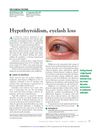
November 2020 in “Cleveland Clinic Journal of Medicine” Eyelash loss can be a sign of thyroid problems.
October 2024 in “Journal of the Endocrine Society” This case report highlights that a patient with resistance to thyroid hormone was misdiagnosed as having Graves’ disease, leading to unnecessary radioactive iodine treatment.
 3 citations
,
January 2013
3 citations
,
January 2013 This chapter discusses hypothyroidism in dogs, highlighting that most cases are due to primary thyroid gland issues and that some breeds may have a hereditary predisposition; it reports no new clinical findings.
1 citations
,
January 2018 in “Indian Journal of Dermatology/Indian journal of dermatology” This report describes cases of transient thyrotoxicosis potentially linked to oral retinoid treatment, suggesting a possible mechanism involving increased iodine uptake by thyroid cells.
 3 citations
,
December 2016 in “PubMed”
3 citations
,
December 2016 in “PubMed” This study found that PCOS patients with menstrual disorders exhibited hormonal changes and higher fasting glucose levels, despite no significant differences in insulin resistance markers.
 1 citations
,
December 2020 in “Harran Üniversitesi týp fakültesi dergisi”
1 citations
,
December 2020 in “Harran Üniversitesi týp fakültesi dergisi” This study suggests that low serum iron and ferritin levels may be associated with telogen effluvium in patients presenting with hair loss.