4 citations
,
July 2023 in “Frontiers in Microbiology” HGF combined with ADA is highly accurate for diagnosing tuberculous pleural effusion, especially in younger females.
164 citations
,
December 1984 in “Proceedings of the National Academy of Sciences” This study found that TCDD significantly reduced EGF receptor binding in various animal models, linked to toxic symptoms like weight loss and developmental delays, with receptor phosphorylation persisting several days.
 September 2024 in “International Journal of Applied Pharmaceutics”
 This study describes a new LC-MS/MS method for analyzing Finasteride and Tadalafil, demonstrating system suitability, linearity, and accuracy in pharmacokinetic studies in rats, aligning with USFDA guidelines.
 24 citations
,
September 2015 in “JAAD case reports”
24 citations
,
September 2015 in “JAAD case reports” This case report describes a patient with frontal fibrosing alopecia experiencing significant hair regrowth and reversal of cutaneous atrophy after treatment with the 5α-reductase inhibitor finasteride.
208 citations
,
November 2000 in “Development” This study found that while Eda and Edar proteins interact in vitro, their roles in dental development differ, with downless mutant mice showing distinct tooth defects compared to tabby mutants.

In this case report, a two-year-old girl with acrodermatitis enteropathica was misdiagnosed for over a year before low serum zinc levels led to the correct diagnosis, and her skin lesions resolved completely after two weeks of zinc sulfate treatment.
February 2010 in “Faculty Opinions – Post-Publication Peer Review of the Biomedical Literature” Finasteride can cause skin reactions, so dermatologists should be aware.
 March 2026 in “Clinical Cosmetic and Investigational Dermatology”
 In this case study, treatment with the selective JAK1 inhibitor upadacitinib significantly improved symptoms in a patient with refractory alopecia areata, vitiligo, ankylosing spondylitis, and allergic asthma-nasal syndrome, though a transient liver function abnormality was noted.
9 citations
,
June 2020 in “Trials” This study aims to conduct the first double-blind randomized trial comparing spironolactone and doxycycline for female acne treatment, with the goal of establishing spironolactone as a potentially superior alternative, especially given concerns about antibiotic resistance.
 3 citations
,
June 1983 in “Archives of Dermatology”
3 citations
,
June 1983 in “Archives of Dermatology” This article discusses the effectiveness of adrenal cortex compounds E and F in treating connective tissue disorders like rheumatoid arthritis and lupus erythematosus, but it reports no new clinical results.
November 2021 in “SPAST Abstracts” In this study, EFH-SLM cream demonstrated greater efficiency in reducing hair density compared to plain EFH cream in Swiss albino female mice, with significantly less skin irritation and inflammation observed, suggesting improved permeability and effectiveness of EFH when using the new cream formulation.
2 citations
,
January 2016 in “Dermatology online journal” This case report describes a 46-year-old man diagnosed with frontal fibrosing alopecia, a condition primarily affecting postmenopausal women, highlighting its rare occurrence in men.
 16 citations
,
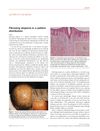
February 2010 in “Journal of the European Academy of Dermatology and Venereology”
16 citations
,
February 2010 in “Journal of the European Academy of Dermatology and Venereology” This article is a letter to the editor about fibrosing alopecia in a pattern distribution and reports no new research findings.
 September 2023 in “Acta dermato-venereologica”
 This study observed that oral tofacitinib was effective and safe for treating alopecia areata in paediatric patients, with 82% of pre-adolescent participants experiencing hair regrowth and 64% showing significant improvement in their hair loss severity scores.
12 citations
,
January 2016 in “Journal of clinical biochemistry and nutrition” In this study, combining deferasirox with sorafenib significantly reduced liver fibrosis and preneoplastic lesions in rats while also lessening adverse effects compared to sorafenib alone.
169 citations
,
September 2002 in “British journal of dermatology/British journal of dermatology, Supplement” This study reports that ZD1839 (Iressa), an anticancer drug, was associated with acneiform eruptions and hair growth abnormalities due to its inhibition of epidermal growth factor receptor signaling in the skin.
 15 citations
,
January 2014 in “Medicinal chemistry”
15 citations
,
January 2014 in “Medicinal chemistry” This study conducted molecular docking and ADME property analysis on 144 newly designed isatin analogs, suggesting they exhibit lead-like properties for targeting EGFR enzymes.
1 citations
,
March 2009 in “The Journal of Urology” This review discusses trials on therapies for benign prostatic hyperplasia and reports that combination treatment is more effective than monotherapy for symptom relief and slowing disease progression in men with moderate to severe symptoms and enlarged prostate glands.
January 2007 in “Frontiers in Medicine” This study found that tofacitinib was an effective and better-tolerated treatment for moderate-to-severe AA compared to SCs, though its efficacy decreased in patients with disease episodes longer than two years.
June 2026 in “Advanced Healthcare Materials” This study found that engineered extracellular vesicles (293F-EGF-EV), enriched in EGF mRNA, significantly aided skin wound healing in vitro and in a rat model by promoting fibroblast activity and improving wound recovery through processes like angiogenesis and reduced scarring.
2 citations
,
July 2022 in “Sexual Medicine” This study found that 5-α reductase inhibitors and neuropsychiatric medications were most frequently reported for erectile dysfunction in a national pharmacovigilance database from 2010 to 2020.
 April 2012 in “Informa Healthcare eBooks”
 Fibrosing alopecia in a pattern distribution is a unique hair loss condition with inflammation and scarring, resembling but distinct from common balding.
7 citations
,
September 1997 in “PubMed” This study found that Finasteride treatment significantly reduced dihydrotestosterone and epidermal growth factor levels in benign prostatic hyperplasia tissue, particularly in the periurethral zone, while Flutamide decreased epidermal growth factor but not dihydrotestosterone.
5 citations
,
November 2015 in “Journal of Enzyme Inhibition and Medicinal Chemistry” This study found that aliphatic ester moieties in 16-formyl-17-methoxy dehydroepiandrosterone derivatives increased their potency as 5α-reductase type 2 inhibitors in vitro compared to finasteride.
3 citations
,
January 1993 in “Toxicological Sciences” This study found that 2-ethylhexanoic acid impaired fertility in Wistar rats and delayed postnatal development of pups, suggesting potential reproductive toxicity at certain dosages.
 7 citations
,
April 2009 in “Bioorganic & Medicinal Chemistry Letters”
7 citations
,
April 2009 in “Bioorganic & Medicinal Chemistry Letters” Diphenyl ethers can potentially reduce excess oil production when applied on the skin, helping treat conditions like acne.
 39 citations
,
January 2019 in “Journal of the American Academy of Dermatology”
39 citations
,
January 2019 in “Journal of the American Academy of Dermatology” In this study, three children with severe alopecia treated with systemic tofacitinib showed significant hair regrowth, suggesting it may be a potential option for those unresponsive to conventional therapy.
31 citations
,
March 1963 in “American journal of diseases of children” This report details a case of acrodermatitis enteropathica in a 4-month-old infant, noting the disorder's rarity and familial transmission, and includes a literature review with no new clinical results.
 April 2020 in “Journal of evolution of medical and dental sciences”
 This report reviews the clinical presentation and genetic aspects of a case of acrodermatitis enteropathica in a one-year-old child but provides no new clinical findings.
4 citations
,
September 2021 in “Sensors” In this study, LED therapy for eyebrow loss in older females with frontal fibrosing alopecia significantly increased eyebrow hair count after 10 treatments and maintained improvement at 6 months, indicating it could be a promising and well-tolerated treatment option.