121 citations
,
December 2001 in “American Journal of Dermatopathology” This study found that trichoblastomas and nodular basal cell carcinomas have similar cytokeratin expression patterns, indicating differentiation towards the outer root sheath epithelium.
54 citations
,
May 1999 in “Journal of Cutaneous Pathology” This study reports various immunophenotypical patterns in apocrine mixed skin tumors, resembling the structures of hair follicles, sebaceous glands, and apocrine glands.
107 citations
,
May 1999 in “Archives of Dermatological Research” In this study, the immunohistochemical and lectin binding profiles of basal cell carcinoma closely resembled those of the outer root sheath of vellus hair follicles, suggesting a potential histochemical relationship.
 8 citations
,
August 2007 in “Histopathology”
8 citations
,
August 2007 in “Histopathology” This article discusses the kinetic and topographical heterogeneity in follicular thyroid neoplasms and reports no new research findings; the authors emphasize understanding diverse growth patterns.
 5 citations
,
September 2017 in “Medicine”
5 citations
,
September 2017 in “Medicine” In this case report, a patient with Cronkhite-Canada Syndrome developed colon cancer and liver metastasis despite hormone therapy, highlighting the need for regular monitoring and early detection strategies.
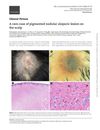
This study reported the case of a 30-year-old man with a bluish-grey scalp nodule that developed over a previously stable hairless plaque, revealing histopathological features consistent with epithelioid cell nests and spindle-shaped dermal melanocytes embedded in collagen.
 80 citations
,
June 2000 in “Modern Pathology”
80 citations
,
June 2000 in “Modern Pathology” Long-standing benign tumors can become cancerous, especially in people with weakened immune systems.
 551 citations
,
November 2013 in “Nature”
551 citations
,
November 2013 in “Nature” This study found that differentiated airway epithelial cells can revert into functional stem cells in vivo, suggesting a more general role for this dedifferentiation process in tissue regeneration in higher vertebrates.
 49 citations
,
August 2004 in “The FASEB Journal”
49 citations
,
August 2004 in “The FASEB Journal” This study found that transgenic mice expressing human keratin K8 in the epidermis showed increased progression of skin lesions toward malignancy, suggesting a role for K8 in the development of invasive skin cancer.
 38 citations
,
January 2006 in “Journal of Cellular Biochemistry”
38 citations
,
January 2006 in “Journal of Cellular Biochemistry” This study reported the successful isolation of epithelial stem cells from mouse embryonic skin using a simple culture method, with the cells showing the potential to differentiate into multiple cell types.
 29 citations
,
February 2013 in “Proceedings of the National Academy of Sciences of the United States of America”
29 citations
,
February 2013 in “Proceedings of the National Academy of Sciences of the United States of America” This study found that Merkel cell clusters require Frizzled6 signaling for their polarity information, while other hair follicle-associated structures align their orientation based on the hair follicle itself.
 15 citations
,
September 2007 in “Cell & tissue research/Cell and tissue research”
15 citations
,
September 2007 in “Cell & tissue research/Cell and tissue research” This study suggests that human embryonic stem cells may improve skin graft quality and functionality by enabling the identification and amplification of early ectodermal progenitors, pending confirmation from preclinical studies.
 14 citations
,
October 2015 in “PLoS ONE”
14 citations
,
October 2015 in “PLoS ONE” This study found that keratins 5, 7, 8, and 19 are expressed in human trophoblast cells while vimentin is solely expressed in stromal-mesenchymal cells, aiding in placental cell type identification.
 13 citations
,
June 2018 in “Dermatopathology”
13 citations
,
June 2018 in “Dermatopathology” This classification proposal introduces a novel system for categorizing cutaneous adnexal cysts based on their origin in the folliculosebaceous unit and sweat glands, aiming to simplify and enhance understanding of these skin lesions.
 1 citations
,
November 2024 in “Romanian Journal of Morphology and Embryology”
1 citations
,
November 2024 in “Romanian Journal of Morphology and Embryology” This overview examines the biology, origin, structure, and function of various cells and structures, such as the blood-retinal barrier and Merkel cells, and discusses their roles in disease pathogenesis, along with recent findings related to the lymph nodes' paracortex.
 December 2025 in “Doğu Fen Bilimleri Dergisi”
 In this study, researchers found that the expression of vimentin, desmin, and laminin in rat skin contributes to cell structure and tissue integrity, with varying reactions across different cell types.
 October 2024 in “Frontiers in Oncology”
 This review examines the potential of K18 as a diagnostic and prognostic marker in epithelial-derived tumors, highlighting its specific expression in tumor tissues and interaction with proteins involved in tumor progression, without reporting new clinical findings.
 April 2018 in “The journal of investigative dermatology/Journal of investigative dermatology”
 This study found that electrical epilation in organ-cultured human scalp skin perturbs hair follicles by causing inflammation, impairing melanin production, and possibly inhibiting post-epilation hair re-growth.
 April 2018 in “Journal of Investigative Dermatology”
 This article proposes a new classification system for cutaneous adnexal cysts based on their origin in the folliculo-sebaceous unit and sweat glands, aiming to clarify their categorization and origins.
 April 2018 in “Journal of Investigative Dermatology”
 This study identified the osteopontin-derived peptide, FOL-005, as a potential inhibitor of unwanted human hair growth by promoting catagen development without reducing stem cell numbers or showing toxicity.
 April 2018 in “The journal of investigative dermatology/Journal of investigative dermatology”
 This study observed that in an ex vivo setting, 17β-estradiol increased CB1 expression in human hair follicles, suggesting possible sensitivity to endocannabinoids and a potential mechanism for hair therapy.
 April 2018 in “The journal of investigative dermatology/Journal of investigative dermatology”
 The authors concluded that Lrig1-positive stem cells are essential for sebaceous gland formation in mice, as their ablation led to temporary sebaceous gland disappearance without affecting hair growth.
 51 citations
,
October 2002 in “British Journal of Dermatology”
51 citations
,
October 2002 in “British Journal of Dermatology” Finasteride increases hair density in female androgenetic alopecia, but individual results may vary.
 16 citations
,
January 2006 in “The Aging Male”
16 citations
,
January 2006 in “The Aging Male” This review discusses various skin diseases with endocrinological origins and reports no clinical results, highlighting the need for interdisciplinary understanding in diagnosis.
 8 citations
,
November 2020 in “Nature Communications”
8 citations
,
November 2020 in “Nature Communications” This study demonstrates that Tp63-expressing epithelial stem cells from non-skin tissues can respond to skin morphogenetic signals and contribute to the formation of hair follicles, sebaceous glands, and epidermis.
 5 citations
,
January 2021 in “Biomedicine & Pharmacotherapy”
5 citations
,
January 2021 in “Biomedicine & Pharmacotherapy” This study suggests that policosanol may prevent androgenetic alopecia in mice by regulating hormone levels and suppressing premature hair follicle entry into the regression phase.
19 citations
,
January 2015 in “Development” This study found that misexpression of Hoxc8 in mice led to ectopic mammary development and suggests Hox genes may play crucial roles in the regional specification and initiation of cutaneous accessory organs.
 July 2023 in “British journal of dermatology/British journal of dermatology, Supplement”
 This study found that the E6 gene, but not E7, was responsible for HPV8-induced expansion of keratinocyte stem cells in hair follicle junctional zones in mice.
3 citations
,
August 2018 in “Journal of Structural Biology” KAP8.1 protein is crucial for hair structure and interacts with keratin 85.
75 citations
,
October 1999 in “Differentiation” This study suggests that mouse keratin 6 isoforms, K6a and K6b, have overlapping but distinct expression profiles, differing notably in their expression in suprabasal cells and response to phorbol esters.