 5 citations
,
December 2021 in “Journal of Investigative Dermatology”
5 citations
,
December 2021 in “Journal of Investigative Dermatology” This study observed that Hedgehog signaling in reticular and papillary fibroblast lineages plays different roles in wound repair and de novo hair follicle formation.
488 citations
,
July 2021 in “Cell” This review discusses the development, lineages, functions, and roles of fibroblasts in fibrosis across four organs, highlighting their capabilities in tissue repair and contributions to fibrotic disorders when aberrantly activated, but it reports no new experimental findings.
 6 citations
,
June 2021 in “Developmental biology”
6 citations
,
June 2021 in “Developmental biology” This study found that dermal EZH2 plays a crucial role in controlling fibroblast differentiation by regulating Wnt/β-catenin and retinoic acid signaling during skin development.
 145 citations
,
November 2018 in “Nature Communications”
145 citations
,
November 2018 in “Nature Communications” This study found that activating the Sonic hedgehog pathway in scarring wounds can remodel the dermis to promote hair follicle regeneration, highlighting a potential new approach to enhance healing.
 4 citations
,
October 2018 in “Cell Stem Cell”
4 citations
,
October 2018 in “Cell Stem Cell” This study shows that differences in Hoxc gene expression in hair follicle mesenchyme along the body axis contribute to regional variations in mammalian hair growth.
 43 citations
,
August 2018 in “Cell Stem Cell”
43 citations
,
August 2018 in “Cell Stem Cell” This study found that Hoxc gene expression can reprogram mesenchymal dermal papilla cells, enhance epithelial stem cell regenerative potential, and promote region-specific hair follicle regeneration through Wnt signaling.
85 citations
,
January 2018 in “Cell stem cell” This study found that synchronized signals in the microenvironment regulate stem cell lineage choices in hair follicles by influencing chromatin dynamics during regeneration.
 115 citations
,
December 2017 in “Wiley Interdisciplinary Reviews-Developmental Biology”
115 citations
,
December 2017 in “Wiley Interdisciplinary Reviews-Developmental Biology” This review discusses the origins, differentiation, and function of dermal fibroblasts in skin development and healing, reporting no new clinical results.
 149 citations
,
July 2017 in “PLoS Biology”
149 citations
,
July 2017 in “PLoS Biology” This study found that hair follicle patterning in development may arise from a combination of epidermal prepattern signals and mesenchymal self-organisation, with fibroblast growth factor and bone morphogenetic protein activities playing key roles.
 408 citations
,
January 2017 in “Science”
408 citations
,
January 2017 in “Science” This study found that hair follicles in mice and humans can convert wound-related myofibroblasts into adipocytes, suggesting a potential pathway to reduce scar formation by activating BMP signaling.
 23 citations
,
April 2016 in “American Journal of Pathology”
23 citations
,
April 2016 in “American Journal of Pathology” The research suggests that a specific skin gene can be controlled by signals within and between cells and is wrongly activated in certain skin diseases.
 82 citations
,
March 2016 in “Cell”
82 citations
,
March 2016 in “Cell” This review highlights various methods of stem cell communication that reflect the unique organization and function of different tissues and reports no new results.
 87 citations
,
January 2016 in “Development”
87 citations
,
January 2016 in “Development” This study suggests that the postnatal loss of hair follicle formation in wounds may be due to elevated Wnt/β-catenin activation in the dermis, affecting fibroblast function in mice.
 321 citations
,
March 2015 in “Nature”
321 citations
,
March 2015 in “Nature” This study found that super-enhancers are essential for hair follicle stem cell identity, lineage commitment, and plasticity in mice, with SOX9 being a key regulator of these chromatin dynamics.
1235 citations
,
December 2013 in “Nature” This study found that skin fibroblasts in mice arise from two distinct lineages which contribute differently to dermal structure and repair, impacting hair follicle formation during wound healing.
 170 citations
,
July 2012 in “Journal of Investigative Dermatology”
170 citations
,
July 2012 in “Journal of Investigative Dermatology” In this study, researchers showed that Wnt ligands secreted by hair follicle epithelium are crucial for hair follicle regeneration and may be significant for treating hair disorders like alopecia.
 207 citations
,
March 2012 in “Development”
207 citations
,
March 2012 in “Development” In this mouse study, researchers found that dermal Wnt signaling/β-catenin activity is essential for fibroblast proliferation and initiating hair follicle formation by interacting with epidermal Wnt ligands.
86 citations
,
February 2012 in “Journal of Clinical Investigation” This review discusses recent advances in understanding hair follicle stem cell dynamics and interactions, but it reports no new experimental findings.
193 citations
,
May 2008 in “Development” This study found that activating β-catenin signaling in embryonic epidermis promoted hair follicle characteristics at the expense of normal epidermal differentiation, leading to early pigmentation and innervation.
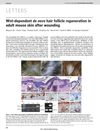 829 citations
,
May 2007 in “Nature”
829 citations
,
May 2007 in “Nature” Hair follicles can regrow in wounded adult mouse skin using a process like embryo development.
854 citations
,
February 2002 in “The journal of investigative dermatology/Journal of investigative dermatology” This review summarizes recent advances in understanding the molecular mechanisms of hair follicle formation and discusses potential future clinical applications for treating hair loss and skin tumors, but it reports no new clinical results.
92 citations
,
April 1999 in “The journal of investigative dermatology/Journal of investigative dermatology” This study suggests that keratin 9 expression in nonpalmoplantar keratinocytes can be induced by signals from palmoplantar fibroblasts, potentially enabling the use of nonpalmoplantar epidermis to treat palmoplantar wounds.
125 citations
,
August 1992 in “Development” This study found that implanting isolated adult rat dermal papillae into ear cuts led to the emergence of unusually large vibrissa-type hair follicles, demonstrating their capacity to induce specific hair fiber characteristics.
745 citations
,
February 1992 in “Trends in genetics” This article describes the potential role of various growth factors and molecules in regulating mammalian hair follicle development but does not present new experimental results.