 21 citations
,
May 2022 in “Frontiers in Cell and Developmental Biology”
21 citations
,
May 2022 in “Frontiers in Cell and Developmental Biology” This review covers the structure, development, cycle, and molecular regulation of hair follicles but does not report new results, aiming to offer insights for addressing hair follicle-related diseases.
2 citations
,
February 2022 in “Genomics” This study used cashmere goats to map the differentiation of dermal papilla stem cells and identified key intermediate cell states involved in hair follicle regeneration.
 12 citations
,
December 2020 in “Archives animal breeding/Archiv für Tierzucht”
12 citations
,
December 2020 in “Archives animal breeding/Archiv für Tierzucht” This study found that EDA and EDAR are expressed throughout cashmere goat fetal development and play a critical role in hair follicle formation by influencing gene expression in fibroblasts and epithelial cells.
 25 citations
,
February 2019 in “Genomics”
25 citations
,
February 2019 in “Genomics” This study reports that milk goats exhibit significantly more differentially expressed genes related to hair follicle cycling across different months compared to cashmere goats, especially in December.
 33 citations
,
January 2018 in “International Journal of Biological Sciences”
33 citations
,
January 2018 in “International Journal of Biological Sciences” This study demonstrates the use of the CRISPR-Cas9 system to successfully edit the EDAR gene in Cashmere goats, resulting in goats with distinct hair follicle characteristics.
33 citations
,
December 2017 in “Saudi Journal of Biological Sciences” In this study, researchers found that microRNAs in the oar-let-7 and oar-miR-200 families were significantly up-regulated during critical fetal periods of cashmere goat hair follicle development, suggesting their role in this process.
18 citations
,
March 2016 in “Journal of Investigative Dermatology” This study found that calbindin-D9k knockout mice on a maternal vitamin D-deficient and low-calcium diet developed transient alopecia, but a high-vitamin D and calcium diet in mothers reduced this effect.
 223 citations
,
January 2014 in “International Journal of Molecular Sciences”
223 citations
,
January 2014 in “International Journal of Molecular Sciences” This article reviews the complex signaling pathways between epithelial and mesenchymal cells crucial for hair follicle morphogenesis, highlighting the Wnt pathway's role as a master regulator without reporting new experimental findings.
72 citations
,
January 2012 in “Annals of Dermatology” In this study, IGF-I was shown to enhance human hair follicle growth, maintain the anagen phase, and increase expression of certain growth factors and anti-apoptotic markers.
117 citations
,
April 2008 in “Developmental biology” This study identified that Eda-A1 unexpectedly induces placode inhibitors dkk4 and lrp4, indicating the importance of tightly regulated signaling for proper ectodermal organ development.
 829 citations
,
May 2007 in “Nature”
829 citations
,
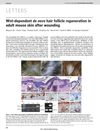
May 2007 in “Nature” Hair follicles can regrow in wounded adult mouse skin using a process like embryo development.
43 citations
,
December 2006 in “The American journal of pathology” This study found that Edar signaling plays a role in regulating the hair cycle and apoptosis in hair follicle keratinocytes during the catagen phase in mice.
57 citations
,
August 2002 in “American Journal Of Pathology” Cathepsin L deficiency causes hair and skin issues in mice.