 829 citations
,
May 2007 in “Nature”
829 citations
,
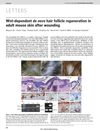
May 2007 in “Nature” Hair follicles can regrow in wounded adult mouse skin using a process like embryo development.
December 2020 in “Faculty Opinions – Post-Publication Peer Review of the Biomedical Literature” The KDM1 gene helps Venus flytraps close by managing potassium ions.
 4 citations
,
April 2018 in “Biotechnology Letters”
4 citations
,
April 2018 in “Biotechnology Letters” Human growth factor 20 can boost mouse whisker growth.
 January 2025 in “Cell Communication and Signaling”
 This study reviews the role of the zinc finger protein CXXC5 in cellular signaling and its implications for cancer, discussing how its dysregulation is linked to various physiological and pathological processes, as well as potential therapies targeting CXXC5.

This study observed that activating the Wnt/β-catenin pathway enhances hair follicle stem cell proliferation and differentiation, promoting hair growth and wound healing, and demonstrated the potential for outer root sheath transplants to aid skin repair, although challenges remain for clinical application.
 October 2023 in “Cell & bioscience”
 This study identified a primitive coarse wool characteristic in Merino sheep that enhances environmental adaptability and fine wool yield without reducing quality, suggesting that epigenetic mechanisms, particularly involving the imprinted Gtl2-miRNAs locus, regulate this advantageous trait.
 August 2023 in “bioRxiv (Cold Spring Harbor Laboratory)”
 This study found that maintaining a low level of Wnt/β-catenin activity is crucial for mammary gland development, as excessive activity inhibits branching and promotes characteristics of hair follicles instead, highlighting its role in skin appendage identity decisions.
25 citations
,
March 2022 in “International journal of biological macromolecules” This study found that exosomal miR-181a-5p promotes hair follicle growth and development in vitro by activating the Wnt/β-catenin signaling pathway and suppressing hair follicle stem cell apoptosis.
11 citations
,
December 2024 in “Wound Repair and Regeneration” In this study, researchers created the WRAHPS Guidelines to standardize the reporting of preclinical wound healing studies, aiming to improve transparency, enable comparative analysis, and support the development of human clinical trials for wound healing disorders.
February 2026 in “Small Ruminant Research” This study found that specific genetic variations in the IRF2BP2 gene influence fleece structure in sheep, with one variant completely determining coat type and another significantly modifying fiber characteristics, providing valuable insights for improving fleece quality through selective breeding.
 1 citations
,
August 2021 in “Canadian journal of neurological sciences”
1 citations
,
August 2021 in “Canadian journal of neurological sciences” This article offers HTML content and a downloadable PDF but does not provide an abstract or new findings for summary.
December 2009 in “Cancer Research” This study suggests that over-expression of Sp2 may limit stem cell differentiation and contribute to tumorigenic cell growth in mice.
 November 2023 in “The journal of investigative dermatology/Journal of investigative dermatology”
 In this study, mice lacking the Mcpip1 gene in their myeloid cells did not develop SCC-like tumors but instead showed increased melanocyte activity and hair loss, indicating a distinct role for myeloid Mcpip1 in skin cancer development compared to keratinocyte Mcpip1.
August 2011 in “BIO-PROTOCOL” This protocol paper details methods for live imaging and analysis of dividing germline stem cells in C. elegans and reports no new research findings.
 206 citations
,
September 2010 in “PLoS ONE”
206 citations
,
September 2010 in “PLoS ONE” This study found that using a Picosecond IR Laser (PIRL) on mouse skin led to less tissue damage and scarring compared to conventional surgical lasers and tools.
 September 2025 in “Wound Repair and Regeneration”
 This review discusses wound‐induced hair follicle neogenesis and its potential for developing therapies for scar formation, but reports no new clinical results.
92 citations
,
April 2009 in “Journal of Investigative Dermatology” The Celsr1 gene is crucial for normal hair patterning in mice.
 3 citations
,
April 2019 in “The journal of investigative dermatology/Journal of investigative dermatology”
3 citations
,
April 2019 in “The journal of investigative dermatology/Journal of investigative dermatology” This research suggests that innate lymphoid cells type 1 (ILC1) may contribute to the development of alopecia areata, alongside CD8+ T cells, by disrupting hair follicle immune privilege and promoting features of the disease.
 November 2022 in “The journal of investigative dermatology/Journal of investigative dermatology”
 This study found that STRIP1 and the STRIPAK complex play a key role in regulating F-actin and cell-cell junctions, which are essential for maintaining the epidermal barrier in mouse skin.
2 citations
,
January 2014 in “Photochemical & photobiological sciences” This study suggests that the Grasp protein may play a role in regulating skin homeostasis following UVB exposure by influencing p53-mediated apoptotic responses in mice.
This study found that a combination of four transcription factors can transform mouse fibroblasts into cells resembling inner ear hair cells, potentially aiding research into hearing loss treatments.
 87 citations
,
January 2016 in “Development”
87 citations
,
January 2016 in “Development” This study suggests that the postnatal loss of hair follicle formation in wounds may be due to elevated Wnt/β-catenin activation in the dermis, affecting fibroblast function in mice.
July 2024 in “Journal of Investigative Dermatology” CRISPR/Cas9 and prime editing can potentially fix skin disorder genes safely and effectively.
This study found that inhibiting apoptosis during hair follicle regression in mice disrupted hair regeneration, causing delays and alterations in stem cell niche architecture and associated tissue remodeling processes.
 1 citations
,
December 2023 in “The journal of investigative dermatology/Journal of investigative dermatology”
1 citations
,
December 2023 in “The journal of investigative dermatology/Journal of investigative dermatology” This study found that manipulating Wnt/β-catenin signaling in embryonic mammary glands impacted their development, with high activity levels hindering branching and potentially redirecting cells toward hair follicle identity instead of mammary tissue.
 April 2017 in “Journal of Investigative Dermatology”
 This study found that long-term hair follicle stem cells originate from embryonic progenitor cells in a niche with reduced Wnt/β-catenin signaling, which is essential for their specification.
28 citations
,
December 1997 in “Journal of Biological Chemistry” This study found that the hHa1-t protein variant, caused by a genetic polymorphism in the hHa1 gene, forms functional keratin filaments despite lacking a complete nonhelical tail domain, explaining the absence of a pathological hair phenotype.
 June 2020 in “bioRxiv (Cold Spring Harbor Laboratory)”
 In this study using a mouse model, researchers found that expressing Lef1 in dermal fibroblasts may enhance skin regeneration without affecting normal development.
6 citations
,
July 2021 in “International Wound Journal” In this study, a novel biofilm-dispersing wound gel did not interfere with healing and may enhance it by reducing inflammation in murine models with full-thickness skin wounds.
 3 citations
,
January 2023 in “Journal of Hard Tissue Biology”
3 citations
,
January 2023 in “Journal of Hard Tissue Biology” This study found that Wnt10a expression in odontoblasts increased with dental pulp regeneration and may be a potential non-cellular agent for inducing dental pulp regeneration with dentine-inducing capacity.