August 2025 in “BMC Pharmacology and Toxicology” The LTF gene may help predict and manage nonspecific orbital inflammation.
1 citations
,
January 2024 in “Clinical Cosmetic and Investigational Dermatology” This case report discusses a 58-year-old female diagnosed with oral lichen sclerosus, an extremely rare form of the disorder, which improved following treatment with topical and intralesional corticosteroids, highlighting the importance of recognizing this rare condition in the oral mucosa.
 October 2023 in “International Journal of Science and Research (IJSR)”
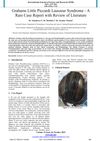
 This paper describes Grahams Little Piccardi Lassueur Syndrome, a rare type of Lichen Planopilaris that causes different types of alopecia and distinctive skin papules, primarily affecting females aged 40 to 70, and notes the current challenges in treatment options, particularly once scarring occurs.
July 1999 in “Journal of the American Academy of Dermatology” This review discusses valproic acid as a common antiseizure medication associated with alopecia and highlights the need for its inclusion in relevant medical guides, without presenting new clinical findings.
 33 citations
,
February 2021 in “Advanced Pharmaceutical Bulletin”
33 citations
,
February 2021 in “Advanced Pharmaceutical Bulletin” This article explains the preparation methods and applications for various vesicle and particle systems used in transdermal drug delivery, highlighting their effectiveness and potential for further development in this field.
54 citations
,
November 2014 in “JEADV. Journal of the European Academy of Dermatology and Venereology/Journal of the European Academy of Dermatology and Venereology” This study found that combining low-fluence Q-switched Nd: YAG laser and intense pulsed light led to faster and more effective melasma treatment compared to using the laser alone, though recurrence still occurred.
 165 citations
,
August 2013 in “Lasers in Surgery and Medicine”
165 citations
,
August 2013 in “Lasers in Surgery and Medicine” This review discusses the potential mechanisms and evidence supporting low-level laser therapy for stimulating hair growth in men and women, while noting its safety and effectiveness but needing further study on specific parameters.
 3 citations
,
January 2024 in “Signal transduction and targeted therapy”
3 citations
,
January 2024 in “Signal transduction and targeted therapy” This study presents a detailed overview of lymphatic vessel development and highlights the role of abnormal lymphangiogenesis in various diseases, suggesting that targeting lymphangiogenic factors may improve treatment strategies.
December 2025 in “Journal of Drug Discovery and Therapeutics” This review discusses spanlastics, advanced elastic vesicles used in drug delivery to enhance bioavailability of poorly soluble drugs, offering improved stability and targeted delivery compared to traditional systems like liposomes and nanoparticles, thus reducing side effects and enhancing therapeutic outcomes.
 16 citations
,
November 1992 in “Journal of International Medical Research”
16 citations
,
November 1992 in “Journal of International Medical Research” In this randomized study, ViviScal® significantly outperformed a fish extract in increasing non-vellus hair count and achieving clinical and histological improvement in young males with hereditary androgenic alopecia.
 January 1994 in “Nippon Ronen Igakkai Zasshi Japanese Journal of Geriatrics”
 In this study, both VEPA and ML-Y1 treatment regimens for older patients with non-Hodgkin's lymphoma showed similar response and survival rates, but neither was sufficient, indicating the need for a more effective approach.
 16 citations
,
December 2017 in “Journal of The American Academy of Dermatology”
16 citations
,
December 2017 in “Journal of The American Academy of Dermatology” This study found that low-level laser therapy may reduce inflammation and increase hair thickness in patients with lichen planopilaris after six months of treatment, though the small sample size limits the findings.
 33 citations
,
March 2017 in “Dermatologic Surgery”
33 citations
,
March 2017 in “Dermatologic Surgery” In this clinical study, low-level laser therapy using the HANDI-DOME LASER device increased hair counts by 51% compared to controls, indicating its potential as a safe and effective treatment for androgenetic alopecia in women aged 18 to 60.
4 citations
,
May 2025 in “Stem Cell Research & Therapy” This review explores the potential of extracellular vesicle therapy as a novel strategy to delay intervertebral disc degeneration and enhance tissue repair, by modulating key pathogenic mechanisms, with a focus on the molecular components and bioengineering modifications of extracellular vesicles.
29 citations
,
December 2021 in “Pharmaceutics” This review discusses the use of phospholipid soft vesicle carriers to improve the delivery and therapeutic outcomes of topical treatments for various skin conditions, but reports no new clinical results.
2 citations
,
April 2012 in “American Journal of Dermatopathology” This report describes two cases of nevus lipomatosus superficialis with the unusual feature of dilated hair follicles, emphasizing the need for precise histopathological diagnosis to differentiate from similar conditions.
3 citations
,
August 2018 in “Medical Journal Armed Forces India/MJAFI” In this study, IPL treatment for six months significantly reduced hair growth in females with faun tail nevus linked to spinal abnormalities.
 17 citations
,
April 2021 in “Molecules/Molecules online/Molecules annual”
17 citations
,
April 2021 in “Molecules/Molecules online/Molecules annual” This study found that linoleic acid from Malva verticillata seed extracts may promote hair follicle cell growth and counteract hair loss signaling in a lab setting.
11 citations
,
August 2023 in “Regenerative Therapy” This study proposes a reporting guideline, CLINIC - STRA-SVF, to standardize and improve the design and reporting of clinical studies involving SVF, highlighting its safety and effectiveness despite the low level of current evidence.
January 2026 in “Pattern Recognition” This study found that their newly developed ADRL framework significantly improved the accuracy of scalp tissue layer segmentation in HR-MR images compared to existing methods.
April 2023 in “Zenodo (CERN European Organization for Nuclear Research)” This case study reported significant improvement in autoimmune-related symptoms, including complete hair regrowth, in a patient with systemic lupus erythematosus and alopecia areata after treatment with the LGS Protocol.
 June 2026 in “Communications Biology”
 In this study, researchers found that the cornification process in the nuptial pads of Xenopus frogs involves the expression of the type II hair keratin homolog, krt59, and is regulated by the transcription factor hoxc13, showing similarities to mammalian hair evolution.
 April 2017 in “Journal of Investigative Dermatology”
 This study suggests that sirolimus and propranolol may reduce abnormal lymphatic endothelial cell proliferation in lymphatic malformations, potentially improving vessel function and patient outcomes.
 May 2024 in “International Society of Hair Restoration Surgery”
 This paper describes various emerging regenerative therapies for hair loss, such as platelet-rich plasma, exosomes, and low-level laser therapy, but it doesn't provide results or conclusions about their efficacy.

Low level laser or LED therapy combined with infiltrations may help hair growth.
 March 2021 in “Indian Journal of Case Reports”
 This case report describes a young adult female with late-stage Vogt-Koyanagi-Harada disease featuring panuveitis, retinal detachment, hearing loss, alopecia, and vitiligo, who was successfully treated in a hospital.
 May 2014 in “Clinical and Experimental Dermatology”
 A 70-year-old woman with a rare skin condition improved after treatment with topical steroids and acitretin.
 December 2014 in “Faculty Opinions – Post-Publication Peer Review of the Biomedical Literature”
 Low-level light therapy significantly increased hair density and thickness in people with hair loss, but they didn't notice a difference.
7 citations
,
April 2021 in “Journal of Lower Genital Tract Disease” This study concluded that erosive lichen sclerosus is a distinct subtype marked by red patches on hairless skin, while ulcerated lichen sclerosus typically results from trauma in uncontrolled dermatosis.
 September 2020 in “International journal of computer science and mobile computing”
 This article discusses the use of low-level laser therapy for hair regrowth in men and women but reports no new clinical results; it reviews types of lasers and evidence from animal and human studies.