85 citations
,
May 2009 in “Hippocampus” This study found that progesterone enhances the survival of newborn neurons in the hippocampus of adult male mice, which is associated with improved spatial learning and memory.
October 2025 in “Journal of Obstetric and Gynaecological Practices POGS” 26 citations
,
November 2013 in “Neuroscience” This study suggests that progesterone has both THP/GABAA-dependent and independent anticonvulsive effects in a hippocampal-kindled mouse model.
 2 citations
,
April 2012 in “Science-business Exchange”
2 citations
,
April 2012 in “Science-business Exchange” Blocking a protein called prostaglandin D2 might help treat hair loss.
 February 2026 in “Archives of Dermatological Research”
 In this study, microneedle-assisted delivery of polyglutamate significantly improved hair parameters, scalp symptoms, and quality of life in androgenetic alopecia patients, with no serious adverse reactions reported.
14 citations
,
August 2020 in “Journal of cosmetic dermatology” This consensus report provides detailed recommendations for using Polynucleotides Highly Purified Technology™ in aesthetic skin rejuvenation, highlighting its potential as a biostimulatory booster for face and body revitalization.
 19 citations
,
November 1971 in “Clinica Chimica Acta”
19 citations
,
November 1971 in “Clinica Chimica Acta” In this study, the researchers found that the absence of the NFI-C transcription factor delayed the hair growth cycle in mice by affecting key gene expressions and signaling pathways.
 February 2026 in “Bioengineering”
 This study concluded that repeated platelet-rich plasma injections provided greater and more consistent improvements in stress urinary incontinence symptoms compared to pelvic floor muscle training.
12 citations
,
June 2025 in “Gut Microbes” This study developed BroadAMP-GPT, a computational-experimental framework, to discover new antimicrobial peptides, identifying candidates effective against multidrug-resistant pathogens. Notably, AMP_S13 showed strong stability, low toxicity, and efficacy in infection models, highlighting the platform's potential in combating antimicrobial resistance.
January 2010 in “프로그램북(구 초록집)” July 2024 in “Journal of Investigative Dermatology” PRP preparation partially activates platelets, causing varied growth factor release.
 June 2003 in “Obstetrical & Gynecological Survey”
 In this study, the size of vaginal prolapse was significantly linked to preoperative vaginal length and the length of vaginal excision following the Michigan four-wall sacrospinous suspension.
 April 2019 in “Journal of Investigative Dermatology”
 The study suggests that variability in platelet-derived growth factors in PRP is influenced by both patient-to-patient differences and the devices used for PRP preparation, contributing to inconsistent clinical outcomes in hair loss treatments.
February 2022 in “The Nurse Practitioner” This article provides an introduction to gender-affirming hormone therapy for transgender and gender-nonbinary patients, designed as a continuing education activity, but does not report new clinical results.
 1 citations
,
April 2018 in “Journal of Investigative Dermatology”
1 citations
,
April 2018 in “Journal of Investigative Dermatology” In this study, researchers found that the variability in growth factor expression, particularly TGFβ1, in PRP samples could influence patient responses to hair loss treatment with PRP therapy.
 October 2025 in “Dermatology Practical & Conceptual”
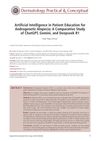
 This study found that ChatGPT 4.0 and Gemini 1.5 Flash provided more accurate and user-friendly responses to androgenetic alopecia questions than Deepseek R1, suggesting they could be effective tools for patient education with physician guidance.
April 2011 in “Cancer Research” In this study, ginsenoside 20(S)-protopanaxadiol-aglycone (PPD) was shown to downregulate androgen receptor expression and inhibit tumor growth in prostate cancer cells.
 July 1996 in “Annals of Internal Medicine”
 In 1995, international medical graduates did better than U.S. graduates on a medical exam.
 July 2026 in “International Journal of Molecular Sciences”
 This study found that TSG-enriched Polygonum multiflorum extract, optimized through microwave-assisted and chromatographic methods, promotes hair regrowth in a mouse model of androgenetic alopecia via 5α-reductase inhibition and Wnt/β-catenin pathway activation, suggesting its potential as a natural treatment.
 August 2025 in “Intisari Sains Medis”
 This study found that in healthy individuals, TGF-β1 levels in platelet-rich plasma are significantly higher when extracted using the buffy coat method compared to the pure method, with additional gender differences observed only in the buffy coat PRP.
103 citations
,
April 2005 in “Experimental dermatology” This study found that PGF2alpha analogues and PGE2 stimulated hair follicle activity in mice, with PGF2alpha analogues also linked to potential side effects like poliosis when used as eye treatments.
In this study, Paljeong-san pharmacopuncture reduced dihydrotestosterone levels and inhibited prostate tissue proliferation in a rat model of benign prostatic hyperplasia.
7 citations
,
April 2008 in “Progrès en Urologie” 18 citations
,
December 2002 in “European Journal of Biochemistry” This study found that the MsPG3-GFP fusion protein accumulates at the growing root hair tips in Medicago plants, suggesting its role in tip growth during symbiosis.
91 citations
,
May 1972 in “Journal of Biological Chemistry” This research found that the transfer reaction catalyzed by human plasma and guinea pig hair follicle transglutaminases aligns with a ping-pong mechanism involving peptide-bound glutamine.
 3 citations
,
March 2016 in “Journal of Cosmetic Dermatology”
3 citations
,
March 2016 in “Journal of Cosmetic Dermatology” This study found that the penta-peptide Gly-Pro-Ile-Gly-Ser increased the proportion of thick hair and improved baldness appearance in Japanese men with androgenetic alopecia.
March 2026 in “Journal of Investigative Dermatology” This study found that GPT-4o demonstrated high concordance with in-person and image-based provider assessments in generating SALT scores for alopecia areata, suggesting its potential as an adjunct tool in clinical practice for automating these assessments.
June 2026 in “Journal of Cosmetic Dermatology” CGF-PF may improve hair loss treatment by targeting hair follicle stem cells more effectively.
July 2025 in “Journal of Investigative Dermatology” Upadacitinib effectively treats pyoderma gangrenosum.

The project developed and tested a method using plasma rich platelets to treat hair loss.