 2 citations
,
January 2018
2 citations
,
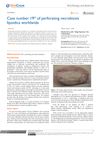
January 2018 This article reports the first case of perforating necrobiosis lipoidica in Colombia and the 19th case worldwide in diabetic patients.
 2 citations
,
October 2010 in “Springer eBooks”
2 citations
,
October 2010 in “Springer eBooks” Using cheek skin and cartilage grafts for nose reconstruction after skin cancer surgery can maintain shape and function but may require multiple surgeries and hair removal in men.
 2 citations
,
April 2008 in “Journal of Dispersion Science and Technology”
2 citations
,
April 2008 in “Journal of Dispersion Science and Technology” This study observed that including cationic minoxidil particles in a shampoo facilitated notable hair growth promotion despite a negative surface charge after rinsing, likely due to ionic interactions with the skin.
 2 citations
,
June 2006 in “Experimental dermatology”
2 citations
,
June 2006 in “Experimental dermatology” This article discusses the development of skin patterns during embryogenesis and postnatal life, linking them to genetic, environmental, and mathematical factors, but presents no new empirical findings.
 1 citations
,
January 2017 in “Springer eBooks”
1 citations
,
January 2017 in “Springer eBooks” This chapter reviews the hair follicle's role in drug and chemical penetration through the skin but does not present new experimental findings.

This article reviews surgical techniques for addressing scalp defects and highlights hair restoration as a cosmetic improvement strategy, but it reports no new clinical results.
 1 citations
,
May 2014 in “Lipid Technology”
1 citations
,
May 2014 in “Lipid Technology” This news review reports on the latest developments in lipid technology but presents no new research findings.
 1 citations
,
January 2014 in “Elsevier eBooks”
1 citations
,
January 2014 in “Elsevier eBooks” This review discusses melanocytes' role in pigmentation, their clinical significance in conditions like vitiligo and hair graying, and highlights current research on hair follicle regeneration without reporting new clinical results.
 1 citations
,
January 2013 in “Springer eBooks”
1 citations
,
January 2013 in “Springer eBooks” Cosmeceuticals may benefit skin health but need more research for efficacy and safety confirmation.
 1 citations
,
January 2009 in “Elsevier eBooks”
1 citations
,
January 2009 in “Elsevier eBooks” This chapter provides an overview of skin physiology, aging effects, and how environmental factors like UV damage impact skin health, without presenting new research findings.
 1 citations
,
December 1972 in “Journal of Colloid and Interface Science”
1 citations
,
December 1972 in “Journal of Colloid and Interface Science” Ethanol spreads well on hair at low humidity but less so at higher humidity due to water condensation.
 March 2026 in “ArXiv.org”
 This review presents a comprehensive evaluation of medical reasoning using large language models, highlighting a significant gap between exam-level performance and true clinical decision-making accuracy.
 February 2026 in “Journal Educational Research and Development | E-ISSN 3063-9158”
 This study formulated and evaluated a Moringa oleifera-based shampoo bar, finding it has a safe pH, does not cause irritation, and is favored by 64% of respondents, with potential hair loss reduction benefits and environmental advantages over liquid shampoos.
 November 2025 in “Clinical Cosmetic and Investigational Dermatology”
 This study found that specific immune cell phenotypes, particularly CD25 on CD4 Treg cells, were causally linked to androgenic alopecia, suggesting potential targets for immune-based therapies.
 October 2025 in “Jurnal Medisains Kesehatan”
 This experimental study found that leaf extracts from Averrhoa bilimbi and Muntingia calabura significantly inhibited the growth of Staphylococcus aureus, with M. calabura demonstrating stronger antibacterial activity, suggesting potential for acne treatment.
 October 2025 in “Current Pharmaceutical Research”
 This study evaluated a new herbal shampoo made from traditional plants and found it to have effective cleansing properties, moderate foam stability, and environmental safety, suggesting it as a favorable natural alternative to synthetic shampoos.
 August 2025 in “International Journal of Advanced Research in Science Communication and Technology”
 In this study, researchers aimed to develop a herbal shampoo by replacing harmful synthetic ingredients with natural alternatives to improve safety and effectiveness, targeting issues like hair loss and scalp irritation often associated with traditional shampoos.
January 2025 in “Multimedialen Archiv und Publikationsserver der Christian-Albrechts-Universität zu Kiel (Christian-Albrechts-Universität zu Kiel)” In this study, human gingival mesenchymal stem cells responded differently to inflammation mediated by oxidized low-density lipoprotein (oxLDL) compared to cytokines; oxLDL significantly reduced cell proliferation but had less negative impact on differentiation characteristics.
 August 2024 in “Journal of Ayurveda and Integrated Medical Sciences”
 This review explores the effectiveness of Murdha Tailam methods, particularly in Panchakarma treatments, for illnesses related to the head and neck, highlighting the advantage of scalp drug absorption due to anatomical features that facilitate treatment outcomes.
 February 2024 in “Pharmaceutical research”
 In this in silico study, researchers found that the hair follicle's contribution to dermal permeability of small molecules varies with the lipophilic and hydrophilic properties of substances, highlighting the need for careful characterization of substances filling the follicular route when interpreting experimental permeability data.
 January 2024 in “International Research Journal of Modernization in Engineering Technology and Science”
 This study formulated a poly-herbal shampoo using ingredients like hibiscus, neem, and alo-vera and evaluated its cosmetic properties, reporting positive organoleptic and physico-chemical characteristics, with the potential for safe use as a hair cleansing and conditioning product.
 October 2023 in “Oriental Journal of Chemistry/Oriental journal of chemistry”
 This study focused on the rheology of almond oil at various temperatures and shear rates, using a Brookfield RVDV II I Ultra Rheometer, to evaluate its potential as a biodegradable lubricant.

Bee pollen, green tea, essential oils, and various plant extracts improve skin and hair health.
 December 2022 in “Deleted Journal”
 In this study, topical application of keratin extract from wool promoted hair growth in mice by reducing the time for initiation and completion of growth phases and improving hair quality.
 November 2022 in “International journal of biology, pharmacy and allied sciences”
 In this study, the researchers formulated an herbal shampoo and found it exhibited excellent cleansing properties and foam stability, comparable to commercial shampoos, suggesting it as a safe and cost-effective alternative to marketed formulations.
 August 2020 in “International journal of research in ayurveda and pharmacy”
 This article discusses the use of Maltadya tail for treating forms of alopecia in Ayurvedic medicine but presents no clinical results, emphasizing the oil's potential scalp and hair health benefits.
 July 2018 in “Benha Journal of Applied Sciences”
 In this study, researchers found that patients with alopecia areata had significantly higher levels of miR-203 in their skin compared to healthy controls.
 March 2018 in “Suez Canal University Medical Journal”
 This review examines targeting the JAK-STAT pathway in inflammatory skin diseases, highlighting existing JAK inhibitors and potential developments, but presents no new experimental or clinical results.
 January 2018 in “SOJ microbiology & infectious diseases”
 This review outlines the changing landscape of psoriasis vulgaris treatment with biologics, which offer benefits but also have increasingly recognized adverse effects, without presenting new clinical results.
 April 2014 in “Journal of Aesthetic Nursing”
 This article provides descriptive results indicating high client satisfaction and good tolerance associated with mesotherapy in treating hair loss, based on the author's personal experience with clients.