 7 citations
,
January 2015 in “International Journal of Trichology”
7 citations
,
January 2015 in “International Journal of Trichology” This case report describes a woman who experienced frontal edema after topical minoxidil application following mesotherapy, noting that excessive absorption of minoxidil may cause localized vasodilatory side effects.

This study observed that both intradermotherapy with 5% minoxidil and topical minoxidil application resulted in perceived improvements in hair density and thickness among patients with androgenetic alopecia, with no significant difference between the two groups.
 22 citations
,
July 2006 in “Indian Journal of Pharmaceutical Sciences”
22 citations
,
July 2006 in “Indian Journal of Pharmaceutical Sciences” This study evaluated four minoxidil gel formulations for alopecia treatment, finding similar drug release across membranes and stability over three months, with no skin irritation observed in mice.
 5 citations
,
January 1994 in “Skin Pharmacology and Physiology”
5 citations
,
January 1994 in “Skin Pharmacology and Physiology” This study found that minoxidil forms a reservoir in the skin, allowing sustained drug delivery even after cleansing, while propylene glycol does not.
This study found that applying topical cinnamon essential oil on male wistar rats increased hair length and hair follicle diameter similarly to 2% minoxidil over 30 days.
 November 2024 in “Skin Health and Disease”
 This review suggests that while minoxidil is effective in promoting hair growth, its precise mechanism remains unclear, and it may have emerging applications in treating various dermatological conditions.
 33 citations
,
June 1995 in “Journal of Pharmaceutical Sciences”
33 citations
,
June 1995 in “Journal of Pharmaceutical Sciences” This study found that minoxidil penetration through the skin increased with higher ethanol content and occlusion, with the highest penetration observed at 90% ethanol.
June 2026 in “YAKUGAKU ZASSHI” This study investigated the impact of container-tip design and hair density on the scalp delivery of minoxidil in topical formulations, finding that higher hair density reduced delivery, particularly with larger tip containers, indicating the importance of these factors in product design.
This study found that a data-driven model using XGBoost effectively predicts individualized responses to minoxidil for androgenetic alopecia, outperforming traditional methods in accuracy and reliability.
 December 2023 in “Annales Pharmaceutiques Françaises”
 This study concluded that Trilayer Dissolving Microneedles show promise in enhancing Minoxidil delivery for treating alopecia areata by improving its bioavailability and reducing side effects.
September 2022 in “Chinese Journal of Dermatology” This review highlights emerging evidence that low-dose oral minoxidil could be used off-label to treat androgenetic alopecia, offering insights into its potential mechanisms and clinical applications beyond its current role in treating hypertension.
January 2022 in “Physics and Chemistry of Liquids” This study investigated the solubility of minoxidil in various solvent mixtures and applied multiple models to understand solute-solvent interactions and energy dynamics.
3 citations
,
January 2002 in “Actas Dermo-Sifiliográficas” In this case report, a 23-year-old woman developed localized trichorrhexis nodosa after compulsively applying 3% minoxidil to her scalp for two months.
 July 2025 in “The Journal of Dermatology”
 This study reported that 5% topical minoxidil lotion may be beneficial for enhancing hair regrowth in patients with telogen effluvium, although its effectiveness is limited by the self-healing nature of the condition and the small sample size.
 December 2025 in “Saudi Pharmaceutical Journal”
 This study developed a nanoemulsion containing Minoxidil, which showed effective stability and significantly increased hair growth rates in pretreated mice, suggesting its potential for treating hair loss.
 25 citations
,
November 1987 in “British Journal of Dermatology”
25 citations
,
November 1987 in “British Journal of Dermatology” This study observed increases in scalp blood flow following the application of 3% minoxidil and 0.1% hexyl nicotinate in individuals with alopecia.
1 citations
,
January 2023 in “Journal of Clinical Medicine” This paper presents the first reported case of Acute Localized Exanthematous Pustulosis linked to topical minoxidil use, suggesting a contact-induced hypersensitivity reaction as a potential mechanism.
 April 2024 in “Indian journal of ophthalmology. Case reports”
 This study reports a case of acute central serous chorioretinopathy potentially linked to prolonged topical minoxidil use for alopecia, with improvement following cessation of the treatment.
July 2021 in “Indian journal of drugs in dermatology” In this study, the combination of intradermal meso-solution and topical 5% minoxidil significantly increased hair re-growth in men with androgenetic alopecia compared to minoxidil alone.
 4 citations
,
September 2015 in “Case Reports”
4 citations
,
September 2015 in “Case Reports” The authors describe a case of syncope in a young man after using high strength topical minoxidil, which resolved when he stopped the treatment, highlighting a rare documented reaction.
 January 2025 in “International Journal of Research and Innovation in Applied Science”
 This study aimed to enhance the skin penetration of minoxidil by encapsulating it in glycerosomal vesicles, offering a potential improvement in transdermal drug delivery for treating androgenetic alopecia. Results of the investigation were not reported.
 3 citations
,
January 2018 in “Annals of Dermatology”
3 citations
,
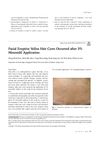
January 2018 in “Annals of Dermatology” A woman developed facial hair cysts after using a 3% minoxidil solution for hair loss, which disappeared after stopping the treatment and removing the cysts surgically.
January 2009 in “Journal of Tissue Engineering and Reconstructive Surgery” This study found that using small-unit hair transplantation with a No.16 hollow needle, followed by minoxidil, was effective for treating alopecia or low eyebrow density in 25 patients.
 May 2026 in “Zenodo (CERN European Organization for Nuclear Research)”
 In this study, a chitosan-based minoxidil nanogel was developed and optimized for better scalp retention and targeted follicular delivery, showing sustained drug release over 48 hours and improved drug deposition compared to conventional minoxidil solutions.
 May 2026 in “Zenodo (CERN European Organization for Nuclear Research)”
 This study developed a chitosan-based nanogel for minoxidil, showing in vitro sustained drug release and higher deposition compared to conventional solutions, suggesting potential as an effective topical treatment for alopecia.
 March 2005 in “Journal of The American Academy of Dermatology”
 This study investigates the potential of a cosmetic day lotion with a 5a-reductase inhibitor and a night lotion with an angiogenic ingredient to modulate hair growth, but reports no clinical results.
4 citations
,
February 2021 in “Journal of Pharmaceutical Sciences” This study suggests that the developed PBPK model effectively predicts pharmacokinetic and pharmacodynamic profiles of topical finasteride and minoxidil on the scalp, indicating potential broader applicability for other formulations.
 July 2023 in “International journal of advanced research in medical and pharmaceutical sciences”
 In this study, researchers formulated and evaluated a gel containing minoxidil and aloe vera for alopecia treatment, finding that it was stable and non-irritant on albino rats, suggesting enhanced topical drug delivery over traditional solutions.
 January 2026 in “Zenodo (CERN European Organization for Nuclear Research)”
 In this clinical study, Prachhanna followed by Guñjā lepa was found to be more effective than PRP therapy with Minoxidil 5% in improving hair regrowth and reducing symptoms in patients with Indralupta (Alopecia Areata), achieving 91.14% overall improvement compared to 74.74% for the alternative treatment.
 January 2026 in “Zenodo (CERN European Organization for Nuclear Research)”
 This study observed that Prachhanna followed by Guñjā lepa was more effective than Platelet-Rich Plasma therapy with Minoxidil 5% in promoting hair regrowth and reducing symptoms of Indralupta, showing greater reductions in hair loss and itching over a 45-day period.