 12 citations
,
January 2020 in “Skin appendage disorders”
12 citations
,
January 2020 in “Skin appendage disorders” Low-dose oral minoxidil effectively treats female hair loss with good safety.
1 citations
,
November 2023 in “SKIN The Journal of Cutaneous Medicine” 
In this randomized, controlled trial, the researchers observed that sub-lingual minoxidil at doses of 1.35 mg and 4.05 mg, but not 0.45 mg, significantly increased hair fibre diameter in men with male androgenetic alopecia over 24 weeks, suggesting a dose-dependent reversal of follicle miniaturization.
3 citations
,
January 2022 in “Journal of The American Academy of Dermatology” This study found that 1 mg/day low-dose oral minoxidil significantly increased hair count compared to 0.25 mg/day over 24 weeks in women with female pattern hair loss, though no differences were observed in hair-shedding and quality-of-life scores between the two doses.
 13 citations
,
November 2013 in “The Journal of Dermatology”
13 citations
,
November 2013 in “The Journal of Dermatology” This study suggests that minoxidil 2% lotion is a safe and effective treatment for enhancing eyebrows, showing better results than placebo after 16 weeks.
3 citations
,
March 2012 in “Arab Journal of Urology” This study found that cromakalim and pinacidil significantly inhibited porcine detrusor muscle contractions, suggesting these ATP-sensitive potassium channel openers may have potential in treating certain bladder diseases.
 1 citations
,
December 2022 in “Indian pediatrics/Indian Pediatrics”
1 citations
,
December 2022 in “Indian pediatrics/Indian Pediatrics” A toddler who accidentally swallowed hair growth medicine experienced serious heart-related side effects but recovered after hospital treatment.
 11 citations
,
June 2013 in “Journal of Chemical Education”
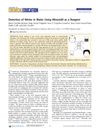
11 citations
,
June 2013 in “Journal of Chemical Education” This study reports an easy colorimetric method for detecting nitrite in water using minoxidil, which may be suitable for various analytical applications due to its effective detection range.
 July 2026 in “European Journal of Plastic Surgery”
 This study found that combining needle-free intradermal minoxidil delivery with standard topical minoxidil therapy improved early hair growth parameters and satisfaction in women with early-stage female pattern hair loss compared to topical therapy alone, with no serious adverse events reported over the 10-week period.
 13 citations
,
March 2014 in “Pediatric Dermatology”
13 citations
,
March 2014 in “Pediatric Dermatology” This case report observed that a 2-year-old girl with loose anagen hair syndrome experienced rapid and significant improvement without adverse effects from tapered minoxidil 5% treatment over 28 months.
 22 citations
,
January 1985 in “Annals of Internal Medicine”
22 citations
,
January 1985 in “Annals of Internal Medicine” Minoxidil in breast milk may harm nursing infants.
 19 citations
,
July 2019 in “Biomedical Microdevices”
19 citations
,
July 2019 in “Biomedical Microdevices” This review discusses the safety and potential adverse events of microneedling as both a medical and consumer product, noting the need for further understanding; no new clinical results are presented.
32 citations
,
August 1996 in “Journal of Investigative Dermatology”  6 citations
,
January 2017 in “Annals of Dermatology”
6 citations
,
January 2017 in “Annals of Dermatology” In this study, Korean women with female pattern hair loss who used a combination of topical 0.025% 17α-estradiol and 3% minoxidil saw significant increases in total hair count and hair caliber over six months.
 18 citations
,
July 1975 in “Clinical Pharmacology & Therapeutics”
18 citations
,
July 1975 in “Clinical Pharmacology & Therapeutics” Oral minoxidil effectively controls blood pressure quickly and safely.
 14 citations
,
April 2009 in “Acta Medica Scandinavica”
14 citations
,
April 2009 in “Acta Medica Scandinavica” In this study, oral minoxidil combined with other medications improved blood pressure control in patients with severe hypertension but often had to be discontinued due to side effects.
3 citations
,
May 2024 in “International Journal of Dermatology” February 2023 in “Clinical Toxicology” This letter to the editor raises concerns about minoxidil, an arterial vasodilator also used for androgenic alopecia, noting that overdose can cause severe side effects such as distributive shock, pulmonary edema, and myocardial ischemia.
February 2021 in “European Chemical Bulletin” This study developed and validated a reverse phase liquid chromatography method to accurately and reliably measure Minoxidil and Finasteride in bulk and marketed formulations.

This study developed a co-design framework using finite element analysis to optimize bubble microneedles, achieving controlled tip separation and effective drug delivery through the skin and mucosa while maintaining insertion strength.
 8 citations
,
April 2020 in “Journal of The American Academy of Dermatology”
8 citations
,
April 2020 in “Journal of The American Academy of Dermatology” This report describes nine women who were allergic to topical minoxidil but successfully tolerated low-dose oral minoxidil without significant adverse effects, suggesting it may be a viable alternative for those with similar allergies.
 April 2024 in “Journal of the American Academy of Dermatology”
 Low-dose minoxidil helps hair grow longer and thicker in people with short anagen syndrome.
![Minoxidil and Its Use in Hair Disorders: A Review [Corrigendum]](/images/assets/d5b5fb1b-96a4-4e61-a554-3fe9a1f78497/small/11472.jpg) 1 citations
,
February 2020 in “Drug Design Development and Therapy”
1 citations
,
February 2020 in “Drug Design Development and Therapy” Low-dose Minoxidil combined with Spironolactone helps reduce hair loss and improve hair density in women, with some mild side effects.
 6 citations
,
January 2016 in “Bioorganic & Medicinal Chemistry Letters”
6 citations
,
January 2016 in “Bioorganic & Medicinal Chemistry Letters” This study reported that certain minoxidil conjugates, specifically those with spermine, methylenedianiline, and diaminofluorene, were able to induce differentiation in HL-60 acute myeloid leukemia cells without toxicity at a concentration of 10 μM.
This review identifies headache, hypertrichosis, and allergy as potential side effects of Minoxidil treatment for hair loss, based on only two studies that met inclusion criteria.
1 citations
,
May 2025 in “Current Issues in Molecular Biology” This study found that Centipeda minima and brevilin A significantly reduced oxidative stress and inflammation in human dermal fibroblasts, suggesting their potential to protect against skin aging and inflammation.
 12 citations
,
August 2017 in “Archives of Pharmacal Research”
12 citations
,
August 2017 in “Archives of Pharmacal Research” In this study, lecithin-based microparticle formulations of minoxidil showed enhanced skin penetration and comparable hair growth effectiveness to commercial products in mice, while minimizing skin irritation often seen with standard minoxidil solutions.
 January 2023 in “International Journal of Molecular Sciences”
 This review discusses the biologically active compounds in Maxillariinae orchids, highlighting 62 semiochemicals with medical potential, but reports no new clinical findings.
 August 2019 in “DOAJ (DOAJ: Directory of Open Access Journals)”
 This review discusses the pharmacology, mechanism of action, clinical efficacy, and adverse events of topical minoxidil for hair loss but reports no new clinical findings.
 15 citations
,
January 2000 in “Japanese Heart Journal”
15 citations
,
January 2000 in “Japanese Heart Journal” This case report discusses a 45-year-old Japanese man who developed myocardial infarction while using 1% topical minoxidil for baldness, highlighting the need for caution in patients with cardiovascular disorders.