 October 2024 in “Cermin Dunia Kedokteran”
 This article discusses the surveillance and spread of hand, foot, and mouth disease in China, Singapore, and Indonesia, and reports no new results, emphasizing the need for improved prevention and management strategies.
1 citations
,
September 2023 in “Portuguese Journal of Dermatology and Venereology” This case report describes a 50-year-old man with folliculotropic mycosis fungoides stage IB, noting trichoscopic findings like dilated follicular openings, black dots, and dystrophic hairs, which are less commonly documented in this condition, suggesting trichoscopy could aid in early diagnosis.
46 citations
,
November 2014 in “Journal of Cutaneous Pathology” This study describes the diverse histopathological patterns and clinical features observed in patients with folliculotropic mycosis fungoides, emphasizing the importance of accurate recognition to avoid diagnostic errors.
3 citations
,
July 2016 in “Tropical Journal of Pharmaceutical Research” This study found that the proposed LC-MS/MS method accurately quantified the drug content in split tablets of finasteride and terbinafine, revealing significant variability and suggesting that non-scored tablets should not be split.
January 2025 in “Dermatologic Therapy” This study found that ablative fractional carbon dioxide laser treatment improved skin fibrosis, reduced skin hardening, and enhanced hair follicle growth in localized scleroderma patients, with significant improvements across several clinical measures and no severe adverse effects observed.
 September 2017 in “Journal of Investigative Dermatology”
 This study found that certain circulating miRNAs in skin and plasma may serve as potential biomarkers for distinguishing frontal fibrosing alopecia from control cases, highlighting the need for further validation in larger cohorts.
1 citations
,
March 2012 in “Actas dermo-sifiliográficas/Actas dermo-sifiliográficas” Dermoscopy helps diagnose frontal fibrosing alopecia by identifying specific scalp features.
12 citations
,
April 2004 in “PubMed” This study reports the first known case of multiple type nevus lipomatosus cutaneous superficialis in a 10-month-old girl, with the unique feature of perifollicular fibrosis.
9 citations
,
April 2013 in “Journal of Chromatography B” This study developed and validated a sensitive LC-MS/MS method for quantifying tamsulosin in human serum, achieving high analyte recovery and demonstrating applicability in clinical research for benign prostatic hyperplasia.
 6 citations
,
December 2015 in “International journal of nanomedicine”
6 citations
,
December 2015 in “International journal of nanomedicine” This study found that low-frequency sonophoresis significantly decreased the skin penetration of sodium fluorescein-loaded PEGylated liposomes with D-limonene and affected percutaneous absorption by partially plugging hair follicle orifices.
 3 citations
,
September 2024 in “BMC Oral Health”
3 citations
,
September 2024 in “BMC Oral Health” This study found that low-level laser therapy effectively reduced relapse rates, while functional appliances did not; combining them offered no additional benefits.
 May 2024 in “Journal of cosmetic dermatology”
 This study investigated the effects of heat-treated Limosilactobacillus fermentum LM1020 on hair growth and reported increased hair density, improved cellular activity, and beneficial scalp microbiota changes in patients with androgenetic alopecia over 24 weeks.
January 2021 in “Asian Journal of Pharmaceutical and Clinical Research” This study examined the effectiveness of FT-Raman spectroscopy for detecting polymorphism in Lamivudine and Finasteride, highlighting its advantages over other methods due to its capability to provide sharp, well-resolved spectral bands and reduced sampling issues.
 September 2024 in “Cermin Dunia Kedokteran”
 This research discusses Fahr syndrome, highlighting its association with abnormal brain calcifications and varied clinical symptoms in young to middle-aged adults. Diagnosis involves specific criteria and CT scans, but no specific treatment exists; therapy focuses on managing symptoms and underlying conditions.
 July 2021 in “British Journal of Dermatology”
 This case report describes a novel instance of scarring alopecia with features of frontal fibrosing alopecia in a patient with systemic sclerosis, suggesting a potential link between the two conditions not previously reported.
 July 2026 in “International Journal of Drug Delivery Technology”
 This research reported that liposomal systems made from pig-derived skin lipids enhanced finasteride delivery to hair follicles for treating androgenetic alopecia, showing improved drug deposition, hair length, and growth compared to conventional finasteride forms in vitro.
2 citations
,
January 2019 in “Skin appendage disorders” This article reports a case of frontal fibrosing alopecia in its early inflammatory stage that responded positively to intralesional steroid treatment.
 44 citations
,
September 2019 in “The EMBO Journal”
44 citations
,
September 2019 in “The EMBO Journal” This study found that lymphatic vessels in mice are important for hair follicle development and organization, as their depletion blocks hair growth.
 126 citations
,
April 2006 in “International Journal of Dermatology”
126 citations
,
April 2006 in “International Journal of Dermatology” This study found that frontal fibrosing alopecia and lichen planopilaris have similar histopathological features, but FFA exhibits more prominent apoptosis and less inflammation with spared interfollicular epidermis.
 49 citations
,
January 2003 in “Clinical and Experimental Dermatology”
49 citations
,
January 2003 in “Clinical and Experimental Dermatology” This report from the UK reviews the literature on post-menopausal frontal fibrosing alopecia and highlights its under-recognition and distinctive characteristics compared to lichen planopilaris, but does not provide new results.
 18 citations
,
July 2016 in “Journal of The American Academy of Dermatology”
18 citations
,
July 2016 in “Journal of The American Academy of Dermatology” This study reported that both primary and secondary cutaneous follicle center lymphomas can present with atypical scalp or forehead lesions, leading to potential misdiagnosis as other skin conditions.
February 2023 in “Default Digital Object Group” This study demonstrated that a single multimode fiber can be used for single-shot wide-field reflectance imaging, achieving high correlation with the ground truth and enabling real-time microendoscopy at up to 180 frames per second.
1 citations
,
July 2004 in “The Journal of Dermatology” This case report describes a female patient with systemic lupus erythematosus who developed generalized hair-follicle hamartoma, marking the fourth documented association between the two conditions.

This study suggests that fatigue, joint pain, and light sensitivity are significant impacts for systemic lupus erythematosus patients, highlighting areas of unmet need in current treatment options.

The document recommends a multidisciplinary approach and experience sharing to advance facial feminization surgery as a medical field.
1 citations
,
February 2019 in “bioRxiv (Cold Spring Harbor Laboratory)” This study identified lymphatic vessels as crucial components of the hair follicle stem cell niche, coordinating connections and contributing to hair follicle regeneration in mice.
5 citations
,
April 2014 in “Journal of Lipid Research” This study demonstrates a method to noninvasively assess lipid classes in rodent sebum via high-field proton NMR, observing significant lipid reductions in rats treated with an SCD1 inhibitor.
3 citations
,
August 2024 in “Molecular Biology Reports” This study found that the lncRNA018392, responsive to melatonin, accelerates cell proliferation in cashmere goats by recruiting the transcription factor SPI1 to upregulate the nearby gene CSF1R, which may explain the molecular mechanisms of cashmere growth.
 39 citations
,
July 2015 in “British Journal of Dermatology”
39 citations
,
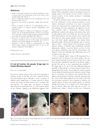
July 2015 in “British Journal of Dermatology” This article discusses the pseudo 'fringe sign' in frontal fibrosing alopecia, highlighting that it is not solely related to traction, and it reports no new clinical results.
17 citations
,
June 2016 in “Archives de Pédiatrie” This case report describes three pediatric cases of frontal fibrosing alopecia, a condition typically seen in postmenopausal women, including a unique instance involving female twins.