 1 citations
,
June 2014 in “Serbian Journal of Dermatology and Venereology”
1 citations
,
June 2014 in “Serbian Journal of Dermatology and Venereology” This case report describes a 22-year-old woman initially suspected of alopecia areata, whose scalp lesions were ultimately diagnosed as discoid lupus erythematosus after histopathological analysis.
1 citations
,
December 2020 in “Medical lasers” The laser therapy device effectively increased hair growth in people with androgenetic alopecia.
2 citations
,
December 2022 in “The Journal of Dermatology” This study found that patients with hidradenitis suppurativa had significantly higher levels of cell-free DNA in their serum compared to healthy controls, suggesting its potential as a biomarker for the disease.
In this case study, donor lymphocyte infusions effectively eradicated measurable residual disease in a patient with relapsed acute myeloid leukemia after hematopoietic cell transplantation, while side effects included the development of vitiligo and alopecia areata, likely due to chronic graft-versus-host disease.
August 2021 in “BMJ Case Reports” This case report details a 27-year-old woman's diagnosis of systemic lupus erythematosus with immune-mediated intravascular haemolysis, which improved with steroid treatment.
1 citations
,
April 2018 in “The journal of investigative dermatology/Journal of investigative dermatology” This study found that topical application of the HDAC1/3 inhibitor Vorinostat promoted hair regrowth in a mouse model of alopecia areata and influenced the hair cycle in normal mice.
 1 citations
,
December 2023 in “Curēus”
1 citations
,
December 2023 in “Curēus” This study observed that five out of fourteen individuals aged 13-16 years, who were homozygous for the p.C282Y mutation related to hemochromatosis, had increased liver and phlebotomy-mobilized iron levels.

In this case report, a 25-year-old woman with VKHD experienced an unusual occurrence of vellus-like hair growth on her normally hairless palm, observed twice over two years, expanding the known integumentary manifestations of VKHD.
126 citations
,
October 1998 in “Experimental Dermatology” This review provides an overview of the hairless gene in mice and humans, discussing its structure, expression, and implications for understanding skin physiology and human disorders related to gene disruption, but it reports no new empirical findings.
 33 citations
,
March 2017 in “Dermatologic Surgery”
33 citations
,
March 2017 in “Dermatologic Surgery” In this clinical study, low-level laser therapy using the HANDI-DOME LASER device increased hair counts by 51% compared to controls, indicating its potential as a safe and effective treatment for androgenetic alopecia in women aged 18 to 60.
8 citations
,
July 2015 in “International Journal of Dermatology” This study reports that a homozygous A1103G mutation in DSG 4 is responsible for localized autosomal recessive hypotrichosis in a 2-year-old Chinese girl, resulting in reduced DSG 4 expression and hair defects.
January 2018 in “Journal of Investigative Dermatology” This quiz article provides a series of dermatological diagnosis questions based on a Journal of Investigative Dermatology article and includes explanations but reports no original research findings.
 October 2009 in “Reactions Weekly”
 A woman developed lupus after taking hydroxyurea for two years.
2 citations
,
July 2013 in “Journal of Life Sciences” In this case report, researchers described a two-year-old girl with Vitamin D dependent rickets Type II, noting elevated 1,25-dihydroxyvitamin D3 and alopecia, and observed limited treatment response likely due to poor compliance.
 35 citations
,
April 2014 in “American Journal of Medical Genetics”
35 citations
,
April 2014 in “American Journal of Medical Genetics” The study reported a significant genotype–phenotype correlation in prepubescent males with XLHED, particularly in the severity of skin and hair manifestations between those with different EDA mutations.
 13 citations
,
September 2008 in “Experimental and Clinical Endocrinology & Diabetes”
13 citations
,
September 2008 in “Experimental and Clinical Endocrinology & Diabetes” This study compared the echocardiographic profiles of patients with polycystic ovary syndrome to those of healthy subjects using conventional methods and tissue Doppler imaging, but it reports no specific findings here.
 April 2023 in “Journal of Investigative Dermatology”
 In this systematic review, researchers found that individuals with lichen sclerosus have a higher prevalence of comorbidities like vitiligo, alopecia areata, and cardiovascular diseases compared to non-affected controls, and suggest screening all LS patients for cardiovascular risk factors and other diseases.
41 citations
,
September 2010 in “British journal of dermatology/British journal of dermatology, Supplement” In this study, hirsute women with normal or medically normalized testosterone levels experienced similar, though declining, hair reduction from both intense pulsed light and long-pulsed diode laser treatments over six months.
July 2026 in “Journal of the American Academy of Dermatology” Higher fluence low-level laser therapy effectively promotes hair growth in androgenetic alopecia, with varying effects based on sex.
 30 citations
,
June 2016 in “Journal of Human Genetics”
30 citations
,
June 2016 in “Journal of Human Genetics” This study found pathogenic mutations in genes EDA, EDA1R, and EDARADD in 101 out of 124 hypohidrotic ectodermal dysplasia patients, revealing 23 novel mutations and indicating genetic variability.
 6 citations
,
May 2012 in “Archives of Dermatological Research”
6 citations
,
May 2012 in “Archives of Dermatological Research” This study reports a novel missense mutation in the HR gene in a 68-year-old Hungarian woman with alopecia universalis and limb deformities, suggesting a need for further research on its role in these conditions.
 1 citations
,
February 2022 in “Case reports in endocrinology”
1 citations
,
February 2022 in “Case reports in endocrinology” This case report describes a 64-year-old postmenopausal woman with hirsutism due to a rare case of bilateral diffuse ovarian Leydig cell hyperplasia, leading to normalized testosterone levels and improved glycaemic control following surgery.
 6 citations
,
August 1989 in “European journal of pediatrics”
6 citations
,
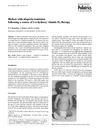
August 1989 in “European journal of pediatrics” This case study describes a child with rickets and alopecia who responded to a small dose of 1-a-hydroxyvitamin D3, but her alopecia remained unchanged despite treatment.
3 citations
,
December 2019 in “Lupus” In this report, researchers describe a case of scalp discoid lupus erythematosus unresponsive to topical treatments, where hydroxychloroquine administered at 200 mg/day led to complete resolution of skin lesions in five months.
3 citations
,
June 2024 in “Skin Research and Technology” Higher LDL lipids may increase alopecia areata risk, while higher triglycerides may decrease it.
This article reviews current understanding of Hutchinson–Gilford Progeria Syndrome and suggests RNA-based treatments show promise, but no new clinical findings are reported.
71 citations
,
May 2019 in “Rheumatology” This study observed that PD-1+CXCR5-CD4+T peripheral helper cells are significantly elevated in patients with systemic lupus erythematosus and are correlated with disease activity indicators, suggesting their potential role in lupus pathogenesis.
 9 citations
,
June 2014 in “European Journal of Obstetrics & Gynecology and Reproductive Biology”
9 citations
,
June 2014 in “European Journal of Obstetrics & Gynecology and Reproductive Biology” Blood AMH levels are higher in women with PCOS than in those with other similar conditions.
31 citations
,
June 1997 in “International Journal of Dermatology” In this case report, a patient with Hodgkin's disease treated with ABVD chemotherapy became disease-free, and accompanying granuloma annulare skin lesions also improved.
 April 2017 in “Journal of Investigative Dermatology”
 In this pilot study, researchers observed a correlation between clinical severity and histologic severity of lichen planopilaris, suggesting that an immunohistochemical scoring system could aid in grading disease activity.