1 citations
,
January 2024 in “Clinical Cosmetic and Investigational Dermatology” This case report discusses a 58-year-old female diagnosed with oral lichen sclerosus, an extremely rare form of the disorder, which improved following treatment with topical and intralesional corticosteroids, highlighting the importance of recognizing this rare condition in the oral mucosa.
51 citations
,
October 2002 in “Archives of dermatology” This case study of a patient with dissecting cellulitis of the scalp found that multiple medications, including isotretinoin, achieved only modest improvement, and symptoms returned after treatments were stopped.
 1 citations
,
April 2018 in “Lasers in Surgery and Medicine”
1 citations
,
April 2018 in “Lasers in Surgery and Medicine” This review summarizes late-breaking abstracts from the American Society for Laser Medicine and Surgery, 2018, and reports no new clinical findings.
 November 2025 in “Clinical Cosmetic and Investigational Dermatology”
 LIPH mutations cause woolly hair in some Chinese people.
 December 2022 in “Medical lasers”
 This study reviews the mechanism and potential treatment roles of low-level laser therapy for immune-mediated skin diseases, reporting no new clinical results.
 5 citations
,
April 2014 in “The American Journal of Dermatopathology”
5 citations
,
April 2014 in “The American Journal of Dermatopathology” This article reports on a typical case of lichen planopilaris with foreign-body granulomas around hair shaft material, suggesting these may be an additional criterion for diagnosing late-stage LPP/FFA.
10 citations
,
May 2020 in “Dermatologic therapy” In this study, a patient with recalcitrant lichen planopilaris and frontal fibrosing alopecia showed significant improvement after receiving four doses of the interleukin-23 monoclonal antibody tildrakizumab.
 16 citations
,
June 2015 in “Pediatric dermatology”
16 citations
,
June 2015 in “Pediatric dermatology” This review discusses lichen planopilaris in children and highlights its rarity, potential for misdiagnosis, and need for suspicion in atypical or treatment-resistant alopecia cases, but reports no new results.
3 citations
,
January 2016 in “Dermatology online journal” This review discusses the potential relationship between lichen planus pigmentosus and frontal fibrosing alopecia, presenting a case study but reporting no new clinical findings.
31 citations
,
January 2019 in “Frontiers in Veterinary Science” This study found that low-level laser therapy at 8 J/cm2 improved cosmetic surgical scar healing in canines after thoraco-lumbar hemilaminectomy compared to controls.
January 2013 in “프로그램북(구 초록집)” This study found that the Hair660™ low-level light therapy device significantly improved hair density and was safe for men with androgenetic alopecia over 24 weeks.
3 citations
,
February 2025 in “Journal of Investigative Dermatology” Lipocartilage is a new type of tissue that affects hair growth and cartilage regeneration.
 December 1997 in “Proceedings of SPIE, the International Society for Optical Engineering/Proceedings of SPIE”
 This study concluded that low energy laser therapy may effectively complement classical treatment for scalp alopecia, leading to faster results, although long-term maintenance still requires ongoing classical therapy.
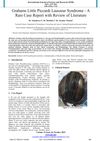 October 2023 in “International Journal of Science and Research (IJSR)”
 This paper describes Grahams Little Piccardi Lassueur Syndrome, a rare type of Lichen Planopilaris that causes different types of alopecia and distinctive skin papules, primarily affecting females aged 40 to 70, and notes the current challenges in treatment options, particularly once scarring occurs.
10 citations
,
November 2018 in “bioRxiv (Cold Spring Harbor Laboratory)” This study introduced laser particles as a new imaging probe capable of real-time tracking of thousands of individual cells in 3D tumor models, suggesting potential for advanced single-cell analyses.
 6 citations
,
November 2018 in “Photodiagnosis and Photodynamic Therapy”
6 citations
,
November 2018 in “Photodiagnosis and Photodynamic Therapy” This study found that using a wearable low-level light therapy device for photodynamic therapy significantly reduced actinic keratosis lesions and improved quality of life in patients with AK of the scalp.
115 citations
,
January 2002 in “American Journal of Clinical Dermatology” 220 citations
,
June 2013 in “The Journal of Pathology” This study found that immune privilege collapse in the hair follicle bulge and associated immune responses may contribute significantly to the pathogenesis of lichen planopilaris, suggesting a potential autoimmune basis for the disease.
 April 2017 in “Australasian Journal of Dermatology”
 This study observed that systemic acitretin improved symptoms in 75% of lichen planopilaris patients, despite varied responses and a dominant female prevalence.
 April 2026 in “International Journal of Clinical Case Reports and Reviews”
 In this preclinical study, researchers developed and evaluated a new non-invasive laser system designed for personalized medical use, showing its potential for chronic disease management and adjunctive fat reduction by offering enhanced treatment precision and adaptability over existing devices.
24 citations
,
July 2015 in “Molecular Medicine Reports” This study found that lysophosphatidic acid increases mesenchymal stem cell proliferation and migration through signaling pathways and reactive oxygen species, implicating potential applications in stem cell expansion.
 14 citations
,
January 2015 in “Skin appendage disorders”
14 citations
,
January 2015 in “Skin appendage disorders” This study reports that subtle presentations of lichen planopilaris may be mistaken for seborrheic dermatitis in patients with androgenetic alopecia, highlighting the importance of dermatoscopy-guided biopsy for accurate diagnosis.
1 citations
,
September 2020 in “Journal of dermatology” This study identified a novel mutation and confirmed a previous mutation in the LIPH gene in a woman with autosomal recessive woolly hair, expanding the mutation spectrum for this condition.
 January 2023 in “Dermatologic Therapy”
 This study evaluated a novel hand-held low-level light therapy device for treating mild-to-moderate acne, finding it significantly reduced inflammatory lesions and moderate acne severity without severe adverse reactions, while also reducing Cutibacterium acnes viability in vitro.
November 2016 in “韓方眼耳鼻咽喉皮膚科學會誌 = The journal of Korean Medicine Ophthalmology & Otolaryngology & Dermatology” This study reports on the effects of combining low level laser therapy, acupuncture, and herbal medicine for treating hair loss in a patient with alopecia areata and bed sore-related alopecia over three months.
January 2025 in “Dermatology Research and Practice” In this research, RNA expression analysis of scalp biopsies from lichen planopilaris patients revealed changes in specific genes after treatments with hydroxychloroquine, narrow band UVB, or low level laser light therapy, suggesting potential biomarkers and implicating M2 macrophages in the disease's immunopathogenesis.
 1 citations
,
February 2010 in “Proceedings of SPIE”
1 citations
,
February 2010 in “Proceedings of SPIE” This study suggests that low level laser therapy may promote hair cell regeneration in rat cochlear explants following gentamicin-induced damage.
19 citations
,
July 1997 in “British Journal of Dermatology” This study successfully developed and characterized a monospecific monoclonal antibody, LHTric-1, that specifically localizes to the pre-cortical region of the hair follicle and can aid research on hair and nail formation.
February 2024 in “Al-Azhar International Medical Journal /Al-Azhar International Medical Journal” This study concluded that topical betamethasone valerate lotion is more effective than topical 15% lactic acid solution for managing multiple patchy alopecia areata over a 12-week treatment period.
 November 2023 in “Scientific Reports”
 In this study, researchers used NIH hairless mice to uncover genetic markers associated with hair loss and identified a Lama3 point mutation as a potential genetic contributor, creating a mutant mouse model that may advance the study of androgenetic alopecia.