 18 citations
,
November 2012 in “Australasian Journal of Dermatology”
18 citations
,
November 2012 in “Australasian Journal of Dermatology” This case report describes a 66-year-old man with frontal fibrosing alopecia, a rare lichen planopilaris variant, presenting with scarring alopecia at the hairline and extensive body hair loss.
 July 2023 in “Journal of Education, Health and Sport”
 This literature review reports that micro-needle radiofrequency is increasingly recognized in aesthetic medicine as a safe, effective treatment for various skin conditions, but further research is needed to optimize treatment parameters for the best outcomes.
 6 citations
,
January 2017 in “British Journal of Dermatology”
6 citations
,
January 2017 in “British Journal of Dermatology” This article reviews frontal fibrosing alopecia, exploring its characteristics, demographics, and associated conditions, and calls for controlled trials due to an increase in worldwide cases; it reports no new findings.
This study found that WISP-1 plays a key role in ligamentum flavum fibrosis through the Hedgehog-Gli1 pathway, with cyclopamine showing potential to reduce fibrosis effects in a rabbit model.
July 2020 in “DOAJ (DOAJ: Directory of Open Access Journals)” This review suggests that excessive facial photoprotection could play a role in frontal fibrosing alopecia through a disturbance in immunological balance via the aryl hydrocarbon receptor-kynurenine pathway.
 16 citations
,
February 2010 in “Journal of the European Academy of Dermatology and Venereology”
16 citations
,
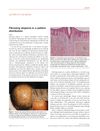
February 2010 in “Journal of the European Academy of Dermatology and Venereology” This article is a letter to the editor about fibrosing alopecia in a pattern distribution and reports no new research findings.
14 citations
,
August 2015 in “Endocrinology” This study describes the development of a monoclonal antibody, 005-C04, which blocks PRLR-mediated signaling, suggesting its potential for furthering understanding of PRLR's role in health and disease.
 November 2025 in “Cosmetics”
 This study evaluated a hair mask containing rice germ oil GX-N and ferulic acid on damaged hair and found that rice germ oil GX-N improved hair characteristics after bleaching, UV, and heat exposure, but adding ferulic acid did not provide extra benefits.
February 2009 in “Journal of Investigative Dermatology” EGFR is essential for organized skin nerve growth and branching.
October 2023 in “Journal of Pakistan Association of Dermatologists” In this study, reflectance confocal microscopy was shown to provide early insights into sub-clinical treatment progress in patients with androgenetic alopecia, potentially offering advantages over global photography.
38 citations
,
April 2018 in “Diseases” This study observed that fibrin rich in leukocytes and platelets (L-PRF) might effectively heal diabetic foot ulcers with osteomyelitis, showing positive preliminary results in all three patients treated.
 25 citations
,
July 2013 in “Journal of Dermatological Science”
25 citations
,
July 2013 in “Journal of Dermatological Science” This study suggests that the androgen receptor locus on the X chromosome may play a role in the pathogenesis of early-onset female pattern hair loss.
20 citations
,
March 1975 in “Journal of steroid biochemistry/Journal of Steroid Biochemistry” This study found a direct correlation between the testicular feminization gene and decreased androgen receptor activity, potentially explaining the androgen insensitivity in affected individuals.
198 citations
,
September 2007 in “Clinics in Dermatology” Radiofrequency devices effectively tighten skin without surgery.

This study found that injecting sFRP4 into mouse skin partially inhibited hair follicle regeneration, suggesting a potential therapy for hair follicle regeneration disorders.
 November 2025 in “Clinical Cosmetic and Investigational Dermatology”
 LIPH mutations cause woolly hair in some Chinese people.
 April 2023 in “The journal of investigative dermatology/Journal of investigative dermatology”
 This study reported significant transcriptomic changes in keratinocyte and immune cell populations in a mouse model with EGFR-deficient epidermis, suggesting possible targets for mitigating adverse skin events in EGFR-targeted cancer therapy.
 2 citations
,
January 2007 in “Journal of The American Academy of Dermatology”
2 citations
,
January 2007 in “Journal of The American Academy of Dermatology” Red and infrared light therapy improves hair growth in balding patients.
July 2025 in “Journal of the European Academy of Dermatology and Venereology” This study reports no new findings but provides corrected figures for the long-term safety and efficacy of ritlecitinib in treating alopecia areata from the ALLEGRO-LT phase 3 study.
 115 citations
,
March 2019 in “Nature Communications”
115 citations
,
March 2019 in “Nature Communications” This study identified significant genetic associations with frontal fibrosing alopecia at four genomic loci, suggesting it is a genetically predisposed immuno-inflammatory disorder influenced by the HLA-B*07: 02 allele.
October 2021 in “QJM: An International Journal of Medicine” This study suggests that altered levels of NRF2 may be important in the development of androgenetic alopecia in men.
June 2003 in “Faculty Opinions – Post-Publication Peer Review of the Biomedical Literature” GLABRA2 represses root hair formation by inhibiting a specific gene.
 45 citations
,
January 2014 in “International Journal of Trichology”
45 citations
,
January 2014 in “International Journal of Trichology” This study found that low-level laser therapy may improve hair growth in patients with androgenetic alopecia, either as a standalone treatment or combined with minoxidil or finasteride, without reported adverse reactions.
 1 citations
,
May 2015 in “Journal of The American Academy of Dermatology”
1 citations
,
May 2015 in “Journal of The American Academy of Dermatology” Lichen planus pigmentosus and fibrosing frontal alopecia in Colombia are likely different stages of the same disease.
 4 citations
,
January 2016 in “International journal of reproduction, contraception, obstetrics and gynecology”
4 citations
,
January 2016 in “International journal of reproduction, contraception, obstetrics and gynecology” This study found that the FSHR Ser680Asn (rs6166) gene polymorphism is associated with an increased risk of PCOS in the examined population and could serve as a molecular biomarker for identifying risk.
 5 citations
,
July 2003 in “Drug Development Research”
5 citations
,
July 2003 in “Drug Development Research” In this study, using a novel topical androgen receptor suppressor, fluridil, significantly increased the percentage of growing hairs in males with androgenetic alopecia without systemic absorption or adverse side effects.
 4 citations
,
April 2021 in “Frontiers in Immunology”
4 citations
,
April 2021 in “Frontiers in Immunology” This study found that clusters of mRNAs and lncRNAs in the peripheral blood of PCOS patients were aberrantly expressed, and certain lncRNA-mRNA pairs in the chemokine signaling pathway may be genetically related to PCOS.
 1 citations
,
June 2012 in “Revista Brasileira de Cirurgia Plástica”
1 citations
,
June 2012 in “Revista Brasileira de Cirurgia Plástica” In this study, the authors reported that frontal rhytidectomy with a pre-hairline incision effectively reduces a long forehead in select patients, with patients feeling the benefits outweighed the visibility of the scar.
9 citations
,
July 2020 in “Cell Proliferation” In this study, EREG promoted hair growth by activating specific receptors in cell and animal models, indicating it may be a potential treatment for hair loss.
 8 citations
,
September 2011 in “European Journal of Dermatology”
8 citations
,
September 2011 in “European Journal of Dermatology” This study reports that most cases of frontal fibrosing alopecia did not show significant improvement with available treatments, and effective management remains unproven.