125 citations
,
August 2003 in “Development” In this study, mice engineered to express human EGFR showed tissue-specific growth defects and neurodegeneration rescue, but developed severe heart issues and accelerated bone cell differentiation.
90 citations
,
August 2006 in “British Journal of Dermatology” This paper describes the PRIDE syndrome associated with epidermal growth factor receptor inhibitors but reports no new clinical results.
12 citations
,
November 2022 in “Toxics” This review describes how liver and kidney diseases and diabetes may affect ethyl glucuronide levels in hair, impacting forensic and clinical interpretations, but reports no new experimental results.
3 citations
,
January 2025 in “International Journal of Molecular Sciences” In this study, researchers investigated EGCG's spectroscopic properties and its interaction with DPPG lipid, finding that both experimental and theoretical approaches agree on the electronic transitions and reveal an increased absorbance due to molecular interactions.
15 citations
,
August 1991 in “Histochemistry and Cell Biology” Enhancing Factor is found in growing tissues like young mouse intestines and skin but not in adults.
5 citations
,
January 2022 in “Asian Journal of Pharmaceutical and Clinical Research” In this review, the authors highlight that emulgels, a combination of gel and emulsion, provide an effective topical drug delivery system for hydrophobic drugs, offering benefits like controlled release and versatility in treating various dermatological conditions.
 April 2018 in “The journal of investigative dermatology/Journal of investigative dermatology”
 This study describes a new method for isolating intact human eccrine glands from scalp follicular units, potentially advancing research on sweat gland physiology.
39 citations
,
March 2009 in “Dermatology Online Journal” This review observes that trichomegaly, a newly described side effect of EGFR inhibitors causing excessive eyelash and scalp hair growth, persists in some patients whose tumors respond positively to the therapy.
 May 2026 in “International Journal of Drug Delivery Technology”
 This case study highlights Erythromelanosis follicularis faciei et colli as an easily overlooked pigmentary disorder characterized by a distinctive triad requiring precise diagnosis for effective patient counseling and cosmetic management.
33 citations
,
June 2009 in “Journal of Cutaneous Pathology” This article discusses the cutaneous side effects of erlotinib, an EGFR inhibitor, in a patient with non-small cell lung cancer, reporting nonscarring alopecia and indicative scalp biopsy findings.
36 citations
,
June 2012 in “Alcoholism Clinical and Experimental Research” This study found that patients with decreased kidney function had significantly higher hair levels of ethyl glucuronide compared to healthy individuals, suggesting these results should be cautiously interpreted.
 10 citations
,
October 2015 in “Medicina Clínica (english Edition)”
10 citations
,
October 2015 in “Medicina Clínica (english Edition)” This review discusses the therapeutic potential and safety of bioidentical recombinant human epidermal growth factor (rhEGF) for various skin and mucosa conditions and reports no new clinical results.
 19 citations
,
January 2009 in “Journal of Young Pharmacists”
19 citations
,
January 2009 in “Journal of Young Pharmacists” This study found that the alcoholic extract of Eclipta alba exhibited dose-dependent antianaphylactic effects in animal models, possibly due to membrane stabilization and reduced histamine release.
 3 citations
,
August 2021 in “Research Square (Research Square)”
3 citations
,
August 2021 in “Research Square (Research Square)” This study found that increased mRNA expression of the Ectodysplasin-A2-Receptor, observed across multiple species and tissues, may exacerbate inflammation during aging, suggesting potential benefits of blocking EDA2R/EDA-A2 signaling.
January 2012 in “Journal of Northwest A & F University” In this study, the researchers observed that Eda mRNA expression in goat skin peaks during the catagen phase of the hair cycle, suggesting its involvement in hair cycle regulation.
 April 2023 in “Journal of Investigative Dermatology”
 This study reports that improvements to the EczemaNet pipeline, incorporating pixel-level segmentation and data augmentation, enhanced the reliability and interpretability of assessing atopic dermatitis severity from digital images.
5 citations
,
February 2014 in “PloS one” This study reports differential gene expression in the leading edge and inner surface epithelial cells of murine eyelids, suggesting that distinct signaling pathways are active during embryonic eyelid closure.
September 2017 in “The journal of investigative dermatology/Journal of investigative dermatology” This study found that N-acetyl-GED may protect and partially rescue human hair follicles from experimentally-induced epithelial-mesenchymal transition ex vivo, suggesting its potential in treating scarring alopecias like lichen planopilaris.
43 citations
,
January 2014 in “Indian Journal of Dermatology” This study reported that EGFR inhibitor therapy in lung and head/neck cancer patients was associated with acneiform eruptions and severe skin dryness, which rarely necessitate discontinuation of treatment and can be managed symptomatically.
48 citations
,
March 1993 in “The Laryngoscope” This study found that EGF receptors are aberrantly regulated and persist in cholesteatoma epithelium, suggesting a hyperproliferative character compared to normal human skin.
 12 citations
,
November 2006 in “Journal of thoracic oncology”
12 citations
,
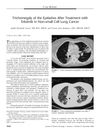
November 2006 in “Journal of thoracic oncology” This case report describes a patient with non-small cell lung cancer who experienced trichomegaly (excessive eyelash growth) as a side effect of erlotinib treatment without developing typical skin rash.
 4 citations
,
May 2021 in “The journal of investigative dermatology/Journal of investigative dermatology”
4 citations
,
May 2021 in “The journal of investigative dermatology/Journal of investigative dermatology” This study reported that ELL is crucial for maintaining the proliferative capacity of the basal layer in human epidermal keratinocytes by stabilizing RNA polymerase II at the transcription start site.
 August 1995 in “Journal of The European Academy of Dermatology and Venereology”
 New therapy helps treat hair loss.
 August 1995 in “Journal of The European Academy of Dermatology and Venereology”
 New therapy helps treat hair loss.
July 2026 in “Journal of the American Academy of Dermatology” Estetrol (E4) can help hair grow longer by extending its growth phase.
2 citations
,
January 2012 in “Zhongguo nongye Kexue” In this study, epidermal growth factor expression significantly correlated with the development of secondary hair follicles in Jining Gray goats until two months of age.
97 citations
,
June 2013 in “Journal of Dermatological Science” This review discusses the role of the EGF receptor/ligand system in skin homeostasis and its implications for keratinocyte stem cells and reports no new clinical results.
9 citations
,
July 2020 in “Cell Proliferation” In this study, EREG promoted hair growth by activating specific receptors in cell and animal models, indicating it may be a potential treatment for hair loss.
29 citations
,
June 2014 in “Experimental Cell Research” This study found that treating mouse epidermal neural crest stem cells with EGF and FGF2 increased their proliferation and enhanced their neuronal differentiation potential.
25 citations
,
April 2008 in “Clinical and experimental dermatology” This case series describes Erythromelanosis follicularis faciei et colli in five Indian patients, suggesting it may be more common than currently reported.