August 2025 in “Biomacromolecules”
 This study presents a novel composite hydrogel dressing with berberine-loaded silk fibroin microspheres and Calotropis gigantea fibers, demonstrating enhanced antibacterial activity, mechanical strength, and wound healing capabilities in treating chronic and infected wounds.
July 2025 in “Colloids and Surfaces B Biointerfaces” This study found that the new delivery system HL@Mi enhanced the skin penetration, local bioavailability, and safety of minoxidil, supporting improved hair growth in an androgenetic alopecia animal model.
June 2025 in “ACS Materials Letters”  June 2025 in “ACS Biomaterials Science & Engineering”
 In this study, researchers developed a new microneedle patch delivery system for minoxidil, which enhanced its controlled release and improved hair growth in mice, potentially offering better treatment outcomes for androgenetic alopecia.
May 2025 in “Acta Biomaterialia” This study developed microneedles combining insulin-like growth factor-1 and type XVII collagen, showing more effective hair regeneration and reduced inflammation compared to minoxidil in a mouse model of androgenetic alopecia.
 May 2025 in “Journal of the American Academy of Dermatology”
 This review highlights the available and investigational anti-androgen treatments for female pattern hair loss in the US, noting their limitations and the potential for fewer systemic side effects with topical options compared to oral medications.
 March 2025 in “Journal of Controlled Release”
 This study found that a biocomposite microneedle system, which includes selenium nanozyme and hypoxic extracellular vesicles, enhanced hair density and follicle diameter in androgenetic alopecia mice by fighting inflammation, promoting blood vessel growth, reducing reactive oxygen species, and counteracting androgen effects.
 November 2024 in “ACS Materials Letters”
 This study developed a nitric oxide delivery system using PVA films and HA liposomes, which enhanced hair follicle vitality and repaired blood vessels in androgenic alopecia by promoting angiogenesis and reducing inflammation through the HIF-1 signaling pathway.
 May 2024 in “Chemical engineering journal”
 This study reports that a new minoxidil and epigallocatechin gallate co-loaded ionic liquids system showed superior efficacy in promoting hair regrowth in a mouse model of androgenic alopecia by activating hair follicle stem cells and improving microenvironment conditions, compared to existing minoxidil products.
 March 2024 in “ACS Applied Materials & Interfaces”
 This study developed a delivery platform using hyaluronic acid-based dissolvable microneedles with nanoliposomes containing kopexil and kopyrrol, which showed improved hair regeneration for treating androgenetic alopecia in vivo at lower dosages compared to minoxidil.
 June 2023 in “Stem cell reviews and reports”
 This review summarizes current methods, effectiveness, and clinical progress of stem cell therapies for androgenetic alopecia, highlighting their potential for hair regrowth and follicle repair despite unclear long-term effects and mechanisms.
This comprehensive review analyzes androgenetic alopecia treatments, discussing the mechanisms, costs, efficacy, and safety of FDA-approved drugs like minoxidil and finasteride, as well as newer non-FDA-approved options that have shown effectiveness across various studies.
March 2023 in “ACS Applied Materials & Interfaces” This study reports that a water-soluble microneedle patch with minoxidil-loaded microspheres showed similar or better hair regeneration effects in mice with less frequent application compared to daily topical minoxidil.
 February 2023 in “International Journal of Pharmaceutics”
 In this study, the researchers developed minoxidil cubosomes using nanotechnology, which improved drug penetration in the skin, showed greater hair growth efficacy, and reduced adverse skin reactions compared to traditional minoxidil solutions.
 12 citations
,
February 2022 in “Acta Biomaterialia”
12 citations
,
February 2022 in “Acta Biomaterialia” In this study, researchers found that dissolving microneedles made with hyaluronic acid enhanced the effectiveness of minoxidil in reducing hair loss and promoting hair growth in alopecia-affected mice more effectively than topical minoxidil alone, while using only 10% of the drug amount.
 9 citations
,
February 2022 in “European Journal of Pharmaceutics and Biopharmaceutics”
9 citations
,
February 2022 in “European Journal of Pharmaceutics and Biopharmaceutics” This study suggests that a nanostructured lipid carrier formulation delivering minoxidil and latanoprost may enhance effectiveness and tolerability in treating alopecia by targeting hair follicles.
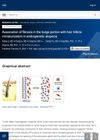 February 2021 in “Journal of The American Academy of Dermatology”
 This study observed that fibrosis occurs in the bulge region of hair follicles affected by androgenetic alopecia and is correlated with the hair miniaturization process.
 46 citations
,
January 2020 in “Theranostics”
46 citations
,
January 2020 in “Theranostics” This study demonstrated that OSA hydrogels enhanced the stability and retention of dermal papilla-derived extracellular vesicles, which significantly improved hair regeneration in both cultured human hair and a mouse depilation model.
 16 citations
,
September 2018 in “Journal of Ethnopharmacology”
16 citations
,
September 2018 in “Journal of Ethnopharmacology” This review discusses the role of inheritance, androgens, and microinflammation in androgenetic alopecia and suggests some plant-based folk remedies may help address these factors but reports no new clinical results.
24 citations
,
January 2018 in “Indian Journal of Dermatology, Venereology and Leprology” This review discusses advances in molecular biology and genetics related to androgenetic alopecia and reports no new clinical results.
 19 citations
,
November 2017 in “Journal of Pharmaceutical Sciences”
19 citations
,
November 2017 in “Journal of Pharmaceutical Sciences” This research investigated aqueous alginate-based hydrogels for delivering minoxidil and reported that using hydroxypropyl-β-cyclodextrin (HP-β-CD) with molar substitution 0.65 significantly enhanced minoxidil's solubility and skin permeability without damaging the epidermis, suggesting potential as an alternative to commercial minoxidil solutions.
 14 citations
,
August 2013 in “Facial Plastic Surgery Clinics of North America”
14 citations
,
August 2013 in “Facial Plastic Surgery Clinics of North America” This review discusses current and emerging medical therapies for androgenetic alopecia but reports no new clinical findings, emphasizing the importance of stabilizing the condition as a complement to surgical hair restoration.
 95 citations
,
January 2012 in “British Journal of Dermatology”
95 citations
,
January 2012 in “British Journal of Dermatology” This study found that androgens inhibit hair follicle stem cell differentiation by disrupting the Wnt signalling pathway in dermal papilla cells, but Wnt activation can restore differentiation.
 227 citations
,
January 1998 in “Journal of Endocrinology”
227 citations
,
January 1998 in “Journal of Endocrinology” This study found that dermal papilla cells from balding scalp hair follicles have significantly higher levels of androgen receptors than those from non-balding follicles, supporting their in vivo androgen response.
77 citations
,
January 1993 in “Skin Pharmacology and Physiology” In this study, topically applied glucocorticosteroids were found to block hair growth at the stage of hair formation, but not the initiation of hair growth, in a mouse model.
 21 citations
,
October 1988 in “Clinics in Dermatology”
21 citations
,
October 1988 in “Clinics in Dermatology” This study found that topical minoxidil induced hair regrowth in stumptailed macaques, with more significant effects observed in younger animals, while cessation led to renewed balding and retreatment restored regrowth.