 1 citations
,
April 2023 in “Science Advances”
1 citations
,
April 2023 in “Science Advances” This study found that sustained ERK activity during tissue regeneration in spiny mice is linked to fibroblast growth factor and ErbB signaling, while inhibiting ERK shifted regeneration toward scarring.
 22 citations
,
May 2021 in “Nature Communications”
22 citations
,
May 2021 in “Nature Communications” This study found that in wound-induced hair neogenesis, African spiny mice and laboratory mice exhibit different morphogenetic field formation patterns related to tissue stiffness, suggesting evolutionary developmental biology advantages.
 13 citations
,
January 2020 in “Scientific Reports”
13 citations
,
January 2020 in “Scientific Reports” This study found distinct differences in protein expression and wound healing pathways between Acomys cahirinus and Mus musculus, highlighting potential targets for reducing fibrotic response in mammals.
8 citations
,
November 2019 in “Tissue Engineering Part A” In this study, collagen scaffolds functionalized with heparin and growth factors significantly enhanced long-term skin regeneration and growth in a sheep model of fetal skin defect, suggesting potential for prenatal spina bifida treatment.
 24 citations
,
May 2019 in “PLOS ONE”
24 citations
,
May 2019 in “PLOS ONE” In this study, researchers observed that African spiny mice, Acomys cahirinus, are capable of regenerating skeletal muscle in dermal wound sites, unlike common mice, Mus musculus.
 19 citations
,
November 2018 in “Experimental Dermatology”
19 citations
,
November 2018 in “Experimental Dermatology” This review explores the skin regeneration process in spiny mice and highlights differences from laboratory mice, focusing on potential molecular and immune system roles without reporting new experimental results.
 85 citations
,
December 2017 in “Developmental Biology”
85 citations
,
December 2017 in “Developmental Biology” This review discusses mammalian models of epimorphic regeneration to define a vertebrate regeneration blastema, concluding that regenerative failure likely stems from cellular responses to the microenvironment after injury, not progenitor cell availability, and calls for targeted modification studies in mammals to advance human regeneration.
 418 citations
,
September 2012 in “Nature”
418 citations
,
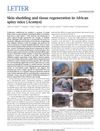
September 2012 in “Nature” This study reports the first instance of skin autotomy in mammals, specifically in African spiny mice, and suggests they may possess a greater regenerative capacity than previously understood, possibly offering insights for regenerative medicine.
29 citations
,
October 2010 in “Acta Biomaterialia”