 77 citations
,
July 2012 in “Journal of Investigative Dermatology”
77 citations
,
July 2012 in “Journal of Investigative Dermatology” The researchers observed that overexpression of Wnt10b in a mouse model can induce hair follicle regeneration by switching follicles from the resting phase to the growth phase via the Wnt-β-catenin signaling pathway.
 101 citations
,
December 2010 in “The journal of investigative dermatology/Journal of investigative dermatology”
101 citations
,
December 2010 in “The journal of investigative dermatology/Journal of investigative dermatology” This study reports the successful differentiation of mouse induced pluripotent stem cells into keratinocytes that can regenerate skin and its structures in an in vivo environment.
36 citations
,
April 2010 in “The journal of investigative dermatology/Journal of investigative dermatology” This study found that canine bulge-derived keratinocytes are highly proliferative and can reconstitute pilosebaceous structures, indicating their potential utility in studying human stem cell biology and hair disorders.
 321 citations
,
December 2009 in “Journal of Dermatological Science”
321 citations
,
December 2009 in “Journal of Dermatological Science” This review discusses the role of dermal cells in hair follicle regeneration and morphogenesis and highlights their potential therapeutic implications, but it reports no new empirical findings.
43 citations
,
September 2009 in “Stem Cells” This study reported that GFP labeling driven by the K15 promoter enables visualization and selection of stem cells in adult human scalp hair follicles for further analysis and manipulation.
 131 citations
,
July 2009 in “Experimental Dermatology”
131 citations
,
July 2009 in “Experimental Dermatology” This review discusses the development and advances in studying trichogenic dermal cells for hair follicle morphogenesis, summarizing methods, bioassays, and molecular markers, but reports no new research findings.
 71 citations
,
October 2008 in “The journal of investigative dermatology/Journal of investigative dermatology”
71 citations
,
October 2008 in “The journal of investigative dermatology/Journal of investigative dermatology” This study presents a novel in vitro assay using human folliculoid microspheres to research hair growth, which may facilitate preclinical testing of hair growth-modulatory agents.
193 citations
,
May 2008 in “Development” This study found that activating β-catenin signaling in embryonic epidermis promoted hair follicle characteristics at the expense of normal epidermal differentiation, leading to early pigmentation and innervation.
46 citations
,
November 2007 in “Gene Expression Patterns” This study observed that Trps1 gene expression in mice is precisely regulated in skin development, particularly during hair follicle morphogenesis, with distinct localization patterns in different cell types.
 829 citations
,
May 2007 in “Nature”
829 citations
,
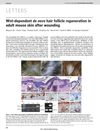
May 2007 in “Nature” Hair follicles can regrow in wounded adult mouse skin using a process like embryo development.
 96 citations
,
April 2007 in “Journal of Investigative Dermatology”
96 citations
,
April 2007 in “Journal of Investigative Dermatology” In this study, co-grafting human keratinocytes with murine dermal papilla-enriched cells produced hair follicle-like structures, but without regular hair formation, suggesting anomalous folliculogenesis.
 26 citations
,
January 2007 in “Organogenesis”
26 citations
,
January 2007 in “Organogenesis” This review outlines the evolution of hair follicle engineering and its foundational discoveries, but reports no new experimental results.
38 citations
,
December 2006 in “Journal of Investigative Dermatology” Keratin patterns in hair follicles help understand hair growth and potential hair and nail disorders.
14 citations
,
October 2006 in “Journal of Investigative Dermatology” This review discusses the evolution and revision of keratin protein nomenclature in light of genomic discoveries, reporting no new experimental results; the authors propose a new naming system for future keratin publications.
550 citations
,
December 2005 in “The Journal of clinical investigation/The journal of clinical investigation” This study found that bulge cells marked by CD200+ in human hair follicles show high colony-forming efficiency, suggesting successful enrichment of keratinocyte stem cells.
 417 citations
,
September 2005 in “PLoS biology”
417 citations
,
September 2005 in “PLoS biology” This study developed molecular signatures for dermal papilla cells and their niche, uncovering novel signaling regulators and genes linked to hair disorders, which may inform future hair development research.
 205 citations
,
April 2005 in “Journal of Investigative Dermatology”
205 citations
,
April 2005 in “Journal of Investigative Dermatology” This study describes a system for generating hair follicles from dissociated cells in mice, suggesting that successful development requires a foundational epithelial platform.
 208 citations
,
December 2003 in “Journal of Investigative Dermatology”
208 citations
,
December 2003 in “Journal of Investigative Dermatology” This study found that dermal papilla and peribulbar dermal sheath cup cells in mice can both induce hair follicle formation, suggesting they may have similar functional roles in hair growth.
 190 citations
,
October 2002 in “The FASEB journal”
190 citations
,
October 2002 in “The FASEB journal” In this study, androgen did not affect keratinocyte growth in coculture with androgenetic alopecia-derived dermal papilla cells, but did significantly suppress keratinocyte growth when androgen receptor was overexpressed in the papilla cells.
 1113 citations
,
August 1999 in “The New England Journal of Medicine”
1113 citations
,
August 1999 in “The New England Journal of Medicine” This article discusses the biologic and psychosocial significance of hair, the current limitations in hair growth drugs, and anticipates future therapies based on advancing hair follicle research.
745 citations
,
February 1992 in “Trends in genetics” This article describes the potential role of various growth factors and molecules in regulating mammalian hair follicle development but does not present new experimental results.