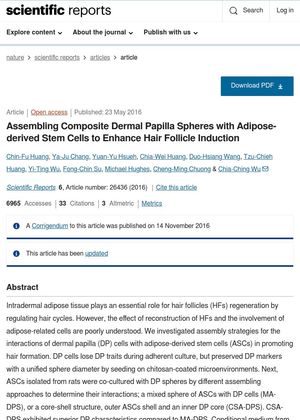
 35 citations
,
January 2014 in “Journal of Tissue Engineering”
35 citations
,
January 2014 in “Journal of Tissue Engineering” This review discusses recent advances in the role of dermal papilla cells and adipocyte lineage cells in hair regeneration, but it reports no new clinical results.
71 citations
,
December 2013 in “The journal of investigative dermatology. Symposium proceedings/The Journal of investigative dermatology symposium proceedings” This review discusses various treatments for alopecia areata, highlighting their limitations and individualized approach, and reports no new clinical results.
 28 citations
,
November 2013 in “The journal of investigative dermatology/Journal of investigative dermatology”
28 citations
,
November 2013 in “The journal of investigative dermatology/Journal of investigative dermatology” This study found that the selective PPARγ modulator GMG-43AC may inhibit unwanted hair growth by inducing catagen phase while preserving hair follicle epithelial progenitor cells, suggesting potential in anti-hirsutism therapy.
 57 citations
,
February 2013 in “Journal of Dermatological Science”
57 citations
,
February 2013 in “Journal of Dermatological Science” This article reviews methods to enhance epithelial–mesenchymal interactions for hair follicle bioengineering but does not present new experimental results; it emphasizes optimizing combinations for successful regeneration.
16 citations
,
February 2013 in “Molecular Medicine Reports” This study found that CD34+ cells from adipose tissue may enhance hair morphogenesis and participate in blood vessel formation in reconstituted skin tissues of mice.
 74 citations
,
January 2013 in “Expert Opinion on Biological Therapy”
74 citations
,
January 2013 in “Expert Opinion on Biological Therapy” This review discusses recent advances in hair follicle biology, regeneration, and tissue engineering, highlighting emerging therapeutic opportunities, and reports no new experimental results.
 78 citations
,
October 2012 in “Biomaterials”
78 citations
,
October 2012 in “Biomaterials” This study found that both human and rat dermal papilla spheroids can induce hair follicle neogenesis, but larger spheroids increase inductivity without significantly affecting hair fiber diameter.
 156 citations
,
October 2012 in “Seminars in Cell & Developmental Biology”
156 citations
,
October 2012 in “Seminars in Cell & Developmental Biology” This study found that hair follicle stem cells initially contribute to wound re-epithelialization, but long-lasting epidermal cells are primarily derived from a stem cell population in the isthmus portion of hair follicles.
 58 citations
,
September 2012 in “Dermatologic Clinics”
58 citations
,
September 2012 in “Dermatologic Clinics” This article reviews current knowledge on the causes, diagnosis, and medical treatments for androgenetic alopecia, particularly in men, and reports no new findings.
 499 citations
,
September 2011 in “Cell”
499 citations
,
September 2011 in “Cell” This study found that intradermal adipocyte lineage cells in mice are necessary and sufficient to activate follicular stem cells, highlighting their role in regulating skin stem cell activity.
 75 citations
,
August 2011 in “Journal of Investigative Dermatology”
75 citations
,
August 2011 in “Journal of Investigative Dermatology” This study found that cultured human dermal papilla cells formed into three-dimensional spheres have an increased ability to induce hair follicles from mouse epidermal cells compared to two-dimensional cultures.
 314 citations
,
April 2010 in “Developmental Cell”
314 citations
,
April 2010 in “Developmental Cell” This study found that in mice, inactivating beta-catenin in the dermal papilla reduces hair follicle progenitor proliferation and disrupts the hair cycle.
 5 citations
,
February 2010 in “Facial Plastic Surgery Clinics of North America”
5 citations
,
February 2010 in “Facial Plastic Surgery Clinics of North America” This article reviews the foundational tenets of hair restoration and emphasizes the importance of adapting techniques for different ethnic populations, but reports no new clinical results.
 134 citations
,
January 2010 in “Biomedical research”
134 citations
,
January 2010 in “Biomedical research” This study found that subcutaneous administration of conditioned medium from adipose-derived stem cells promoted hair growth in mice, and hypoxia enhanced this effect by altering growth factor secretion.
 321 citations
,
December 2009 in “Journal of Dermatological Science”
321 citations
,
December 2009 in “Journal of Dermatological Science” This review discusses the role of dermal cells in hair follicle regeneration and morphogenesis and highlights their potential therapeutic implications, but it reports no new empirical findings.
 81 citations
,
December 2009 in “Journal of Dermatological Science”
81 citations
,
December 2009 in “Journal of Dermatological Science” This review discusses the paracrine effects of adipose tissue-derived stem cells on surrounding cells and tissues, noting their potential therapeutic benefits, but reports no new clinical results.
 63 citations
,
September 2009 in “Regenerative Medicine”
63 citations
,
September 2009 in “Regenerative Medicine” This study developed a method for expanding human dermal papilla cells in vitro while maintaining their ability to induce hair growth, advancing the potential for follicular cell implantation as a treatment for hair loss.
 131 citations
,
July 2009 in “Experimental Dermatology”
131 citations
,
July 2009 in “Experimental Dermatology” This review discusses the development and advances in studying trichogenic dermal cells for hair follicle morphogenesis, summarizing methods, bioassays, and molecular markers, but reports no new research findings.
 44 citations
,
June 2009 in “Biomaterials”
44 citations
,
June 2009 in “Biomaterials” In this study, fibronectin coating on a low-adhesive substratum increased cell aggregation, growth, and motility, enhancing the formation of hair follicle dermal papilla spheroids.
 71 citations
,
October 2008 in “The journal of investigative dermatology/Journal of investigative dermatology”
71 citations
,
October 2008 in “The journal of investigative dermatology/Journal of investigative dermatology” This study presents a novel in vitro assay using human folliculoid microspheres to research hair growth, which may facilitate preclinical testing of hair growth-modulatory agents.
 80 citations
,
June 2008 in “Biomaterials”
80 citations
,
June 2008 in “Biomaterials” This study found that poly(ethylene-co-vinyl alcohol) membranes support the self-assembly of dermal papilla cells into compact spheroidal microtissues capable of inducing new hair follicles, suggesting potential for large-scale production for hair follicle regeneration.
 88 citations
,
May 2005 in “Journal of Dermatological Science”
88 citations
,
May 2005 in “Journal of Dermatological Science” In this study, specific versican expression was observed in the anagen phase of human hair follicles, suggesting its importance in maintaining normal hair growth.
 205 citations
,
April 2005 in “Journal of Investigative Dermatology”
205 citations
,
April 2005 in “Journal of Investigative Dermatology” This study describes a system for generating hair follicles from dissociated cells in mice, suggesting that successful development requires a foundational epithelial platform.
46 citations
,
November 2004 in “Lipids” This study suggests PPAR isotypes play distinct roles in skin, influencing epidermal barrier formation, sebocyte differentiation, and lipid production, with potential implications for treating skin disorders.
854 citations
,
February 2002 in “The journal of investigative dermatology/Journal of investigative dermatology” This review summarizes recent advances in understanding the molecular mechanisms of hair follicle formation and discusses potential future clinical applications for treating hair loss and skin tumors, but it reports no new clinical results.
51 citations
,
September 2000 in “Acta dermato-venereologica” This study found that PPAR alpha, -delta, and -gamma are expressed in human hair follicle cells, and clofibrate exhibited a beneficial effect on hair follicle survival in culture within a specific concentration range.