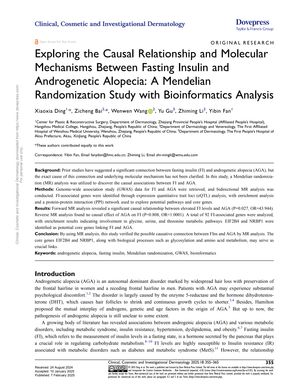
 May 2024 in “Skin research and technology”
 This study used Mendelian randomization analysis to identify Scyllo-inositol and Alpha-ketoglutarate as potential protective factors and Heme and 2-palmitoylglycerophosphocholine as risk factors for androgenic alopecia, suggesting a causal link between these metabolites and the condition.

Among young male patients in a cardiac care setting, this study found that 54.4% had androgenetic alopecia, supporting the hypothesis that vertex pattern baldness could indicate a higher risk of cardiovascular events. Further research is needed to confirm these findings.
5 citations
,
March 2022 in “Frontiers in Cell and Developmental Biology” This study found that exosomes derived from bovine colostrum promoted hair growth in mice by activating the Wnt/β-catenin pathway, with effects similar to minoxidil but without adverse effects.
 2 citations
,
January 2022 in “Dermatologic Therapy”
2 citations
,
January 2022 in “Dermatologic Therapy” Natural products like saw palmetto, caffeine, melatonin, marine extracts, rosemary oil, procyanidin, pumpkin seed oil, and cannabidiol oil could potentially treat male hair loss.
3 citations
,
December 2021 in “Acta dermato-venereologica” This meta-analysis found that patients with androgenetic alopecia had a significantly higher prevalence of metabolic syndrome and poorer metabolic profiles compared to controls, especially among females, those with early onset, and individuals of African ethnicity.
5 citations
,
February 2021 in “JCPSP. Journal of the College of Physicians & Surgeons Pakistan” This study investigated the relationship between early-onset androgenetic alopecia and metabolic syndrome in younger males, but the abstract does not report specific results.
 15 citations
,
June 2020 in “Experimental Dermatology”
15 citations
,
June 2020 in “Experimental Dermatology” This review discusses recent genetic findings on hormonal signaling pathways in androgenetic alopecia, reporting no new study results but highlighting the need for further investigation.
 53 citations
,
February 2020 in “Expert Opinion on Pharmacotherapy”
53 citations
,
February 2020 in “Expert Opinion on Pharmacotherapy” This review discusses pharmacologic and non-pharmacologic treatments for androgenetic alopecia, noting that current medications like finasteride and minoxidil can slow hair loss but only partially restore hair growth, with early treatment offering better outcomes.
 12 citations
,
November 2019 in “PLoS ONE”
12 citations
,
November 2019 in “PLoS ONE” This study suggests a weak association between male-pattern baldness and some coronary heart disease risk factors, but does not support it as a strong indicator of coronary risk.
 43 citations
,
November 2019 in “American Journal of Clinical Dermatology”
43 citations
,
November 2019 in “American Journal of Clinical Dermatology” This review discusses female androgenetic alopecia, highlighting its diagnostic challenges and management strategies, but it reports no new results.
 6 citations
,
June 2019 in “Skin Research and Technology”
6 citations
,
June 2019 in “Skin Research and Technology” In this study, finasteride treatment for two years did not significantly reverse miniaturized hair follicles in men with male pattern hair loss, challenging the "reversal hypothesis" as 79 out of 113 miniaturized hairs remained unchanged.
 26 citations
,
May 2019 in “PLOS ONE”
26 citations
,
May 2019 in “PLOS ONE” This study observed that hair follicles in hair loss patients had increased levels of Propionibacterium acnes, potentially linked to elevated immune response gene expression in miniaturized hair follicles.
10 citations
,
January 2019 in “Indian Journal of Dermatology” This study found that male patients with early-onset androgenetic alopecia were associated with metabolic syndrome, but not insulin resistance, compared to age-matched controls.
13 citations
,
January 2019 in “Indian Journal of Dermatology” This study found that men with early-onset androgenic alopecia had a higher prevalence of cardiovascular risk factors, indicating that early screening for metabolic syndrome may be beneficial in this population.
 30 citations
,
May 2018 in “Experimental Dermatology”
30 citations
,
May 2018 in “Experimental Dermatology” This article reviews the cellular dynamics affecting dermal papilla size in androgenetic alopecia and suggests targeting DP size could improve therapies, but it presents no new clinical data.
9 citations
,
January 2018 in “Indian Journal of Endocrinology and Metabolism” This study found that patients with androgenetic alopecia had a higher prevalence of metabolic syndrome compared to healthy controls.
 178 citations
,
April 2017 in “Journal of The American Academy of Dermatology”
178 citations
,
April 2017 in “Journal of The American Academy of Dermatology” This systematic review and meta-analysis found that minoxidil, finasteride, and low-level laser light therapy significantly improve hair growth in men with androgenetic alopecia, while minoxidil is also effective for women, compared to placebo.
 51 citations
,
November 2011 in “British Journal of Dermatology”
51 citations
,
November 2011 in “British Journal of Dermatology” This study suggests that the HDAC9 gene is a third susceptibility gene for male-pattern baldness, with significant associations found in both German and Australian samples.
 16 citations
,
March 2011 in “Dermatologic Therapy”
16 citations
,
March 2011 in “Dermatologic Therapy” This study suggests that genetic variants in the androgen receptor gene may predict which postmenopausal women with hair loss respond to finasteride therapy.
 28 citations
,
March 2009 in “Clinical and Experimental Dermatology”
28 citations
,
March 2009 in “Clinical and Experimental Dermatology” This article discusses the potential relationship between androgenic alopecia and insulin resistance but presents no new clinical findings, calling for further research on the topic.