8 citations
,
September 2020 in “British Journal of Dermatology” This study explored whether bald characters are disproportionately portrayed as villains in Hollywood films but reports no new empirical results; the authors suggest this pattern may reflect a societal bias associating alopecia with immorality.
 August 2019 in “Research Square (Research Square)”
 This study explored how long non-coding RNA mediates the effects of FGF5 on the hair follicle development and villus growth of Liaoning cashmere goats.
82 citations
,
January 2011 in “New Phytologist” This study demonstrated that AtVLN4 plays a role in root hair growth by regulating actin organization in a calcium-dependent manner.
 67 citations
,
January 2020 in “Cellular & Molecular Immunology/Cellular & molecular immunology”
67 citations
,
January 2020 in “Cellular & Molecular Immunology/Cellular & molecular immunology” This review discusses the dual role of tissue-resident memory T cells in providing immune protection against infections and cancer and contributing to autoimmune skin disease pathology, without presenting new experimental results.
 41 citations
,
April 2017 in “JAMA Dermatology”
41 citations
,
April 2017 in “JAMA Dermatology” This study found that the top 10 film villains have a higher frequency of significant dermatologic features than the top 10 heroes, which may contribute to societal prejudice against individuals with skin conditions.
16 citations
,
June 2022 in “Evidence-based Complementary and Alternative Medicine” This study reported that both Sterculia villosa bark and Vernonia patula plant extracts showed concentration-dependent antioxidant activities, with Vernonia patula demonstrating a stronger effect.
3 citations
,
April 2023 in “Veterinary sciences” This study found that among Large White × Min pigs, 15 significant copy number variation regions were associated with villi hair traits, and identified candidate genes potentially linked to cold resistance, suggesting implications for breeding cold-resistant pigs.
 December 2024 in “Buletin Veteriner Udayana”
 This case report from Darmasaba Village, Bali, identified Colisepticemia in a 27-day-old chicken, based on clinical signs, pathology, and laboratory tests, and highlighted the need for improved farm hygiene and sanitation to prevent disease spread.
 July 2019 in “International Journal of Advance Research in Community Health Nursing”
 This study observed that, among women in Padgampora Village, J&K, aged 15-45, 42.5% had PCOS between ages 15 and 25, with clinical signs like irregular cycles, obesity, acne, and more, highlighting the need for increased awareness and early intervention.
 4 citations
,
January 2019 in “International journal of bioorganic chemistry”
4 citations
,
January 2019 in “International journal of bioorganic chemistry” This study documented 64 medicinal plants used by local communities in Charmang, Pakistan, highlighting their potential significance for traditional medicine and future research on plant-derived therapies.
 9 citations
,
January 2020 in “Critical Reviews in Immunology”
9 citations
,
January 2020 in “Critical Reviews in Immunology” This review suggests that mucosa-associated invariant T cells may regulate the host response to SARS-CoV-2 and could be potential targets for COVID-19 management, but it reports no new clinical results.
 1 citations
,
March 2018 in “Policy and governance review”
1 citations
,
March 2018 in “Policy and governance review” This study explores the factors influencing canal blocking as a peat land fire prevention method in Sungai Tohor Village, Kepulauan Meranti Regency, highlighting government regulations, community participation, and local wisdom as key influences.
 November 2023 in “The Bovine practitioner”
 In this study, a 5-year-old Angus bull experienced systemic granulomatous disease and vasculitis potentially associated with grazing on hairy vetch, but other bulls in the same pasture showed no symptoms, suggesting variability in disease manifestation from similar exposures.
 July 2023 in “Biodiversitas”
 In this study, researchers found that Sundanese mothers in a rural village in West Java frequently used 25 medicinal plant species, primarily from the Zingiberaceae family, during pregnancy, childbirth, and postpartum, with popular preparations including decoctions and cooking.
 September 2021 in “Rumphius Pattimura Biological Journal”
 This study reports varying levels of potassium and iron in honey samples, contributing to the understanding of mineral content in honey.
December 2014 in “CVR Journal of Science & Technology” This study identified various functional groups and chemical constituents in dried leaves of the medicinal plant Bhringaraj, suggesting their potential use in developing wastewater treatment technologies.
47 citations
,
December 2021 in “Applied Sciences” This study demonstrated that Stellaria media extract may enhance wound healing in vitro by promoting cell migration and proliferation, with notable antioxidant and antimicrobial properties.
 45 citations
,
June 2004 in “Lasers in Medical Science”
45 citations
,
June 2004 in “Lasers in Medical Science” This study found that non-coherent intense pulsed light (IPL) treatment significantly reduced hair growth by about 80% in patients with skin type III-V without causing side effects.
 30 citations
,
March 2009 in “Journal of the European Academy of Dermatology and Venereology”
30 citations
,
March 2009 in “Journal of the European Academy of Dermatology and Venereology” This article describes petechiae on the fingertips as a presenting symptom of dermatitis herpetiformis but reports no new clinical results.
6 citations
,
August 2008 in “Journal of Paediatrics and Child Health” This case report describes a 5-year-old girl whose undiagnosed Coeliac disease presented with symptoms of alopecia, iron deficiency anemia, and trichobezoar, indicating a link between malabsorption, anemia, and resulting pica.
This study identified a 14,883 bp genomic deletion affecting the Plcd1 and Vill genes as likely responsible for the abnormal phenotype observed in snthr-1Bao mice.
August 2024 in “International Journal of Molecular Sciences” This study found that root hairs of wild-type Arabidopsis grow faster and longer under low potassium stress, with changes in actin filament dynamics and specific regulation by the actin bundling proteins VLN1 and VLN4.
 41 citations
,
March 2007 in “Steroids”
41 citations
,
March 2007 in “Steroids” This article reviews recent advances in the synthesis of oxasteroids and reports no new experimental results.
 January 2025 in “Journal of Rawalpindi Medical College”
 In this study, among 800 Pakistani patients with Alopecia Areata, the most common location for hair loss was the scalp (89.9%), with significant associations between age and various dermoscopic features like black dots and exclamation mark hairs.
 December 2023 in “Journal of nutritional science and vitaminology”
 This study in mice found that a zinc-deficient diet suppressed body weight gain and increased kidney and cecum tissue weight without decreasing serum alkaline phosphatase activity. Additionally, zinc deficiency caused alopecia and intestinal changes in C57BL/6J mice, potentially affecting nutritional status.
 March 2009 in “Prenatal Diagnosis”
 This paper discusses the management of pregnancy in a carrier of the Donohue mutation and reports no new clinical findings.
 5 citations
,
September 2010 in “Cancer Prevention Research”
5 citations
,
September 2010 in “Cancer Prevention Research” This perspective discusses Villani et al.'s findings on the role of the IGF regulatory protein Igfbp2 in basal cell carcinogenesis and highlights potential therapeutic and preventive targets, while raising questions about the cell of origin.
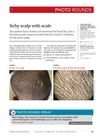 December 2020 in “The Journal of Family Practice”
 This report describes an 11-year-old boy in Panama who visited a village health center due to scalp itching and subtle hair loss, previously treated for head lice, with no hair pulling reported.
 July 2003 in “Journal of Cutaneous Medicine and Surgery”
 Stopping certain drugs can improve skin conditions, arsenicosis affects over half of a Bangladeshi village, males are more vulnerable, and certain treatments are effective for warts, acne, and psoriasis. Smoking and drinking are linked to psoriasis in men, a cream helps with a type of skin cancer, and low iron levels don't directly cause chronic hair loss in women.
8 citations
,
December 2022 in “BMC Genomics” This study revealed gene expression patterns in yak hair follicles during different growth phases, enhancing the understanding of cell fate specialization and providing insights for yak villus development.