 6 citations
,
April 2013 in “International Journal of Dermatology”
6 citations
,
April 2013 in “International Journal of Dermatology” This correspondence describes the dermoscopic features of an osteonevus of Nanta but does not report new clinical findings.
 3 citations
,
June 2023 in “Cureus”
3 citations
,
June 2023 in “Cureus” This case study describes a 4-year-old boy whose neck tumor was initially misdiagnosed as scrofuloderma before being correctly identified as a pilomatricoma, underscoring the need to include pilomatricoma in differential diagnoses for persistent skin lesions.
 3 citations
,
November 2020 in “Cleveland Clinic Journal of Medicine”
3 citations
,
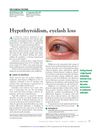
November 2020 in “Cleveland Clinic Journal of Medicine” Eyelash loss can be a sign of thyroid problems.
 3 citations
,
March 2020 in “International Journal of Dermatology”
3 citations
,
March 2020 in “International Journal of Dermatology” This correspondence about the treatment of chronic alopecia areata with tildrakizumab reports no clinical results; the authors present an open-label pilot study setup.
 3 citations
,
April 2019 in “Annals of hepatology”
3 citations
,
April 2019 in “Annals of hepatology” This case report described a peanut allergy transfer from an organ donor to two transplant recipients, emphasizing the need for pre-transplant donor allergy screening.
 3 citations
,
June 2014 in “Klinik Psikofarmakoloji Bulteni-bulletin of Clinical Psychopharmacology”
3 citations
,
June 2014 in “Klinik Psikofarmakoloji Bulteni-bulletin of Clinical Psychopharmacology” This article discusses historical serendipitous discoveries in science and medicine but provides no new research findings.
 2 citations
,
April 2019 in “Dermatologic Therapy”
2 citations
,
April 2019 in “Dermatologic Therapy” A patient with alopecia had hair regrowth with tofacitinib but developed a skin reaction, choosing to continue the treatment despite the side effect.
 2 citations
,
April 2017 in “Molecular Medicine Reports”
2 citations
,
April 2017 in “Molecular Medicine Reports” In this study, blocking autophagy with 3-methyladenine significantly improved the survival of inner ear hair cells in a gentamicin-induced ototoxic mouse model.
 1 citations
,
April 2021 in “Plant Archives/Plant archives”
1 citations
,
April 2021 in “Plant Archives/Plant archives” This review discusses the potential health benefits of Allium vegetables, especially their association with reduced cancer risk, but reports no new clinical outcomes.
 1 citations
,
July 2012 in “Springer eBooks”
1 citations
,
July 2012 in “Springer eBooks” The document concludes that more research is needed to better understand and treat scarring hair loss conditions.
 1 citations
,
October 2008 in “Expert Review of Dermatology”
1 citations
,
October 2008 in “Expert Review of Dermatology” This review discusses frontal fibrosing alopecia, noting its frequent misdiagnosis and highlighting the need for larger studies to better understand its epidemiology, causes, and treatment options; it reports no new clinical findings.
 1 citations
,
November 1953 in “Archives of Dermatology”
1 citations
,
November 1953 in “Archives of Dermatology” This case presentation by Dr. Howard Fox describes a persistent skin eruption in a woman following sun exposure and the use of a specific lotion, highlighting diagnostic challenges between Lupus Erythematosus and Erythema Perstans but reports no definitive diagnosis.
 May 2026 in “International Journal of Homoeopathic Sciences”
 In this case report, a middle-aged female patient experienced significant improvement in chronic telogen effluvium symptoms, including reduced hair fall and improved hair density, following an individualized homeopathic treatment at Dr. Batra’s, highlighting the role of addressing emotional, metabolic, and nutritional factors.
 May 2026 in “International Journal of Homoeopathic Sciences”
 In this case report, a 28-year-old woman with alopecia areata experienced reduced hair fall and gradual hair regrowth following treatment with individualized homeopathy, but the authors note that further studies with larger patient groups are needed to confirm these findings.
 December 2025 in “Universities Journal of Phytochemistry and Ayurvedic Heights”
 This study highlights a comprehensive approach for authenticating and assessing the quality of herbal medicines using a combination of physiological, morphological, and molecular techniques, including HPTLC, ICP-MS, UV spectroscopy, and DNA barcoding, to ensure the standardization of herbal medicinal products, particularly Eclipta alba.
 November 2025 in “International Journal Of Ayurvedic And Herbal Medicine”
 In this case study, a 22-year-old female with trichotillomania showed significant improvement through an integrated approach combining Growth Factor Concentrate therapy, Ayurvedic medications, counseling, and yogic practices, highlighting the importance of addressing both dermatological and psychological aspects for long-term recovery.
 May 2025 in “Galen Medical Journal”
 This research highlights advancements in understanding and treating psoriasis, finding that targeted therapies like IL-17 and IL-23 inhibitors show promise, but challenges such as adverse events, treatment resistance, and the need for personalized approaches remain.
 January 2025 in “UiTM Institutional Repositories (Universiti Teknologi MARA)”
 This study investigated the effects of Christia vespertilionis extract on breast cancer cell lines, finding that it had a concentration-dependent cytotoxic effect, although less potent than tamoxifen, suggesting potential as an alternative cancer treatment.
 October 2024 in “Asian Pacific Journal of Cancer Prevention”
 This study found that methanolic extract from Cnicus Benedictus leaves inhibits the growth of human cervical cancer cells in vitro and selectively targets cancer cells over normal cells, suggesting potential safety in its efficacy.
 March 2024 in “IP Indian journal of clinical and experimental dermatology”
 This case report highlighted the rarity and diagnostic challenges of a giant solitary trichoepithelioma occurring on the neck, noting that while typically benign, these tumors can rarely transform malignantly into basal cell carcinoma.
 March 2024 in “Poster presentations”
 This case report describes a 43-year-old woman diagnosed with both Kikuchi-Fujimoto disease and systemic lupus erythematosus, who showed clinical improvement after treatment with glucocorticoids and hydroxychloroquine, highlighting the rare coexistence of these conditions and the ongoing uncertainty about the precise cause of Kikuchi-Fujimoto disease.
 March 2023 in “Journal of Pakistan Society of Internal Medicine.”
 This case report highlights a young woman diagnosed with lupus enteritis, illustrating the importance of early diagnosis and treatment in this rare clinical manifestation of systemic lupus erythematosus.
 October 2022 in “Journal of advanced research in medicine”
 This case study reports that a 52-year-old woman with Sheehan syndrome improved after receiving hormone replacement therapy, highlighting its importance for patients with similar symptoms.
 September 2022 in “Dermatology and therapy”
 This review summarizes current evidence on the use of contact immunotherapy, excluding alopecia areata, for various skin diseases, discussing its safety, efficacy, and the underlying mechanisms as reported from studies in the PubMed database.
 June 2021 in “Asian Journal of Medical Sciences”
 This case study highlights that vitamin B12 deficiency can cause reversible hyperpigmentation, illustrated by a vegetarian female patient whose skin lesions improved after treatment.
 November 2020 in “International journal of contemporary pediatrics”
 This study reports two siblings with severe combined immunodeficiency due to a mutation in the FOXN1 gene, characterized by T-cell immunodeficiency, alopecia totalis, and nail dystrophy.
 April 2017 in “The journal of investigative dermatology/Journal of investigative dermatology”
 This study found that Quantitative Mass Spectrometry Imaging offers precise localization and quantification of active compounds in skin tissues, demonstrating benefits over traditional LC-MS in drug penetration studies.
 April 2017 in “The journal of investigative dermatology/Journal of investigative dermatology”
 In a guinea pig model of dermatophytosis, this study found that subcutaneous CD101, dosed once weekly, demonstrated significant clinical and mycological efficacy compared to the vehicle control and the oral antifungal terbinafine, suggesting potential for CD101 in treating fungal skin infections.
April 2017 in “The journal of investigative dermatology/Journal of investigative dermatology” This study found that topical Vorinostat induced significant hair regrowth in mice with alopecia areata, suggesting it as a potential repurposable treatment for the condition.
 June 2015 in “Journal of the turkish academy of dermatology”
 This review revisits the principles regarding the critical role of diet and nutrition in managing certain skin diseases but reports no new findings.