 April 2018 in “The journal of investigative dermatology/Journal of investigative dermatology”
 In a laboratory setting, this study found that Biotrinine® dry extract activated hair follicle growth pathways and increased certain growth factor secretions in human dermal papilla cells, suggesting potential benefits for treating chronic hair loss.
2 citations
,
May 2024 in “International Journal of Dermatology”  April 2023 in “The journal of investigative dermatology/Journal of investigative dermatology”
 In this study, a single subcutaneous dose of PTH-CBD showed similar hair regrowth to daily oral ruxolitinib in mice with alopecia, possibly through increased beta-catenin and anagen transition stimulation.
 December 2023 in “Journal of ethnopharmacology”
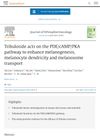
 This study found that tribuloside, a flavonoid from Tribulus terrestris L., enhances melanin production in human melanocytes, zebrafish, and human skin samples without causing toxicity, potentially through inhibiting PDE to increase cAMP levels and promote the melanin biosynthesis pathway.
6 citations
,
June 2009 in “Clinical and Experimental Dermatology” In this study, topical tacrolimus 0.1% ointment applied to mice skin decreased Vegf and Igf-1 mRNA levels during late anagen but did not alter hair cycling or skin appearance compared to untreated skin.
 January 2026 in “BULLETIN OF STOMATOLOGY AND MAXILLOFACIAL SURGERY”
 In this randomized controlled trial, both Botulinum Toxin-A and Triamcinolone Acetonide showed substantial effectiveness in treating patchy Alopecia Areata, but Botulinum Toxin-A avoided complications while Triamcinolone led to skin atrophy in 16.7% of patients.
54 citations
,
July 1994 in “Journal of Dermatological Science” This study found that topical application of FK506 stimulated hair growth in animals, which may occur independently of its immunosuppressive effects, though its effect on human hair growth remains unclear.
 April 2017 in “Journal of Investigative Dermatology”
 In this study, the authors concluded that the TS-associated polyomavirus may disrupt Wnt/β-catenin signaling, likely contributing to abnormal hair follicle formation in trichodysplasia spinulosa.
 April 2018 in “Journal of Investigative Dermatology”
 This study identified the osteopontin-derived peptide, FOL-005, as a potential inhibitor of unwanted human hair growth by promoting catagen development without reducing stem cell numbers or showing toxicity.
 July 2024 in “JAAD Case Reports”
 This source reports that while effective treatments for hereditary hypotrichosis simplex have been limited, recent studies show promising results using interventions such as minoxidil, topical gentamicin, and platelet-rich plasma injections.
36 citations
,
June 2003 in “The journal of small animal practice/Journal of small animal practice” This case report describes a domestic shorthaired cat with pituitary-dependent hyperadrenocorticism treated with trilostane, which improved clinical signs, but the cat later succumbed to renal failure due to a fungal urinary tract infection.
 14 citations
,
August 2007 in “Bioorganic & Medicinal Chemistry Letters”
14 citations
,
August 2007 in “Bioorganic & Medicinal Chemistry Letters” This study reported that the compound (1R, 2S)-4-(2-cyano-cyclohexyl-oxy)-2-trifluoromethyl-benzonitrile effectively stimulated hair growth in mice and reduced sebum production in hamsters.
40 citations
,
October 2004 in “Veterinary Dermatology” In this study, trilostane treatment led to complete hair re-growth in 85% of Pomeranians and all miniature poodles with alopecia X within 4 to 8 weeks.
2 citations
,
September 2016 in “Journal of Dermatological Science” Reduced TRPS1 leads to increased STAT3 and SOX9 in hair follicles, affecting hair growth.
108 citations
,
April 2004 in “Medicinal Research Reviews” This review discusses the medicinal chemistry of steroid sulfatase inhibitors for estrogen- and androgen-dependent disorders but reports no new clinical results.
 42 citations
,
May 2003 in “Mini-reviews in Medicinal Chemistry”
42 citations
,
May 2003 in “Mini-reviews in Medicinal Chemistry” This study found that newly synthesized steroidal trienones demonstrated stronger 5α-reductase inhibitory activity compared to dienones in various biological models, suggesting potential for developing enhanced antiandrogenic drugs.
 57 citations
,
June 2003 in “American Journal of Physiology-cell Physiology”
57 citations
,
June 2003 in “American Journal of Physiology-cell Physiology” This study found that cyclosporin A treatment enhances hair growth in mice by inhibiting calcineurin-NFAT1 activity, which alters keratinocyte differentiation and apoptosis-related gene expression in hair follicles.
1 citations
,
September 2001 in “PubMed” This study found that the serine protease inhibitor ONO-3403 significantly suppressed tumor growth in mice with induced squamous cell carcinoma without apparent side effects, suggesting its potential for cancer treatment.
 22 citations
,
August 2009 in “Evidence-based Complementary and Alternative Medicine”
22 citations
,
August 2009 in “Evidence-based Complementary and Alternative Medicine” This study found that a composition including Serenoa repens extract and anti-inflammatory agents effectively suppressed inflammation-related gene expression in a keratinocyte model, suggesting a potential dual strategy for treating androgenetic alopecia.
April 2017 in “The journal of investigative dermatology/Journal of investigative dermatology” This study found that topical Vorinostat induced significant hair regrowth in mice with alopecia areata, suggesting it as a potential repurposable treatment for the condition.
In this phase 2 trial, STS01 1% significantly improved hair regrowth in patients with mild to moderate patchy alopecia areata compared to placebo, with a manageable skin irritation side effect profile.
 March 2026 in “Journal of Translational Autoimmunity”
 In this study using a mouse model with alopecia areata, the researchers found that ruxolitinib enhances hair regrowth by inhibiting the JAK-STAT signaling pathway, reducing inflammation and oxidative stress, and decreasing apoptosis, which supports its clinical effectiveness in treating this condition.
 101 citations
,
March 2019 in “Cell Stem Cell”
101 citations
,
March 2019 in “Cell Stem Cell” This study found that Oncostatin M, via JAK-STAT5 signaling, keeps hair follicle stem cells inactive, and its removal leads to hair growth initiation in mice.
July 2024 in “Journal of Investigative Dermatology” ITK inhibitors may effectively treat alopecia areata.
August 2021 in “The journal of investigative dermatology/Journal of investigative dermatology” This article reviews current treatments for alopecia areata, discussing the potential role of JAK inhibitors and noting the need for further clinical trials, but it reports no new results.
This study investigated a novel treatment for androgenetic alopecia, combining nanotechnology with a substance called β-sitosterol and laser therapy, and found that this combination showed promise in promoting hair growth without causing irritation or cytotoxicity.
 7 citations
,
July 2018 in “Journal of Functional Biomaterials”
7 citations
,
July 2018 in “Journal of Functional Biomaterials” This study evaluated a new anti-baldness product, IPSTiC patch hair, designed to treat androgenetic alopecia, and reported that it effectively inhibits NO radical and 5α-reductase activity while maintaining safety and stability, suggesting its potential for topical use.
 April 2023 in “The journal of investigative dermatology/Journal of investigative dermatology”
 In this study, researchers found that Derinat treatment in mice maintained the hair cycle in the anagen phase and reduced TRPCs-mediated intracellular ROS accumulation, potentially improving hair growth by altering the skin microenvironment.
 6 citations
,
December 2021 in “Scientific Reports”
6 citations
,
December 2021 in “Scientific Reports” This study found that inhibiting class I histone deacetylases in postnatal mouse dermal cells preserved their ability to induce hair follicles during culture by increasing specific gene expressions and activating the Wnt signaling pathway.
July 2025 in “Clinical Medicine” In this institution-based randomized trial, oral betamethasone mini-pulse therapy for alopecia areata showed a faster therapeutic response compared to oral tofacitinib, as measured by trichoscopic changes and achievement of 50% hair regrowth.