 8 citations
,
April 1979 in “Journal of Cutaneous Pathology”
8 citations
,
April 1979 in “Journal of Cutaneous Pathology” This study observed that multinucleate giant cells were present in 31% of biopsy specimens from patients with male pattern alopecia but not in other alopecia types, suggesting a potential histologic marker for androgenetic alopecia.
 28 citations
,
January 2012 in “International Journal of Trichology”
28 citations
,
January 2012 in “International Journal of Trichology” This study observed that specific trichoscopic features like white peripilar signs, scalp pigmentation, and focal atrichia are associated with advanced female pattern hair loss in Fitzpatrick skin type III patients.
6 citations
,
March 2005 in “Journal of the American Academy of Dermatology” Follicular dystrophy in immunocompromised patients may be linked to medication or viral factors and can improve with treatment changes.
27 citations
,
February 2006 in “International Journal of Dermatology” This study concluded that isolated trichotillomania of the eyebrows and eyelashes, identified by specific hair characteristics, may be linked to underlying obsessive-compulsive disorders in affected patients.
 January 2016 in “Elsevier eBooks”
 This chapter reviews trichoscopic criteria and diagnostic features for various hair and scalp conditions, emphasizing their utility in non-invasive diagnosis, but reports no new clinical results.
15 citations
,
September 2014 in “PloS one” This study found that HIF1 and mTORC1 signalling were active in both basal cell carcinoma and trichoepithelioma, but the pathways do not reliably differentiate between the two.
550 citations
,
December 2005 in “The Journal of clinical investigation/The journal of clinical investigation” This study found that bulge cells marked by CD200+ in human hair follicles show high colony-forming efficiency, suggesting successful enrichment of keratinocyte stem cells.
 30 citations
,
December 2017 in “Journal of The American Academy of Dermatology”
30 citations
,
December 2017 in “Journal of The American Academy of Dermatology” This correspondence discusses proposed updates to the diagnostic criteria for frontal fibrosing alopecia, emphasizing the importance of differentiating it from other types of alopecia.
 June 2025 in “International Journal of Molecular Sciences”
 In this study, researchers used spatial transcriptomics to identify increased expression of genes linked to extracellular matrix organization and epithelial–mesenchymal transition in the progenitor cell regions of hair follicles in androgenetic alopecia patients, suggesting a possible role in progenitor cell loss and fibrogenic microenvironment development.
 February 2020 in “International Journal of Current Microbiology and Applied Sciences”
 This study found that canine hair follicle stem cells in vitro expressed markers associated with multipotency, suggesting their potential role in the hair cycle.
3 citations
,
August 2017 in “Clinical case reports” A rare skin condition causes red and dark patches on the face and limbs.
2 citations
,
May 2020 in “Journal of the American Academy of Dermatology” Hair shaft changes may be linked to CCCA, but their role is unclear.
 January 2019 in “The Egyptian Journal of Hospital Medicine”
 In this study, researchers evaluated trichoscopic features in 500 Egyptian patients with patchy hair loss and found specific patterns, such as perifollicular scale with 90% sensitivity and 99.5% specificity, which effectively aid in diagnosing primary cicatricial alopecias.
 36 citations
,
August 2018 in “Dermatologic Clinics”
36 citations
,
August 2018 in “Dermatologic Clinics” This article reviews various hair abnormalities observable through trichoscopy in conditions like monilethrix, trichorrhexis nodosa, and ectodermal dysplasias, with no new clinical findings reported.
5 citations
,
July 1996 in “Journal of Cutaneous Medicine and Surgery” This study explains that while trichothiodystrophy and xeroderma pigmentosum share genetic defects, TTD patients primarily exhibit issues in transcription initiation, not the increased skin cancer risk seen in XP.
 September 2022 in “Journal of medical sciences and health”
 This case study describes an unusual instance of separate trichoadenoma and melanocytic naevi occurring simultaneously on the face, with the cause of their association remaining uncertain.
1 citations
,
December 1997 in “Archives of dermatology” This report describes a case of trichostasis spinulosa, a condition with pruritic, black papules on the face caused by keratotic plugs with embedded vellus hairs.
 September 2025 in “Dermatology Online Journal”
 In this case study, a 24-year-old woman with frontal alopecia resembling frontal fibrosing alopecia was ultimately diagnosed with primary cutaneous follicle center lymphoma, highlighting the critical role of biopsy in identifying atypical alopecia presentations.
 1 citations
,
October 2023 in “Journal of the Pakistan Medical Association”
1 citations
,
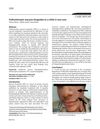
October 2023 in “Journal of the Pakistan Medical Association” This source describes a case of a 12-year-old male diagnosed with folliculotropic mycosis fungoides, presenting with an asymptomatic, erythematous plaque. Histology and immunohistochemistry confirmed FMF, which is typically rare in children and marked by follicular infiltration by CD4+ lymphocytes.
52 citations
,
October 2005 in “Journal of Investigative Dermatology” This study found that human hair follicle stem cells formed more colonies and adhered more rapidly, while transit-amplifying cells showed significantly greater mobility.
October 2023 in “Asian journal of pharmaceutical and clinical research” In this study, researchers used trichoscopy to establish standardized findings for normal hair and scalp characteristics in 360 healthy males, noting significant age-related differences in hair diameter variability and identifying potential pathological indicators like colored dots and scarring not present in healthy individuals.
68 citations
,
August 2009 in “American Journal of Medical Genetics Part A” This study systematically reviewed clinical findings in trichothiodystrophy patients and suggested a new clinico-genetic classification to help better understand the ichthyotic phenotype and its management.
75 citations
,
September 1985 in “Archives of dermatology” This report of ichthyosis follicularis in two boys discusses the challenges of distinguishing it from similar disorders, noting its rarity and unclear inheritance pattern without providing new clinical results.
 4 citations
,
January 2012 in “Springer eBooks”
4 citations
,
January 2012 in “Springer eBooks” This study observed that male and female androgenetic alopecia share similar trichoscopic characteristics, such as hair shaft thickness heterogeneity and increased thin and vellus hairs.
 28 citations
,
August 2018 in “Dermatologic Clinics”
28 citations
,
August 2018 in “Dermatologic Clinics” This article discusses various aspects of trichoscopy for diagnosing hair and scalp disorders and reports no clinical results, offering guidance and highlighting pitfalls for better application of this tool by dermatologists.
3 citations
,
December 2003 in “Archives of Pathology & Laboratory Medicine” This article reviews the distinctive features of cutaneous lymphadenoma, a variant of trichoblastoma, and its differential diagnosis, but it presents no new empirical results.
4 citations
,
June 1989 in “Archives of Dermatology” This case report describes a 65-year-old man diagnosed with a trichofolliculoma, a benign tumor originating from hair follicles, which appeared as a persistent pore on his cheek.
1 citations
,
August 2023 in “Clinical Cosmetic and Investigational Dermatology” This study found that exclamation mark hairs are the only trichoscopic feature that can differentiate clinically suspicious SA from AA.
 June 2018 in “The Medical Journal of Cairo University/The Medical Journal of Cairo University”
 This study found that dermoscopy is effective for distinguishing Tinea Capitis from Alopecia Areata by identifying unique trichoscopic features specific to each condition.
 February 2026 in “Clinical Cosmetic and Investigational Dermatology”
 This study found that a family history of androgenetic alopecia and specific trichoscopic signs are strong predictors of female pattern hair loss, leading to a nomogram model for risk prediction.